Secure workspace invitations for MENA SaaS
A practical acceptance flow for tenant-specific roles, identity checks, invitation expiry and concurrent requests.
An invitation to a company workspace is a request to grant access. The email is only how that request reaches someone. Treating the link as the whole security model leaves awkward questions unanswered: which account accepted it, which organisation gained a member, and whether the person who sent it still had permission to do so.
For a B2B product serving Saudi and UAE customers, these questions become visible when consultants work across several companies, administrators use different identity providers, and invitation screens mix Arabic organisation names with English email addresses. A successful sign-in does not resolve the membership decision.
This guide proposes an invitation flow for application-managed workspaces. It separates the invitation from the account and makes acceptance a controlled change. It is an engineering design, not a claim that every identity platform implements the same lifecycle.
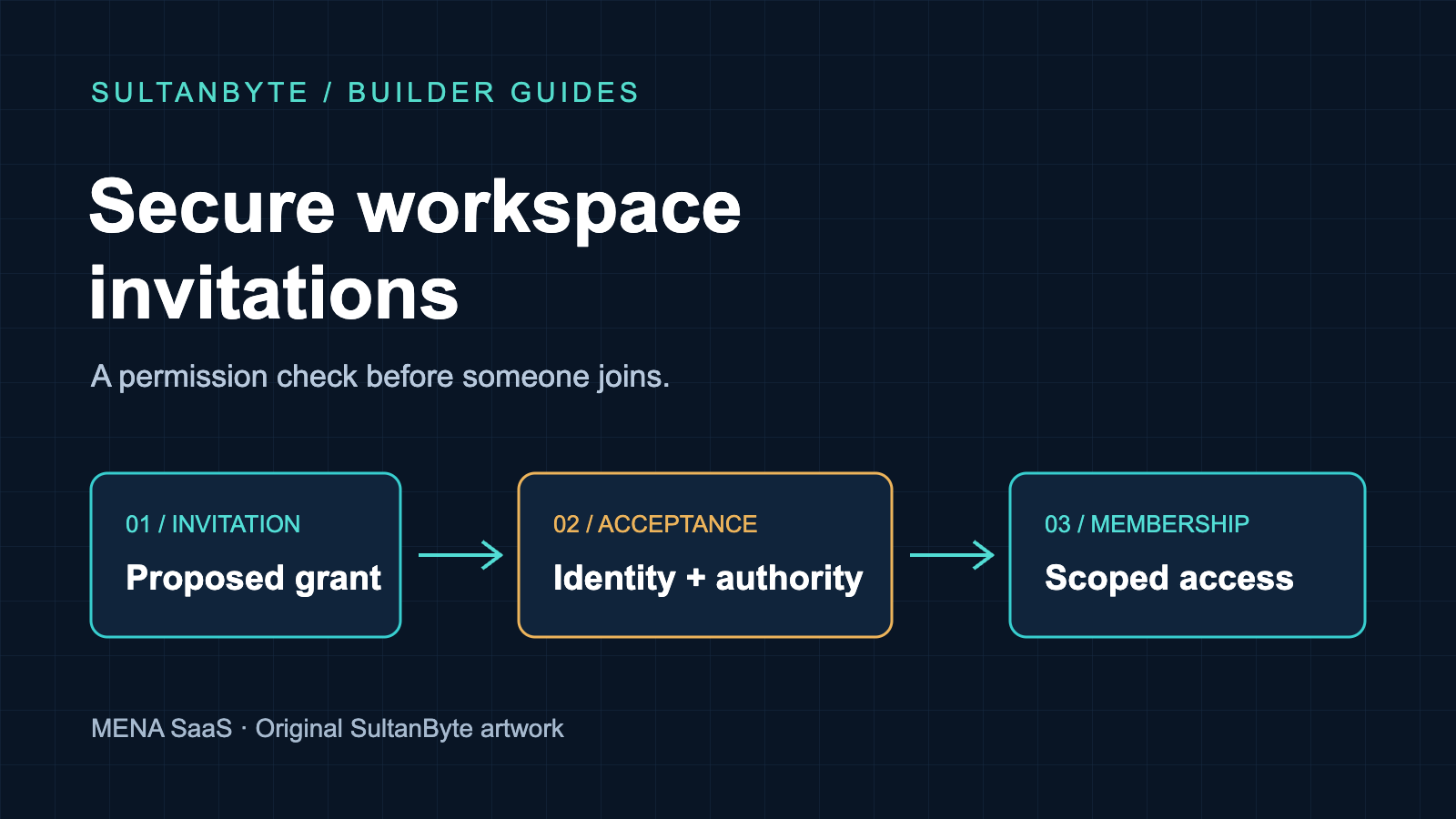
Cover: original SultanByte artwork showing an invitation passing through identity and permission checks before workspace membership.
Bind the invitation to a specific grant
Store an invitation as its own record. Include the destination tenant, intended recipient, proposed role, issuing administrator, expiry and current state. Keep the tenant identifier and deployment assignment under server control. A query parameter, translated workspace name or email domain should not select the customer's database.
Give the invite operation a dedicated permission. An administrator allowed to invite a viewer should not automatically be allowed to create another owner. Check the proposed role against what the administrator can grant, rather than merely checking whether the administrator can open the members page.
OWASP's authorization guidance distinguishes authentication from permission and recommends default denial, least privilege and checks on every request. Apply those principles to invitation creation, cancellation, resending and acceptance. Hiding the owner role in the interface does not protect the API.
For this design, choose a conservative policy: the grant must still be authorised when it is accepted. If the issuer has left the customer organisation or lost invitation privileges, require a current administrator to approve a replacement. A product can instead support durable organisation-approved grants, but that needs an explicit authority model rather than accidental survival of old emails.
In a hypothetical customer group with a Saudi workspace and a UAE workspace, invite the consultant to each separately. Do not interpret a shared corporate domain as permission for both. Country and language remain business attributes; membership belongs to the specific workspace. SultanByte's tenant-isolation review covers the routing and data-access boundary after admission.
Decide which identity can accept
Require the recipient to authenticate, then bind acceptance to the intended identity under a documented matching policy. For an application-managed email invitation, a useful default is a verified address match without automatic account merging. If the browser is signed in as somebody else, show that mismatch and offer account switching without consuming the invitation.
Do not build account linking out of a display name or a client-supplied email field. Keep membership attached to the application's stable principal identifier. When using federation, resolve that principal through the validated provider identity, not an email string supplied alongside it.
Vendor behaviour differs. Auth0's organisation-invitation documentation says recipients must log in or create an account using the invited email address. It also distinguishes organisation member roles from ordinary user RBAC roles. Feature availability depends on the login implementation and plan or agreement; verify the proposed setup rather than assuming that an invitation API is included.
Microsoft Entra's B2B redemption documentation describes a different directory workflow, including identity-provider discovery, guest consent and configurable redemption behaviour. It specifically notes that guests using an email alias need the emailed invitation's redemption URL rather than a direct application link. These are documented product behaviours, not interchangeable contracts.
Before choosing an integration, write down who owns the invitation state, who resolves aliases and which system grants application access. Test a user who already exists, a new user and a user signed into the wrong account. A vendor's successful redemption should not silently grant a broader application role than the customer approved.
Let opening the link remain read-only
Use the email link to open an acceptance screen. Do not add membership, consume the invitation or change a role on a GET request. RFC 9110's safe-method rules explain why automated retrieval and prefetching must not trigger unsafe actions selected through a URL.
The recipient should see the workspace, proposed role and signed-in identity before confirming. Submit the change through an authenticated, CSRF-protected state-changing request. POST alone is not CSRF protection: OWASP's CSRF guidance describes token-based and other defences appropriate to the application's architecture.
Protect the link itself. OWASP's password-reset guidance recommends unpredictable, securely stored, expiring, single-use tokens. Although that guidance concerns recovery, the same properties are useful design inputs for an invitation credential.
For a custom opaque-token implementation, store a digest rather than the redeemable token, and use a cryptographically secure generator. Keep tokens out of analytics, error reports and routine request logs. Serve the landing page over HTTPS, avoid third-party content there, and set a restrictive referrer policy. Build links from a configured trusted origin, not an untrusted request host.
Resending should have a defined consequence. The proposed policy here issues a replacement token and invalidates the previous one. Tell the recipient to use the newest invitation. Rate-limit creation and resends, including per-recipient controls, so an authorised administrator cannot turn the feature into an email-flooding tool.
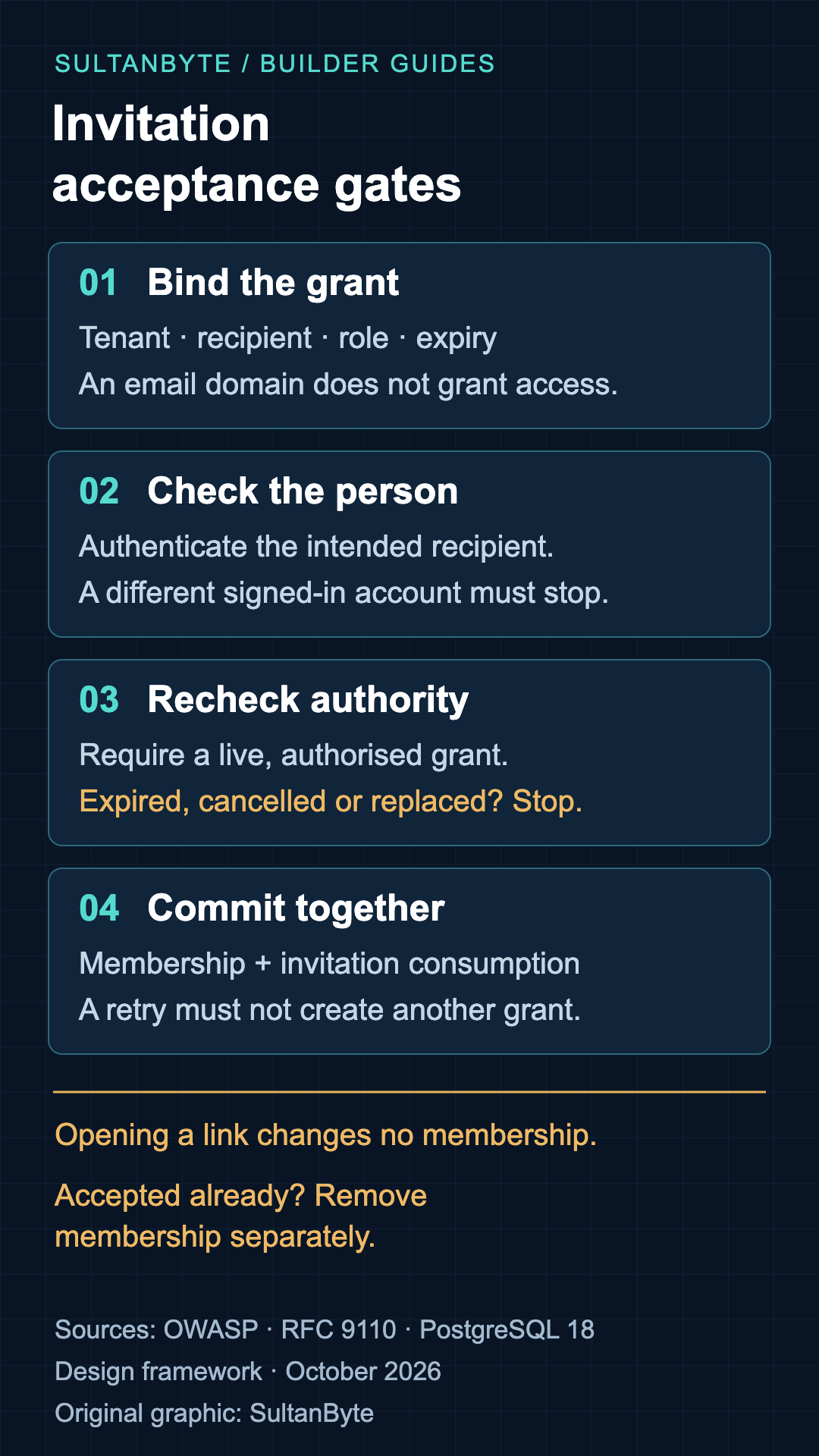
Original infographic: SultanByte. Proposed acceptance framework informed by OWASP guidance, RFC 9110 and PostgreSQL 18 documentation, October 2026. The diagram describes a design, not measured security results.
Commit acceptance as one operation
Two browser tabs can submit the same invitation. An administrator can cancel while the recipient is accepting. Treat these as normal concurrent requests, not rare interface mistakes.
For a relational implementation, acceptance should validate the pending invitation and apply membership inside one transaction. Consume the invitation and record the accepting principal in that same commit. Add a database uniqueness rule for the tenant/principal membership pair, so separate valid invitations cannot create duplicate memberships.
PostgreSQL 18's locking documentation describes how SELECT ... FOR UPDATE prevents competing transactions from modifying or taking conflicting locks on the selected row until the transaction ends. Locking the invitation can serialize acceptance and cancellation, provided both paths use the same protocol. It does not automatically protect a separate administrator-membership row or policy record.
Coordinate the authorisation check with changes to the issuer's privileges. Use a consistent lock order or another concurrency mechanism that makes the permission decision valid at commit. Define which operation wins when cancellation and acceptance race. Avoid claiming immediate cancellation if an already-committed acceptance remains active.
Use this acceptance contract as a design checklist, not runnable transaction code:
Authenticate and validate request protection.
Resolve the token to its server-owned invitation.
Coordinate locks for the grant and its authority.
Require pending state, valid expiry and recipient match.
Recheck tenant status and permission to grant the role.
Create the scoped membership without silent role escalation.
Consume the invitation and record the accepting principal.
Commit together; return the durable membership result.
If the response is lost after commit, a retry by the same authenticated principal can return the recorded outcome without granting access again. A different principal must not receive that result. If the person is already a member, do not use an old invitation to upgrade their role; route a role change through its own permission check.
Email delivery and an external identity-provider mutation are not part of a local database transaction. If another service owns membership, record a pending operation and reconcile its outcome before presenting access as active. Do not label the process atomic across services merely because the local rows committed together.
Make Arabic and English confirmation equally clear
Let the inviter choose a supported message language and let the recipient change the acceptance-screen language. Neither choice should change the destination tenant, identity provider or role. An Arabic invitation to a UAE workspace and an English invitation to a Saudi workspace must follow the same grant rules.
Keep organisation names and addresses visually separate from translated instructions. W3C's directionality guidance explains dir and bdi for mixed-direction content. Use semantic direction handling around dynamic names rather than reversing strings or inserting ad hoc directional characters into stored identifiers.
Show the full recipient address in an authenticated confirmation context, with a clear indication of the account currently signed in. Avoid revealing recipient details on an invalid-token page. Explain the proposed role in ordinary language: a customer should know whether acceptance permits viewing records or administering other members.
Internationalised addresses also need an explicit delivery and matching policy. Do not silently rewrite the mailbox to make an invitation fit a provider's validator. SultanByte's Arabic domain and email checklist covers that separate boundary. Here, the important acceptance test is that the address survives the complete invitation journey unchanged under the declared policy.
Test cancellation separately from removing access
An invitation can expire or be cancelled before acceptance. Once it has created membership, cancelling the invitation is no longer a removal mechanism. The product needs an explicit member-removal operation, with its own permission check and effect on active sessions and cached access decisions.
Give support staff distinct statuses for pending, expired, cancelled, superseded and accepted invitations. Record who issued and accepted the grant, the tenant and role, and the outcome. Keep the redeemable token out of that record's ordinary support view. A resend button should not obscure whether an earlier link is still valid.
Before release, run a small adversarial suite: a forwarded link opened under another account; an expired token; a replacement followed by the old email; simultaneous acceptance; cancellation during acceptance; and removal of the issuer's privileges before redemption. Add a same-domain user from another workspace and an existing member receiving an invitation with a stronger role.
Repeat the confirmation journey in Arabic and English on a narrow screen, including keyboard navigation and account switching. For each case, inspect the resulting membership, not just the success message. Release when the application can explain exactly which principal received which permission and can refuse the grant without partially applying it.