Tenant isolation for MENA SaaS: a production review
A practical isolation review for Saudi and UAE SaaS teams, from tenant routing and PostgreSQL roles to exports and release tests.
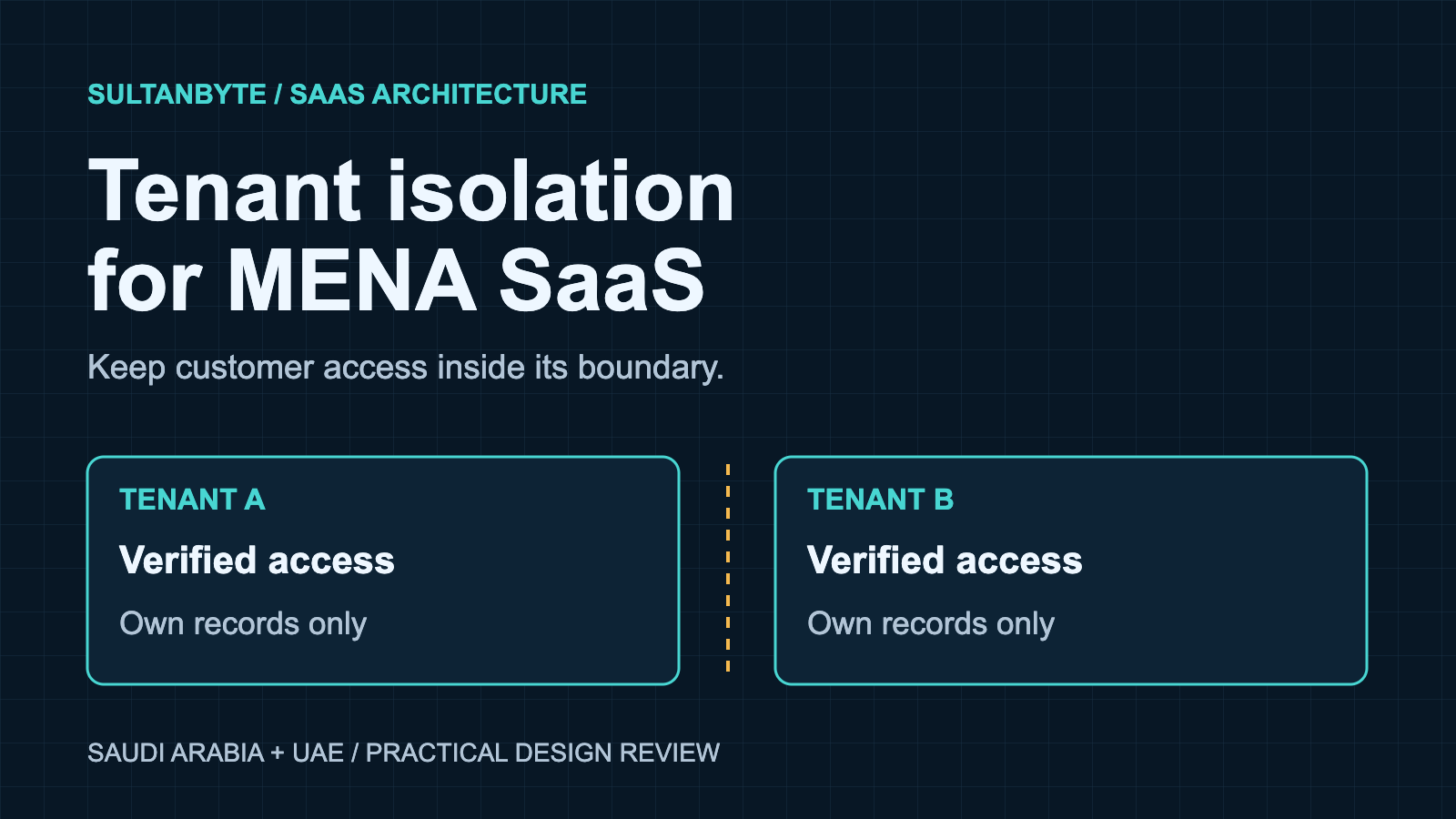
A customer signs in to the right account, opens an invoice and sees another company's details. The login worked. The tenant boundary did not.
For a SaaS team serving customers in Saudi Arabia and the UAE, that failure can sit inside an otherwise sensible regional architecture. Separate deployments do not settle who may read a record, and a shared application does not have to mean shared access. The release decision needs evidence from the paths that actually handle customer data.
This guide proposes an isolation review for a B2B product expanding across those markets. It covers request routing, database roles and the less visible paths through exports and background work. It does not prescribe a hosting location or establish regulatory compliance. Location and transfer requirements need a separate assessment for each customer's activities and contracts; this is practical engineering information, not legal advice.
Cover: original SultanByte artwork showing tenant-scoped access to separate customer records.
Separate the customer, the user and the deployment
Give each customer organisation an internal tenant identifier. Keep it separate from the user's identity and from the deployment that hosts its resources. A consultant may belong to several customer organisations. Several customers may share one deployment. A customer may also have more than one authorised deployment during a controlled migration.
Microsoft's request-to-tenant mapping guidance distinguishes identifying the tenant from establishing the user's permissions. It describes hostnames, request properties and token claims as possible mapping inputs. None should become a shortcut around the access decision.
Consider a product with a Saudi deployment and a UAE deployment. Keep the tenant-to-deployment assignment in a controlled registry, with an owner and change history. Treat a customer's selected country, interface language or billing currency as business attributes, not instructions to move its data. An Arabic interface should not select a Saudi database, and an English interface should not select a UAE database.
For this design, resolve the selected tenant, check the principal's membership and permitted action, then route to the approved deployment. If the registry is unavailable or returns an unknown assignment, fail the operation safely. Do not fall back to whichever database answers first. Recovery routing needs its own approved procedure, as discussed in SultanByte's MENA disaster-recovery guide.
Choose the boundary you can operate
A dedicated database can simplify some customer-specific operations, but it creates more databases to migrate, monitor and restore. Shared tables reduce infrastructure duplication while increasing the importance of consistent row ownership and enforcement. Separate schemas require careful grants and connection handling; a namespace alone is not a complete security boundary.
Microsoft's multitenant architecture overview describes deployment stamps that serve either one tenant or a group. It presents isolation, operating complexity and cost as tradeoffs rather than a universal ranking.
Use a short decision record before choosing:
- If a customer needs independently scheduled restores, demonstrate the restore procedure for the proposed model before promising it.
- If a dedicated deployment is a contractual requirement, identify everything that remains shared, including support tools and deployment credentials.
- If tenants share tables, assign an owner to policy coverage and test new tables before release.
- If you offer both models, prove that migrations between them preserve ownership, permissions and routing.
For founders, this record also defines what the sales team can promise. Avoid selling a vague "isolated environment" when only the database is dedicated. For engineers, it names the boundary they must preserve when adding a feature.
Authorise the object, not just the endpoint
An invoice identifier should locate a candidate record, not grant access to it. OWASP's API1:2023 guidance requires object-level checks wherever an endpoint acts on an object supplied by the client. Random identifiers reduce guessing but do not replace those checks.
In the proposed product, test the same invoice operation with a permitted user, a colleague with insufficient privileges and a user from another tenant. Repeat it for download, update and deletion. A correct list page does not prove that the individual-record endpoint is safe.
Treat bulk operations as separate features. For a request containing records from several tenants, specify whether the entire operation must fail or whether authorised items may proceed with explicit per-item results. Test that choice. Do not silently process the foreign record because the first identifier passed a check.
Support access needs an equally explicit path. A staff role that can assist many customers should require a selected tenant, a reason and an audit trail. Keep ordinary customer requests out of that privileged path. The exception must be visible enough to review, not hidden inside a generic administrator flag.
PostgreSQL policies depend on the connection role
PostgreSQL 17's row-security documentation explains that enabled row-level security uses default denial when no policy exists. It also documents important exceptions: superusers and roles with BYPASSRLS bypass policies, while table owners normally bypass them unless FORCE ROW LEVEL SECURITY applies. That setting does not constrain superusers or BYPASSRLS roles.
For a shared-table design, use a constrained application role and separate migration privileges. Review both existing-row visibility and the checks on newly written rows. Also review how multiple policies combine; an additional permissive policy can widen access. Row security does not replace ordinary grants or protect every table-wide operation.
If policies depend on a connection setting, review its lifetime. PostgreSQL's SET documentation distinguishes session state from SET LOCAL, which lasts only for the transaction. A committed session-level setting can survive into the next use of a pooled connection.
Require every tenant-scoped transaction to establish its verified context before querying and to finish before the connection returns to the pool. Test consecutive requests for different tenants over reused connections, including rollback and missing-context cases. A context-setting mechanism is not a defence against a compromised application that can choose arbitrary tenant values; the application and database controls must work together.
Follow the record beyond the database
A database test cannot certify the cache, search index or export worker. OWASP's multi-tenant security checklist covers these additional boundaries, including tenant-aware asynchronous work, cache isolation and file access.
Make an inventory around one customer journey. For an invoice export, identify the initial authorisation, queued job, database query, generated file, notification and final download. At every step, record where the tenant context comes from and which component checks it. This is a proposed review artifact, not a claim that a particular framework supplies those checks automatically.
Use the same exercise for cached responses. Choose a key structure that includes the relevant tenant and permission scope. Test a warm cache, not only a cache miss: let tenant A populate it, then request the corresponding resource as tenant B. Include administrator and restricted-user views where the response differs.
For queued work, define whether a job represents a still-authorised user request or an independently authorised service operation. Then specify what happens if membership changes before execution. The worker should not infer its tenant from the previous job or an unverified field in a message.
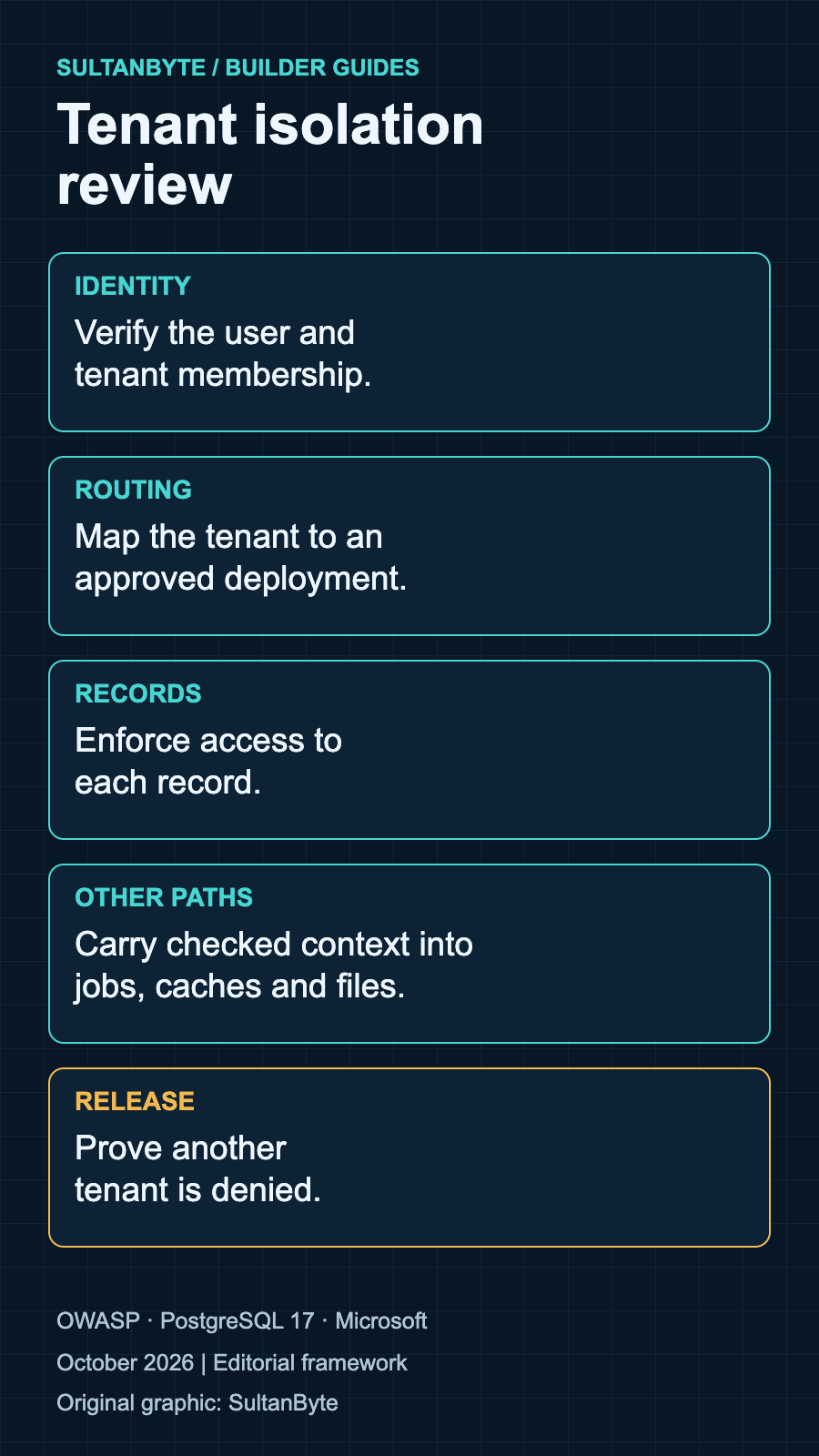
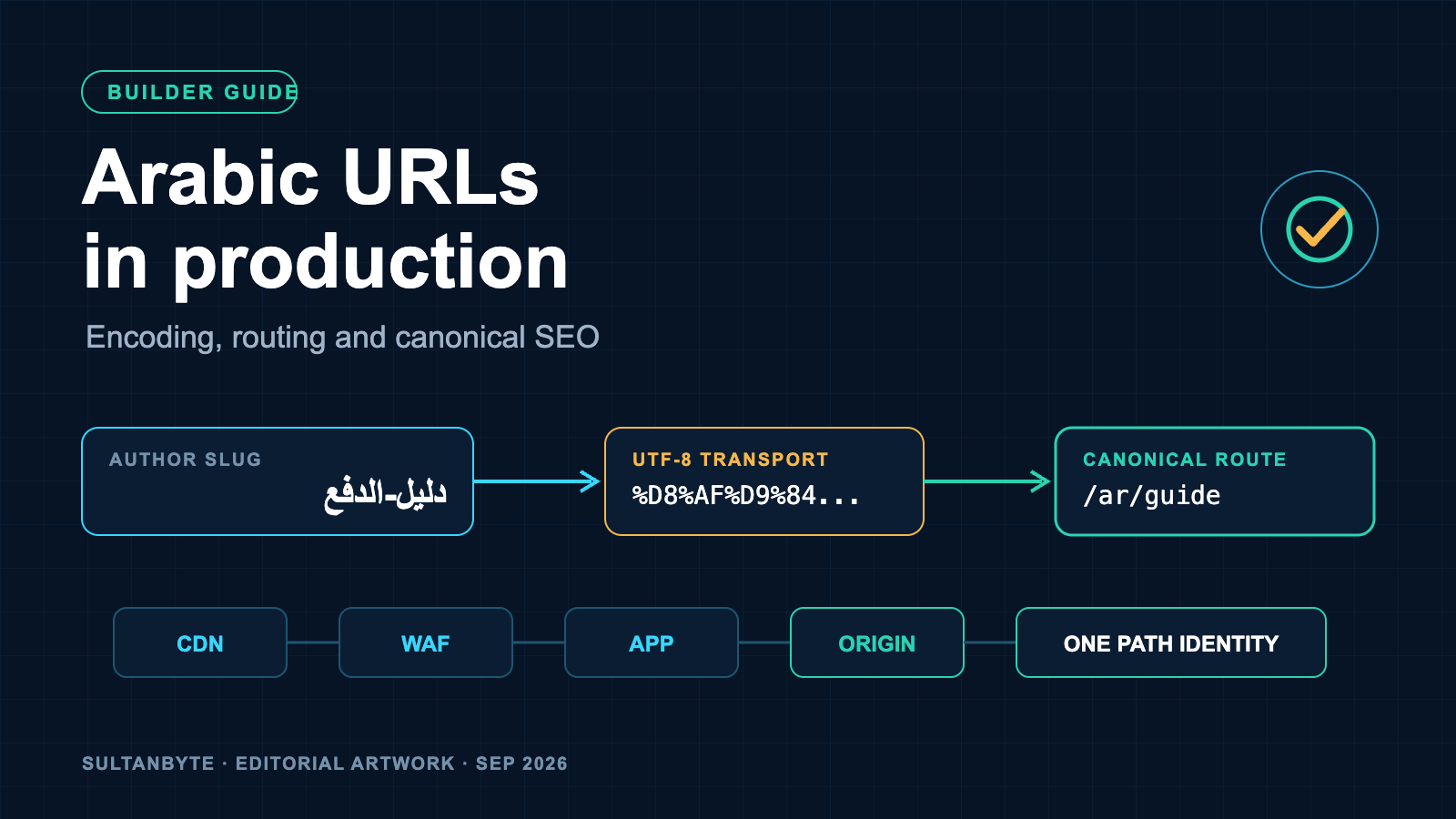
Original infographic: SultanByte. Editorial review framework informed by OWASP, PostgreSQL 17 and Microsoft Azure architecture guidance. Technical references checked October 2026; the diagram is not a compliance certification.
Treat download links as delegated access
A file download can outlive the screen that created it. Amazon S3's presigned-URL documentation describes these URLs as bearer tokens. They can be used repeatedly until expiry, subject to the underlying credentials and applicable policies. Temporary credentials can make a URL expire earlier than its requested lifetime.
Before issuing a link, authorise the exact object for the current principal and tenant. Choose a lifetime appropriate to the workflow, keep signed URLs out of logs and avoid promising that logout alone revokes them. If the product requires access to stop immediately after a permission change, evaluate a download service that rechecks authorisation rather than relying only on an already-issued URL.
Test the complete export lifecycle: requesting it, polling status, receiving notification and downloading the result. Use customer-controlled filenames only as display metadata; they should not select another tenant's storage path. Keep the file's owner and storage locator in a server-controlled record.
Make the release test adversarial and small enough to repeat
Create synthetic tenants A and B with deliberately similar records. Give each an administrator and a restricted user. Add a user who belongs to both tenants so that switching context is tested rather than assumed.
The release fixture should exercise an authorised read, a foreign-record read, a foreign write, a mixed bulk request, a warm-cache read and an export. Add a reused database connection and a delayed job whose initiating user's permissions change. Check both the response and the resulting stored state: an error response does not prove that no write occurred.
These are proposed acceptance cases, not benchmark results. Run them through the deployed application's roles, gateway and connection-pool mode in a safe test environment. For each denied operation, require no foreign data in the response and no unauthorised state change. Keep diagnostic evidence useful without copying customer records into test reports.
A customer restore deserves its own rehearsal. Recover synthetic tenant A into a quarantined target, verify its records and access controls, and prove tenant B is unaffected before reconnecting anything. Record which shared components had to participate. That evidence is more useful to a buyer than a diagram labelled "dedicated".
Approve expansion when the team can demonstrate these boundaries and name their exceptions. A Saudi deployment and a UAE deployment may satisfy different approved hosting decisions; both still need to prove that one customer's identity cannot become another customer's access.