Microsoft’s $10bn Gulf plan: what buyers can verify
Separate planned spending from local delivery across Saudi Arabia, Qatar, the UAE and Kuwait.
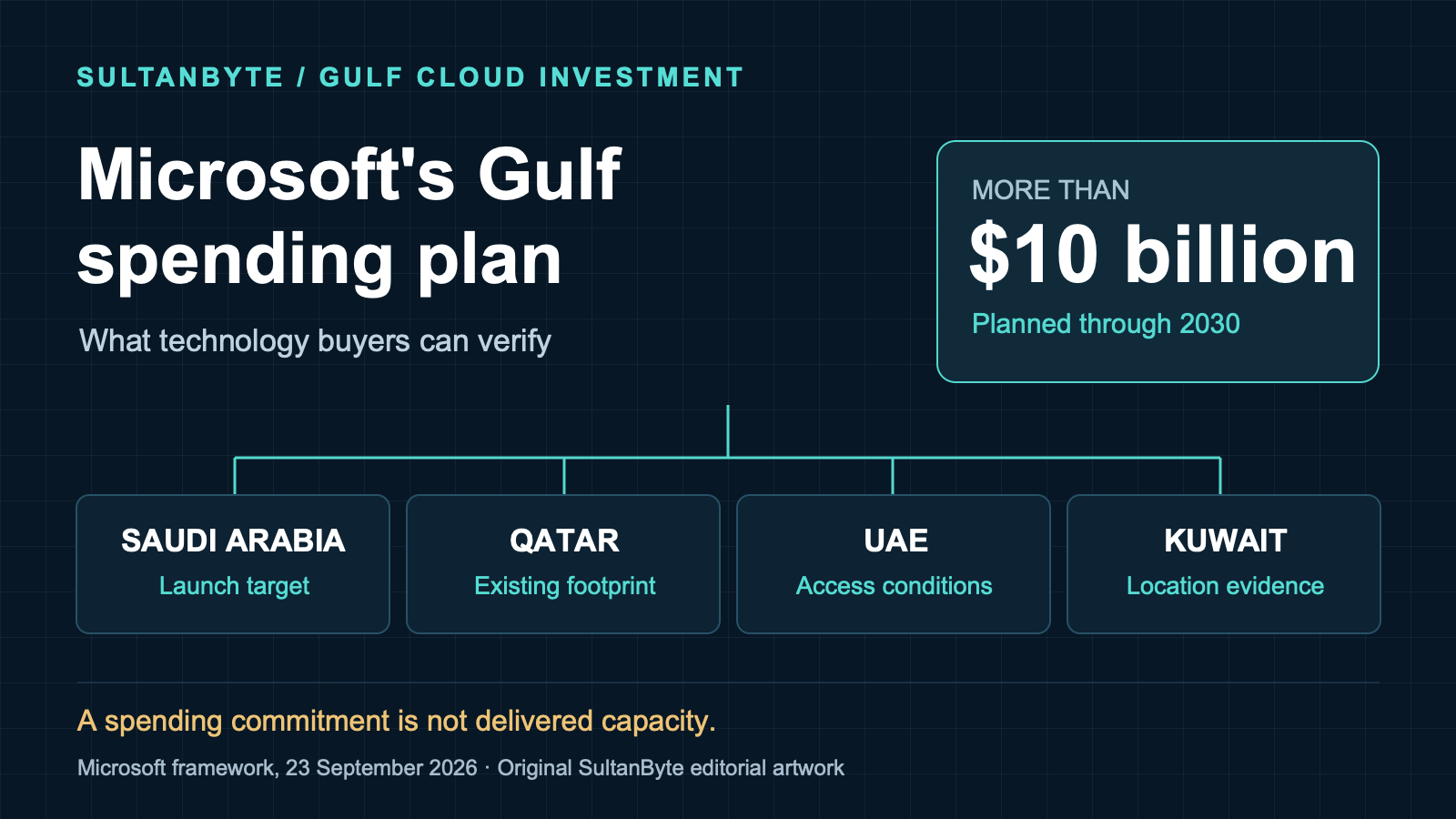
Microsoft's new Gulf spending plan is large, but the number needs careful handling. On 23 September, the company announced plans for more than $10 billion in capital and operating expenses through 2030, with an initial focus on Kuwait, Qatar, Saudi Arabia and the UAE. The Microsoft framework also names a connectivity commitment of more than $400 million.
For technology buyers, this is a reason to ask for a better delivery plan. It is not evidence that an equivalent amount of new computing capacity has arrived, or that a particular workload can run locally today.
The useful reading separates spending, country-level delivery and customer protections. Those are different promises, and they need different evidence.
Cover: original SultanByte editorial artwork showing the spending commitment above four country-specific delivery paths.
What the spending figure includes
The headline combines capital expenditure with operating expenditure. Treating it as a data-centre construction budget would change its meaning. It also describes a period ending in 2030, not expenditure already completed.
Reuters' interview with Brad Smith adds an important qualification: Microsoft would not provide a country or project breakdown, citing factors including security. Smith said the company was maintaining earlier investment plans and adding to them. The public total therefore should not be presented as entirely new money on top of every previous announcement.
Nor should an analyst simply add the connectivity figure to the headline total. Without an explicit reconciliation, the safe reading is to retain both figures with their stated scopes rather than publish a combined sum.
Partnerships need similar care. Reuters reports that Microsoft is working with HUMAIN and QAI in selected priority areas, but does not plan capital investments in those firms. A commercial or technical partnership is not an equity funding round.
For founders and suppliers, the next useful disclosure would be a procurement opportunity, named deployment or contract. A regional spending envelope does not establish which local businesses will receive orders.
Four countries, different starting points
The countries named in the framework do not share a single cloud maturity or delivery schedule.
Saudi Arabia: a dated launch target
Microsoft's 31 August announcement gives Saudi Arabia East a November 2026 availability target and describes three Availability Zones in the Eastern Province. It refers to supported services and eligible workloads. The September spending framework does not replace that narrower service-launch promise.
Saudi buyers should keep the regional launch on their project calendar, but attach acceptance criteria to individual services. SultanByte's Saudi cloud launch analysis covers the migration preparation in more detail. The new question is whether the broader investment produces additional, identifiable deliverables beyond that existing schedule.
Qatar: expansion of an existing footprint
Qatar's Ministry of Communications and Information Technology announced a cloud-region expansion in June 2024. Its account says the region opened in 2022 and reports migration of 143 government and semi-government entities to Azure. That is historical ministry reporting, not a current customer count.
This changes the buying question. An existing user should ask what improves in the current estate: capacity, service coverage, support or recovery options. Repeating the fact that Qatar has a cloud region would tell that customer little about the new commitment.
UAE: check access, not only presence
The Azure regions directory lists UAE North in Dubai and UAE Central in Abu Dhabi, but marks UAE Central as access-restricted for specific scenarios. A two-region map is not an automatic entitlement to deploy every service in both locations.
A UAE architecture review should therefore request subscription-level access and service confirmation for the proposed design. Regional spending cannot substitute for a quota approval or a successful deployment test.
Kuwait: require a named service and location
Kuwait is included in the September framework, but the public Azure regions list does not list a Kuwait public-cloud region. That observation is deliberately narrow: it does not establish the absence of private infrastructure, partner facilities or Microsoft services in Kuwait.
A Kuwaiti buyer should request the exact service, hosting location and operating model instead of inferring a local public-cloud region from inclusion in the investment announcement.
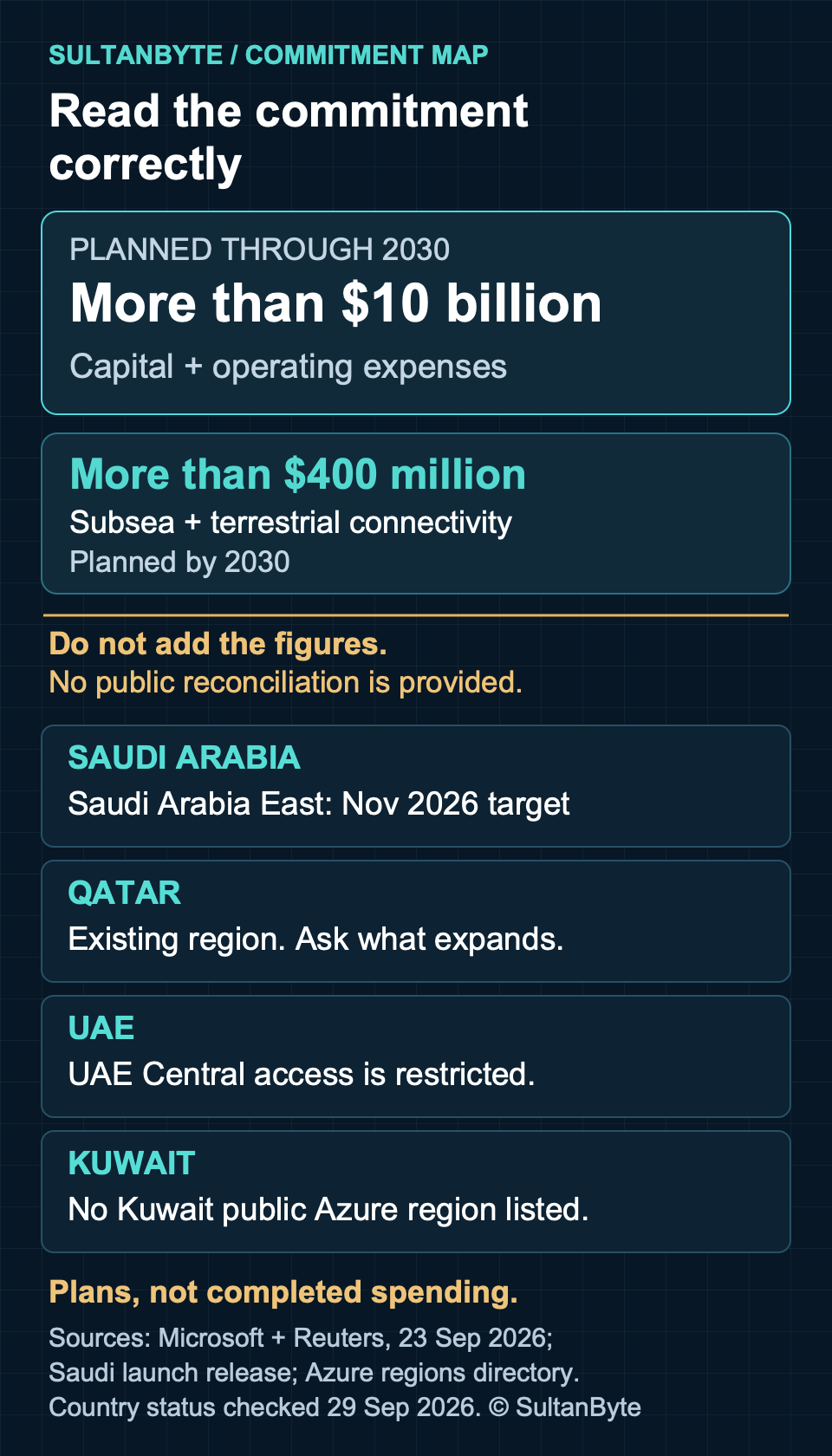
Source: Microsoft framework and Reuters reporting, 23 September 2026; Microsoft Saudi announcement, 31 August 2026; Azure regions directory. Figures describe plans through 2030, not completed spending. Graphic: SultanByte editorial artwork.
Turn the resilience offer into a scoped engagement
Microsoft also proposes resilience assessments, reference architectures and continuity support, and says it will extend data-protection and continuity commitments to eligible customers. Those qualifications belong in the procurement discussion, not in the small print after signature. The framework does not itself supply a workload-specific recovery guarantee.
A useful starting point is NIST's contingency-planning guide, which connects recovery planning to system priorities and organisational resilience. It is US federal guidance, not a Gulf legal requirement. Its value here is methodological: assess the system before accepting a generic continuity proposal.
Our recommendation is to make the assessment a defined deliverable. Name the applications in scope, the incident scenarios, the customer responsibilities and the evidence that must be returned. Ask whether the work includes a technical exercise or only an architecture review. Agree who pays for remediation and who accepts the remaining risk.
An assessment can identify a problem without fixing it. Procurement should avoid recording the engagement as completed resilience work when the output is still a list of recommendations.
What to request before expanding a commitment
CTOs can use this announcement to reopen account planning without committing to a larger contract immediately. Request a written country-level roadmap for the services already on the organisation's dependency list. Separate generally available features from previews and planned releases. Put an owner and a decision date beside every missing item.
Engineering teams should ask for proof tied to their own subscription and workload. A small deployment, a supported backup restore and a measured recovery exercise provide more useful acceptance evidence than a regional investment figure. The Azure directory itself warns that availability-zone support varies by service even within a zone-enabled region.
Procurement should ask how eligibility, support escalation and exit assistance appear in the actual agreement. Where a proposal uses sovereignty language, request a data-flow and administration model that can be reviewed against the organisation's requirements. Do not treat a marketing label as a legal conclusion.
The September plan gives buyers a stronger basis for asking Microsoft to commit resources and dates. The next decision should depend on a named service, a deliverable in the right country and evidence that it works for the intended workload. Until those arrive, keep the spending announcement in the strategy file rather than the production-readiness record.