Dubai's SARAAB deepfake detector needs a buyer's test
DESC says SARAAB can detect deepfake video with 91% accuracy. Buyers still need evidence on benchmarks, thresholds and deployment limits.
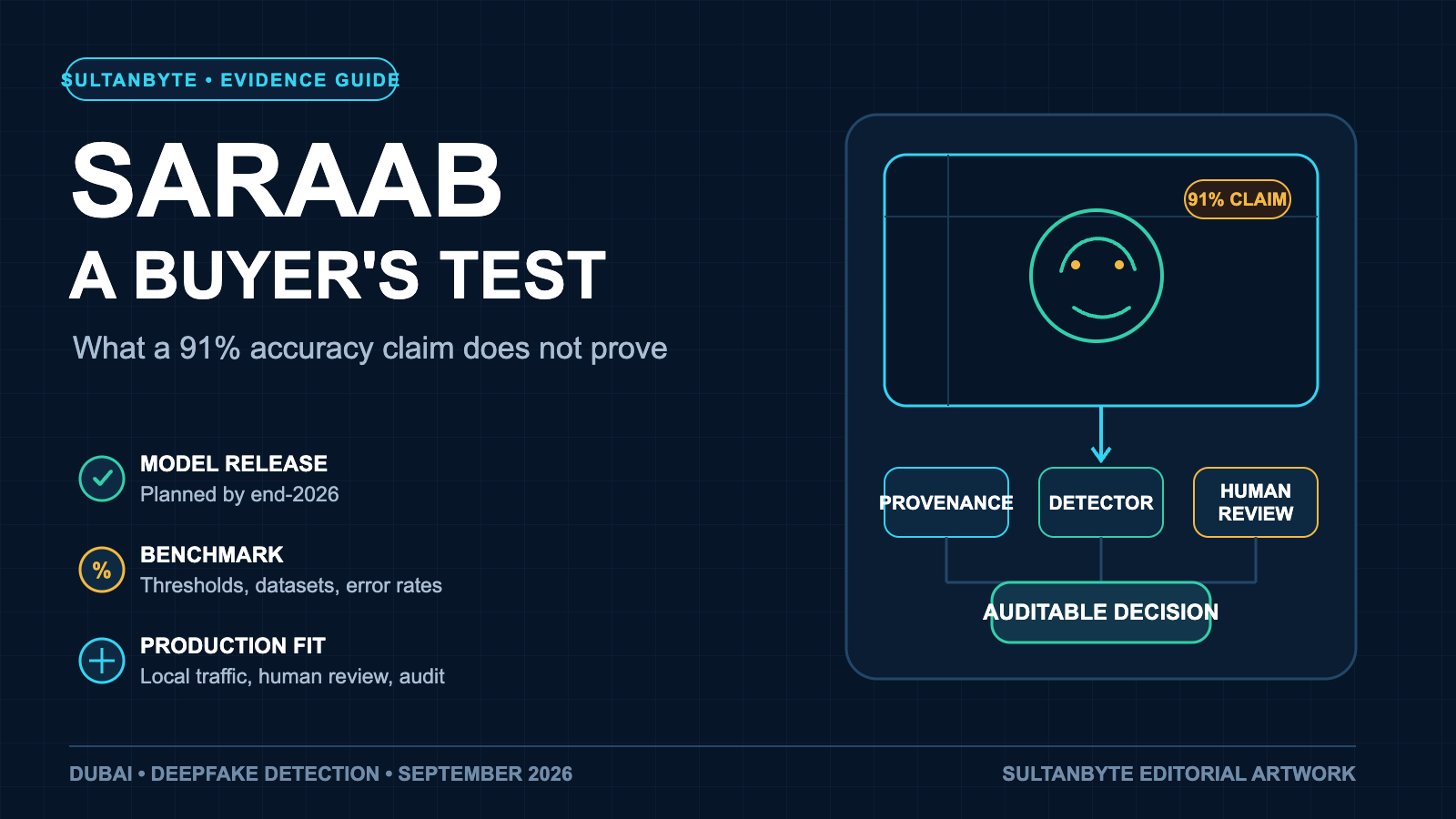
The Dubai Electronic Security Centre has unveiled SARAAB, a video deepfake detector that it plans to release on Hugging Face by the end of 2026. DESC says the model reaches 91% accuracy and can show which facial regions triggered its result.
A government-built, open model would be useful. The announcement alone is not enough evidence for a bank, newsroom, government service or identity team to put SARAAB in a production decision path. Buyers need to know whether it stays reliable on the videos, attacks and failure costs that matter to their organisation.
What DESC has announced
DESC presented SARAAB at GISEC Global in Dubai on 16 September. Khaleej Times reported that the model analyses an entire video and uses a heat map to mark facial areas it considers manipulated. A two-minute clip is analysed across the full two minutes, so a fake segment near the end should not be skipped.
The release is planned for Hugging Face. BankInfoSecurity reported that DESC intends to publish it under a research and learning licence by year-end. The output is expected to include an overall confidence score, per-face analysis and an explanation of the detected manipulation. Gulf News says an Emirati team at DESC developed the model.
Several details still need to arrive with the release: the test datasets, class balance, decision threshold, false-positive and false-negative rates, results on unseen generators, effects of compression, and the exact licence. Until those are public, the 91% figure should be treated as a DESC performance claim rather than a comparable benchmark.
Why one accuracy number is not a buying criterion
Accuracy combines correct results into one percentage. That can hide the two errors buyers care about most.
A false positive labels genuine footage as fake. In a newsroom, that can delay real reporting. In an investigation, it can cast doubt on valid evidence. A false negative allows manipulated footage through. In a bank or executive-impersonation case, that can help an attacker reach the next control.
The acceptable balance changes by workflow. A social platform screening millions of uploads may use a detector to prioritise review. A fraud team assessing a video call may tolerate more false alerts if every alert receives human review. A court-facing process needs a much stronger chain of custody and documented forensic method than either.
The benchmark also has to resemble production traffic. Video passes through messaging apps, social platforms and editing tools that resize frames, change codecs, alter frame rates and add captions. Gulf organisations should add local test cases: low-bandwidth mobile clips, Arabic broadcast graphics, multiple faces, poor lighting, screen recordings and partially manipulated video.
Laboratory scores often break down here. NIST's 2026 deepfake evaluation programme says current detection systems show a 45–50% performance degradation when moving from academic evaluation to operational deployment. NIST is building adversarial tests around face swaps, body swaps and context manipulation because easy benchmark samples do not represent the field.
The authors of DeepfakeBench point to the same problem: inconsistent preprocessing, datasets and metrics can make detector comparisons misleading. Their benchmark covers 15 detection methods and nine datasets under shared evaluation protocols. SARAAB does not need to use that exact suite, but its published evidence should reach the same level of reproducibility.
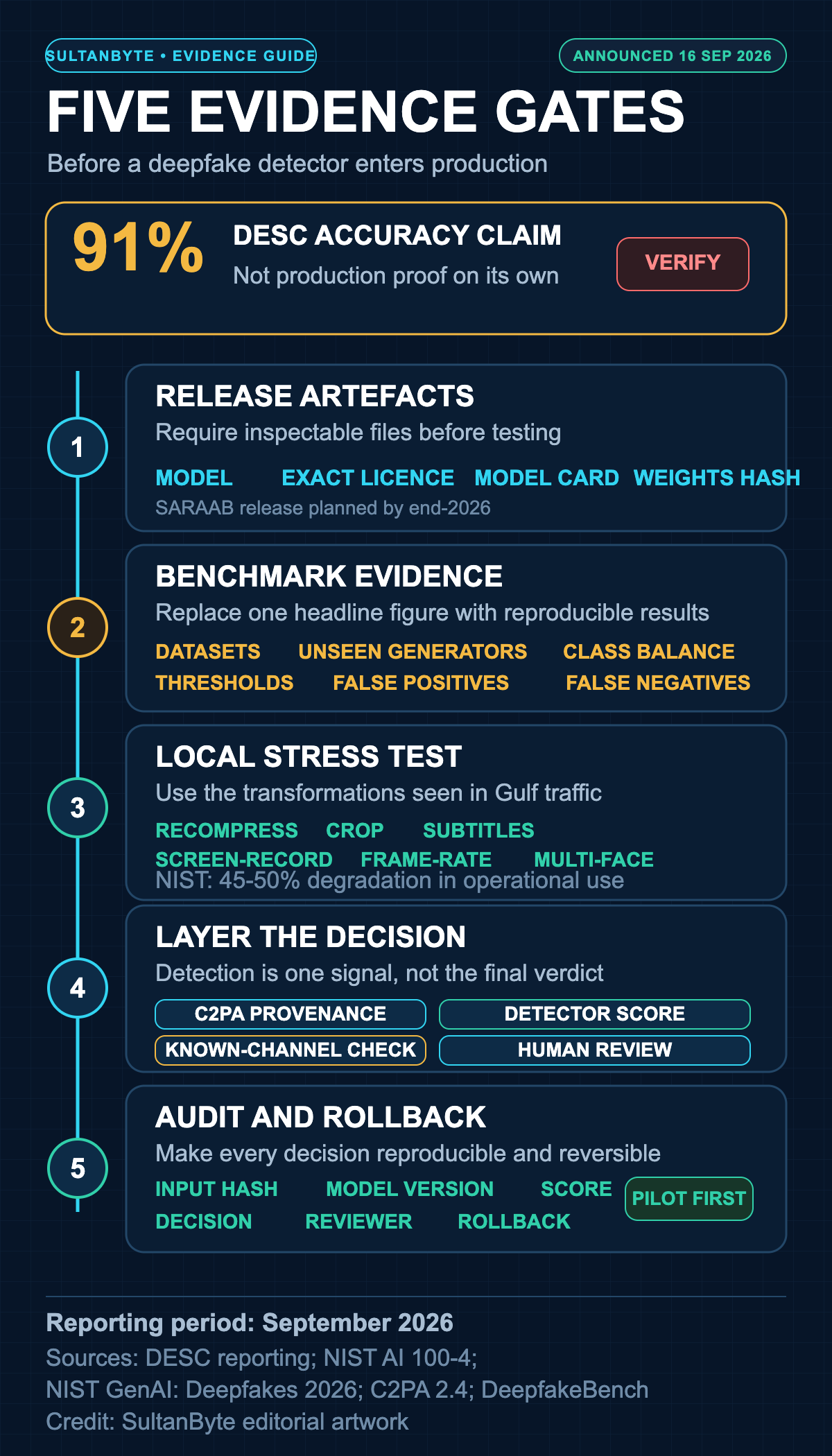
Five evidence gates for a production deepfake detector. Sources: DESC reporting via Khaleej Times and BankInfoSecurity; NIST AI 100-4 and GenAI: Deepfakes 2026; C2PA 2.4; DeepfakeBench. Reporting period: September 2026. Credit: SultanByte editorial artwork.
Use detection as one signal, not the final verdict
A production system should combine three kinds of evidence.
First, check provenance. The C2PA 2.4 explainer describes Content Credentials as cryptographically bound records of an asset's origin, edits and use of AI. A valid credential can show that the credential and linked asset were not altered after signing. C2PA is careful about the limit: it does not decide whether the recorded history is true, and it is not a cure for misinformation.
Second, run forensic detectors such as SARAAB. They can flag visual patterns even when a clip has no provenance record. Their scores should be calibrated on the organisation's own traffic, and the model version, threshold and input hash should be recorded with each result.
Third, verify context. Contact the claimed source through a known channel, compare the clip with other footage, inspect timestamps and metadata, and escalate high-impact cases to a trained reviewer. A detector score should not be the only reason to reject evidence, freeze an account or accuse a person of manipulation.
NIST AI 100-4 treats provenance, watermarking, detection, testing and auditing as complementary techniques. That is the right architecture. No single layer covers unsigned media, stripped metadata, unseen generators and adversarial edits at once.
A practical evaluation plan for Gulf buyers
Before testing SARAAB, write down what the system may do with its score: queue a review, request another identity check, warn an analyst, or block an action. Avoid automatic high-impact decisions during the pilot.
Build a local evaluation set with genuine and manipulated clips from the intended channels. Keep a sealed holdout set that the implementation team does not tune against. Test clean files first, then repeat the test after realistic transformations such as recompression, cropping, subtitles, screen capture and frame-rate changes.
Report results by attack type and operating threshold. At minimum, buyers need recall, precision, false-positive rate, false-negative rate and calibration, not only overall accuracy. Break those results down by generator family, video quality and the number of faces in the scene.
Red-team the whole workflow. Try to evade the detector, overwhelm reviewers with false alerts, strip provenance data and replay previously accepted media. Then check whether the audit record is good enough to reconstruct the decision.
Finally, pin every production release. Store the model version, weights hash, configuration, threshold, licence, evaluation report and rollback point. Open source helps inspection, but it does not make a model safe by default.
If DESC publishes the model, licence and evaluation evidence it has described, Gulf security teams will have a public detector they can test against local traffic. Until those artefacts are available, the 91% claim belongs in a pilot brief, not a production approval. Even after release, SARAAB should remain a fallible forensic component inside a wider trust process.
Cover and infographic credit: SultanByte editorial artwork.