What the Core42-TII deal means for UAE sovereign cloud security
A signed UAE cloud-security scope now needs attestation, key-control and recovery evidence before buyers can treat it as production assurance.
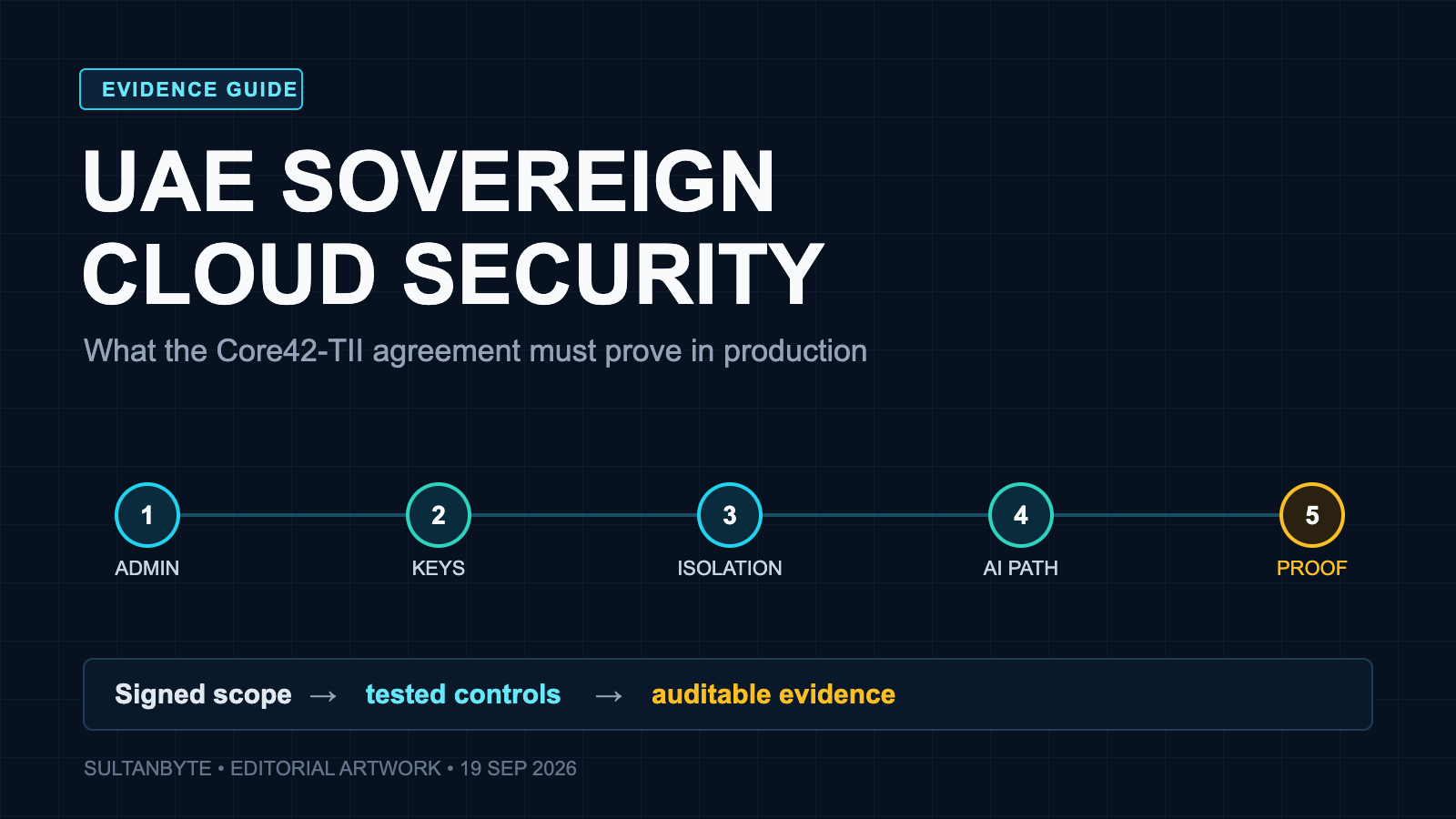
Core42 and Abu Dhabi's Technology Innovation Institute (TII) have signed an agreement to bring locally developed security technology into Core42's sovereign cloud and Compass AI platforms. The scope is unusually specific for a partnership announcement: hardware security modules, confidential computing, encrypted AI inference, key management, data protection and trusted computing.
Specific does not mean available. The 18 September announcement describes co-development, evaluation and deployment, but gives no release date, supported hardware list, benchmark, customer result or service-level commitment. For UAE buyers, the useful question is not whether the deal sounds sovereign. It is what evidence will prove that each control works in production.
Cover: original SultanByte editorial artwork.
The agreement connects research to an operating platform
Core42's announcement says the work will span its sovereign-enabled cloud and Compass, the company's generative and agentic AI platform. TII brings cryptography and security research; Core42 brings the environment where that research could become a managed service.
That matters because the two organisations start from different places. Core42 already markets a Sovereign Public Cloud built on Azure regional infrastructure. Its product page says the platform maps UAE frameworks to more than 200 technical controls and includes external HSMs with customer-managed keys, Azure Confidential Computing and continuous compliance monitoring. Those are Core42's product claims, not independent test results.
TII's Cryptography Research Center works on classical and post-quantum cryptography, implementation and cryptanalysis. Its history also shows that this is not a brand-new research direction. In 2021, TII announced a secure cloud technologies programme covering fully homomorphic encryption, secure multi-party computation and verifiable computation for machine learning. In May 2026, TII said OPAQUE had acquired cryptographic AI technology developed in Abu Dhabi.
The new agreement creates a route from that research into Core42's platforms. It does not identify which TII components are ready for production or which existing Core42 controls will change first. Independent reports from Mobile World Live and ITP.net confirm the agreement and scope, but do not add deployment results.
Residency is only one part of sovereignty
A workload can stay in a UAE data centre while a foreign support team, global identity service or provider-controlled key can still affect it. Data location answers where bytes are stored. It does not, by itself, answer who can administer the service, decrypt information, approve software changes or recover the workload after an incident.
Core42's product page makes a related distinction. It positions Sovereign Public Cloud for Open and Confidential/Sensitive information, while directing Secret and Top Secret workloads to its Signature Private Cloud. Buyers should preserve that classification boundary in architecture reviews rather than treating one "sovereign" label as approval for every dataset.
The same caution applies outside the UAE. A control pack accepted by a UAE authority cannot simply be reused for a Saudi or Qatari deployment. Each market has its own regulators, cloud procurement routes, data-transfer rules and available services. The technology may travel; the compliance conclusion does not.
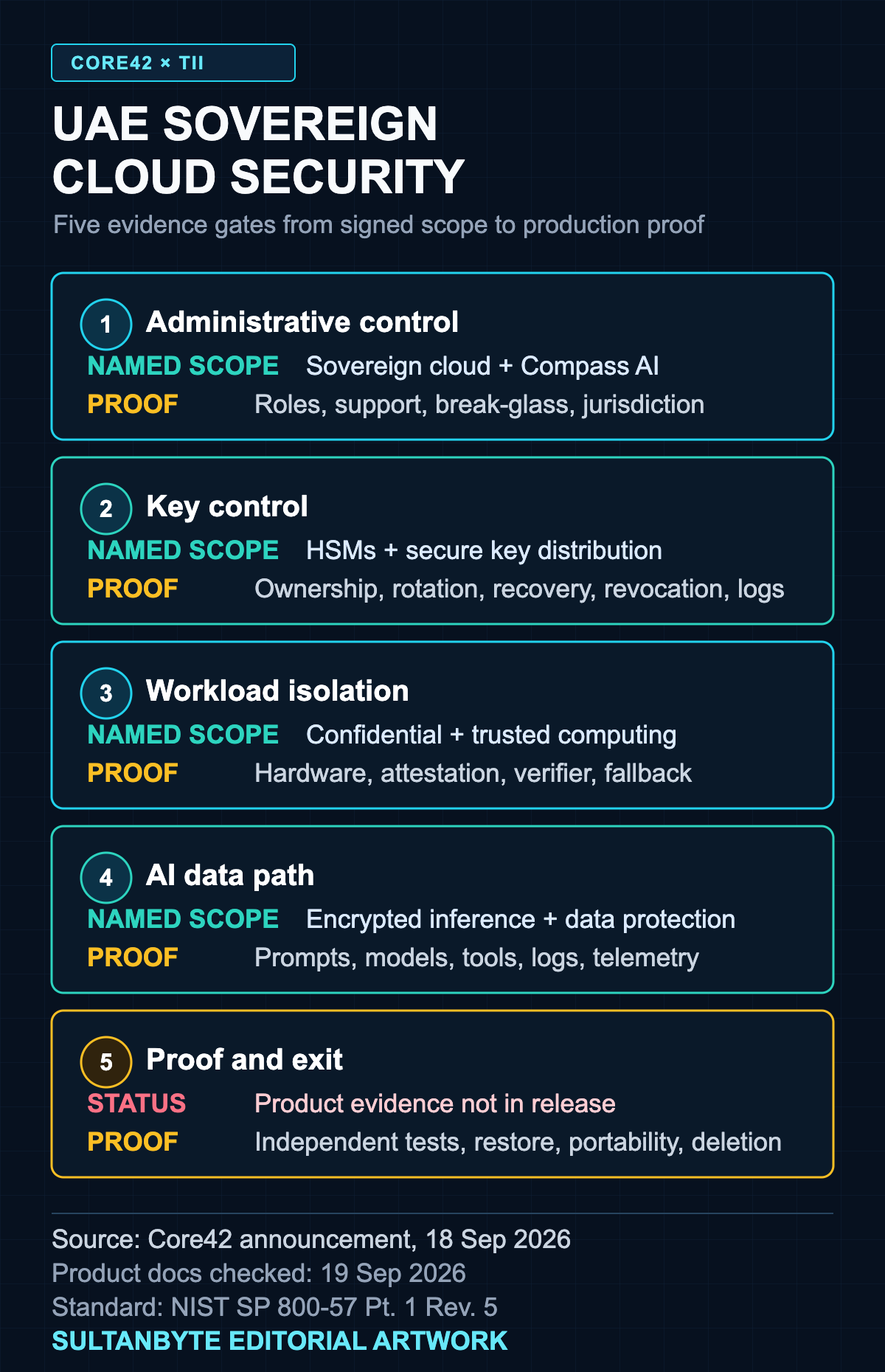
Sources: Core42 announcement dated 18 September 2026; Core42 product documentation checked 19 September 2026; NIST SP 800-57 Part 1 Rev. 5. Credit: SultanByte editorial artwork.
Five checks turn the announcement into an acceptance test
1. Map the administrative boundary
Ask for the complete operator model. Which Core42, TII, Microsoft or subcontractor roles can reach the control plane? Where are privileged identities stored? What does break-glass access look like, and who reviews it? A diagram should include support tooling, update channels and security telemetry, not just the application region.
The test is simple: give the provider a realistic support incident and require an audit trail showing every privileged action. Contract language is useful, but the identity and log evidence should match it.
2. Prove customer control of keys
An HSM icon does not settle key ownership. Buyers need to know who creates the root keys, whether provider staff can invoke them, how rotation and revocation work, and how recovery behaves during a regional or control-plane failure.
NIST SP 800-57 Part 1 Rev. 5 is not a UAE regulatory document, but its lifecycle model is a useful engineering baseline. It treats generation, protection, use, backup, recovery, revocation and destruction as connected parts of key management. A vendor demonstration should cover that lifecycle rather than showing encryption at rest and stopping there.
3. Verify confidential-computing claims
Confidential computing should protect data while a workload is using it, not only while it sits on disk or moves over a network. The buyer still needs the hardware and software boundary: processor type, trusted execution environment, measured components, attestation format and verifier.
Run a negative test. Change an approved image, firmware measurement or policy and confirm that the workload refuses secrets. Then test the fallback path. If the platform silently runs without attestation when the preferred hardware is unavailable, the control is optional in practice.
4. Trace the complete AI request
"Encrypted AI inferencing" can describe several designs. It may mean a trusted execution environment, cryptographic processing, protected transport, or a combination. The announcement does not say which design will reach Compass.
Draw the route for prompts, retrieved documents, model weights, tool calls, logs and telemetry. Mark every place where plaintext can exist and every organisation that can administer that component. Include agent memory and third-party tools. An inference service is not protected end to end if the model runtime is isolated but prompts are copied into an ordinary observability system.
5. Require proof, recovery and exit
A production evidence pack should include independent security testing, configuration and attestation records, incident responsibilities, restore results and deletion evidence. It should also explain how customers export data, policies, keys and logs at contract exit.
The Core42-TII release does not publish those artefacts. That is normal for an agreement signed one day ago, but it fixes the status: this is a signed development framework, not proof that every named capability is generally available.
The next milestone should be inspectable
The partnership has a credible shape. TII has years of cryptography work, and Core42 has a cloud and AI platform where the work could be deployed. The missing layer is public, testable product evidence.
Buyers should watch for a named service release, supported hardware and regions, an attestation specification, a documented key boundary and a reference architecture that includes support access, telemetry and recovery. A customer result would help, provided it says what was tested and under which workload classification.
Until then, the agreement belongs in a roadmap and evaluation plan, not a production assurance statement. The strongest outcome would be a UAE-developed control that a customer can challenge, measure and carry into an audit without relying on the word "sovereign" to do the work.