Saudi Arabia's Azure and AWS regions now have launch months
Azure is due in November and AWS in December. Saudi buyers should use the next 60 days to prove services, residency and rollback.
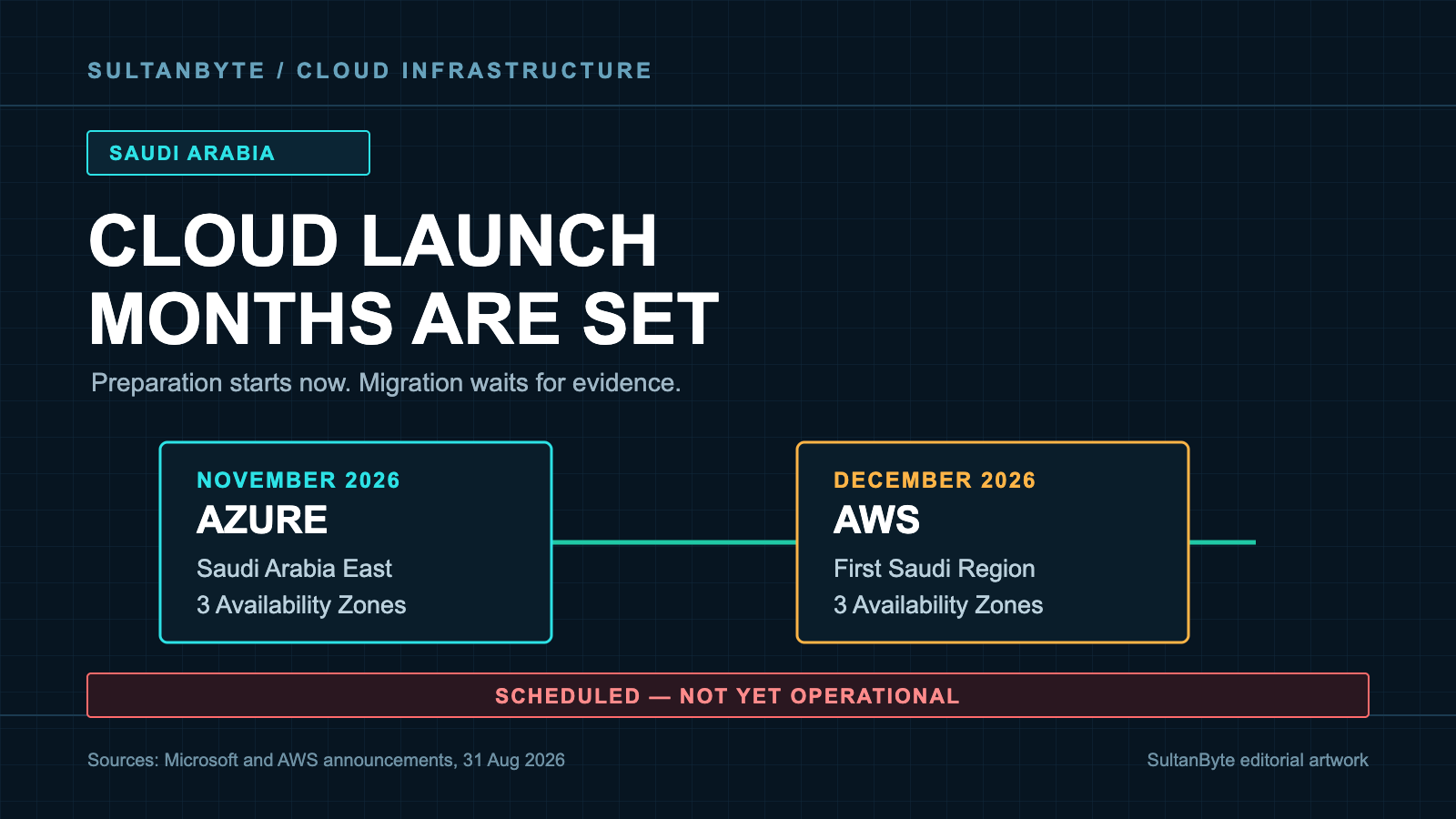
Microsoft and AWS have turned broad 2026 commitments into a two-month cloud calendar. That gives Saudi teams a planning window, not a reason to move production early.
On 31 August, Microsoft said Saudi Arabia East will become available in November 2026. Hours later, AWS said its first Saudi region is on track for December. Both providers say their regions will have three Availability Zones.
The announcements remove one uncertainty: timing. They leave most of the questions that decide whether a workload can move.
A launch month is not a service catalogue
Microsoft's wording matters. The company says customers will be able to use "supported" cloud and AI services and host "eligible" workloads and data locally. It has not yet published a complete launch-day service matrix, regional pricing, default quotas or a specific opening date.
AWS also gives a target month rather than a guaranteed day. Its announcement confirms three Availability Zones and repeats the planned investment of more than $5.3 billion, but buyers still need the service-by-service details that turn infrastructure into a usable platform. Regional reporting from tbreak and The Stack confirms the December target, not production performance.
That distinction is easy to lose in migration planning. A region can be generally available while a database engine, GPU family, security feature or observability integration remains absent. Capacity can also differ across zones. Teams should treat the opening announcement as the start of technical acceptance, not the end of architecture review.
Saudi buyers already have local options
The market is not waiting for November.
Google Cloud's live Compute Engine documentation lists three Dammam zones: me-central2-a, me-central2-b and me-central2-c. The same page shows different machine capabilities by zone, a useful reminder that regional presence does not mean identical capacity everywhere.
Alibaba Cloud lists a two-zone Saudi partner region in Riyadh, identified as me-central-1. Its documentation also warns that supported regions and zones vary by cloud product.
These footprints give teams something concrete to benchmark now. They should not be treated as interchangeable with the incoming Azure and AWS regions. Ownership model, support path, product coverage, connectivity and commercial terms all need separate review. SultanByte's earlier GCC cloud-region comparison covers the wider regional trade-offs; the new Saudi calendar adds a narrower question: what evidence must exist before a migration wave starts?
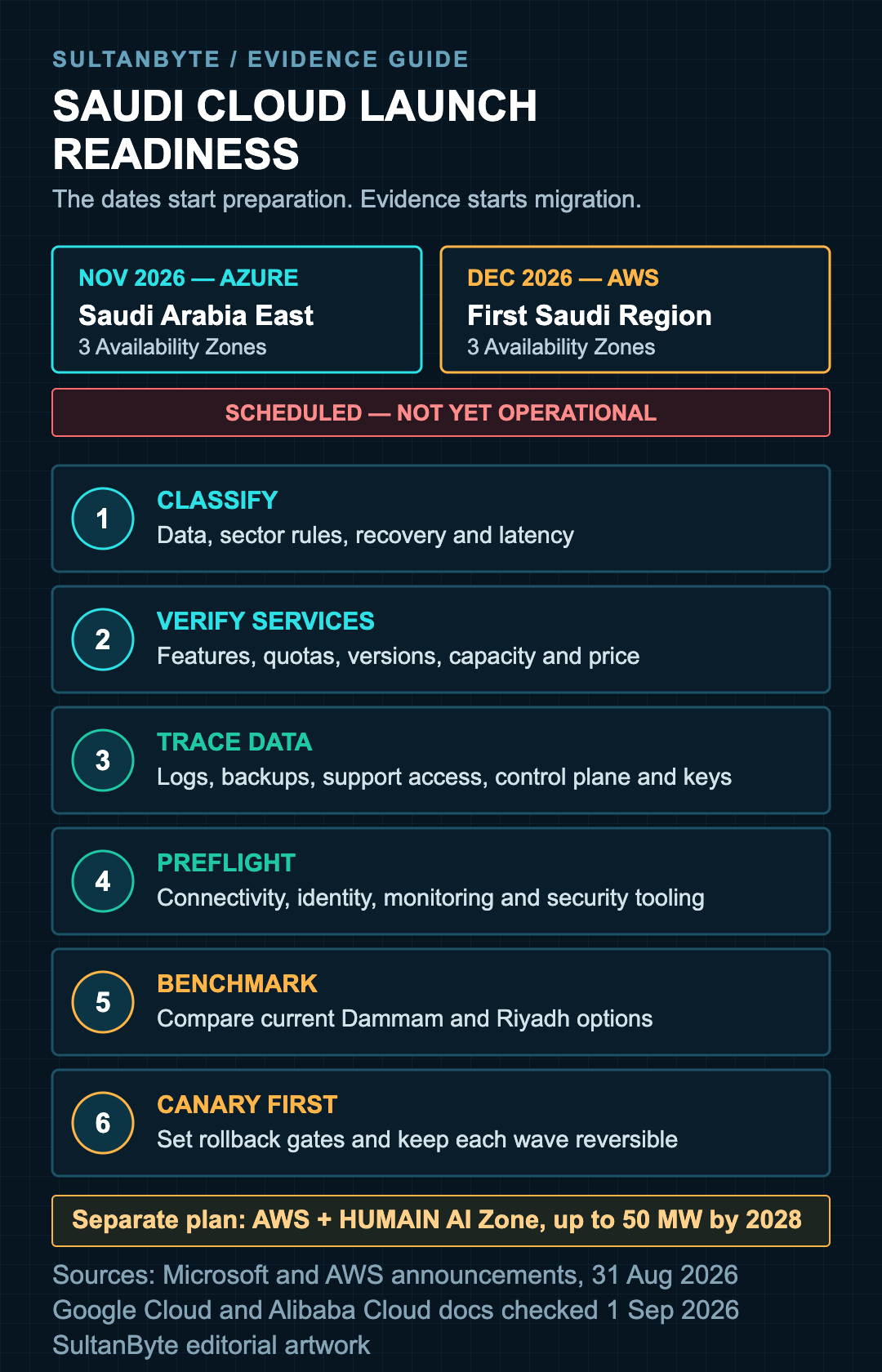
Visual: SultanByte editorial artwork. Sources: Microsoft and AWS announcements dated 31 August 2026; Google Cloud and Alibaba Cloud provider documentation checked 1 September 2026.
Build the evidence pack before November
Start with workload classification, not provider preference. For each system, record the data types it handles, applicable sector rules, recovery objectives, latency needs and dependencies. A public website, regulated customer record and real-time payment path do not belong in one migration bucket.
Next, build a launch-day matrix. List the exact services, versions, features, quotas, instance families and prices the workload needs. Mark each field as confirmed, unavailable or unknown. Do not substitute a global product page for regional proof.
Residency needs the same discipline. Trace where application data, logs, backups, support diagnostics, identity records and encryption metadata travel. A Saudi compute endpoint does not automatically keep every operational data flow inside the Kingdom. Confirm who can administer the environment, where keys are controlled, and what happens during support escalation.
Connectivity deserves an early test. Request private-circuit lead times, routing details and failover options. Verify identity federation, key-management integration, monitoring export, security tooling and marketplace dependencies. Quota approval can become a launch blocker even when the architecture itself is sound.
Then benchmark the proposed design against what is available today. Google Cloud Dammam and Alibaba's Riyadh partner region may not fit every workload, but they provide a current baseline for latency, operations, procurement and product coverage. The comparison should include the cost of changing providers later, not just the first-year bill.
Keep the first migration reversible
A three-zone region supports better intra-region design than a single facility, but zone count alone does not prove independent power, carrier, control-plane or geopolitical failure domains. Ask for architecture evidence. Test the failure modes you can observe.
The first production workloads should be small enough to move back. Use canaries, explicit rollback criteria and limited traffic. Keep backups readable outside the new region until restore tests pass. Avoid a single launch-week migration that combines a new region, a database upgrade and a network redesign.
Procurement teams can help by making evidence part of the contract. Define the required local services, support route, incident reporting, exit assistance and any residency representations that matter to the workload. An announcement page is not a service-level commitment.
AWS's separate agreement with HUMAIN illustrates why scope control matters. The companies say they will make up to 50 MW available in a Saudi AI Zone by 2028. That is a future AI-capacity plan, not capacity promised for the December 2026 cloud-region opening. Combining the two dates would overstate what buyers can use this year.
What should happen in the next 60 days
Cloud teams do not need to freeze while they wait. They can finish dependency maps, request provider service matrices, validate network lead times, prepare landing zones and write acceptance tests now. Security and compliance teams can define evidence requirements before product pressure turns every unknown into an exception.
The November and December targets are useful because they put a deadline on those conversations. They do not remove the need for proof. The teams in the best position to use the new regions will be the ones that arrive with a tested workload inventory, clear acceptance gates and a migration plan that can still reverse course.
About the author
- I have lead the Engineering for multiple startups in UAE. I also have my own agency qualascend.com.
Comments
Join the discussionNo comments yet. Be the first to comment.