44.01’s UAE carbon storage deal: from pilots to delivery
Frontier’s $11.7 million offtake tests continuous mineralisation. Here is how it differs from the Holcim cement pilot in Fujairah.
Frontier's latest carbon-removal purchase gives 44.01 a commercial test that a short injection pilot cannot provide: running the process continuously over several years.
On 15 October, Frontier announced $11.7 million in offtake agreements for 20,932 tonnes of CO₂ removal between 2028 and 2031. The company will dissolve captured CO₂ in water and inject it into reactive underground rock, where it forms solid carbonates. The contracted deliveries are in the future. They are not tonnes already removed.
For Gulf industrial operators and technology investors, the useful part of this deal is the operating evidence it is intended to produce. Can the wells sustain injection? How much water does the process need? What does continuous operation cost?
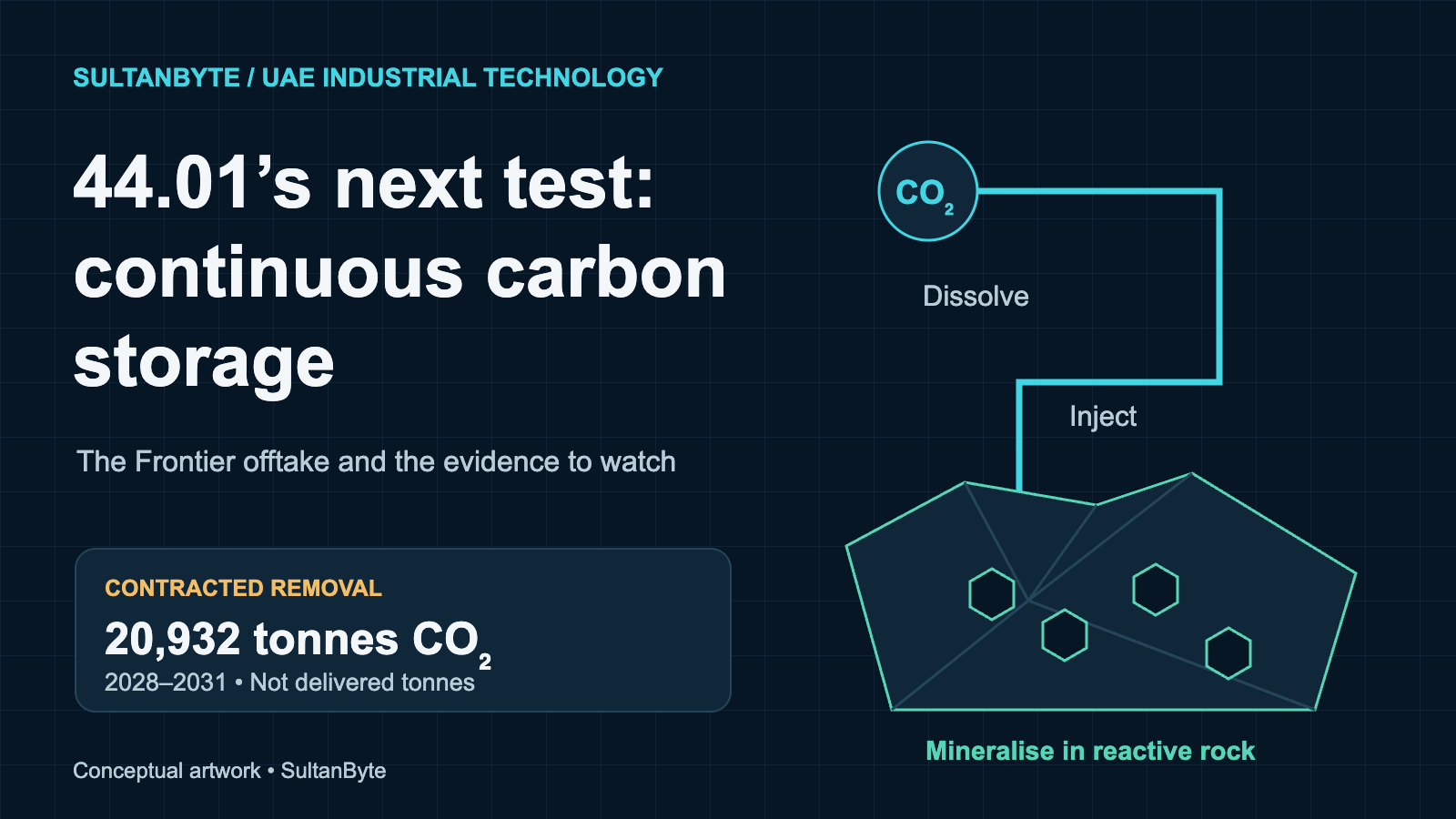
Cover: original SultanByte artwork illustrating captured CO₂ moving into reactive rock. The diagram is conceptual, not a site drawing.
A purchase agreement, not a funding round
44.01's announcement describes carbon-removal offtakes, not an equity investment. Frontier facilitated purchases for buyers including Stripe, Google and Shopify. The supplier says the agreements build on early purchases from Stripe and Shopify in 2022.
Axios also reported the $11.7 million purchase deals on 15 October. That corroborates the announcement; it does not establish delivery performance. Frontier is the buyer-side facilitator and 44.01 is the supplier, so their technical and commercial expectations should be read as interested-party assessments.
The distinction matters for investors. Future contracted demand can support a project's commercial case without proving that its operating costs, throughput or net removals have reached the promised level. Buyers should ask which milestones trigger payment and what happens if delivery is delayed. The public announcements do not disclose the full contract terms.
Follow the carbon source, not just the storage method
Frontier describes a biogenic CO₂ supply separated during biogas upgrading at a wastewater treatment plant and transported to 44.01's storage site. Its account places the opportunity in the UAE and draws on the company's previous demonstrations in Oman and the UAE.
The same storage technology can also receive industrial CO₂. That does not make every tonne stored a tonne removed from the atmosphere. The IPCC's definition of carbon dioxide removal requires human activity that removes atmospheric CO₂ and stores it durably. Avoiding the release of industrial emissions and removing atmospheric carbon are different accounting claims.
This is relevant to 44.01's separate work with Holcim in Fujairah. In its commissioning announcement, published on 5 October with a 1 October dateline, 44.01 says the cement pilot has operated under live industrial conditions since July 2026. It is designed to capture between 4 and 4.5 tonnes of CO₂ per day. That is a design figure, not a published record of achieved daily capture.
Holcim's 6 October account describes capture from active cement-plant flue gas, transport to a nearby storage site and underground mineralisation. It identifies NT Energies and Shell CANSOLV technology in the capture chain, with Gulf Cryo supporting transport.
For a buyer, those are separate propositions: a future carbon-removal offtake using biogenic CO₂, and an industrial pilot storing cement emissions. Do not combine their quantities or describe the cement pilot as delivery against the Frontier agreement.
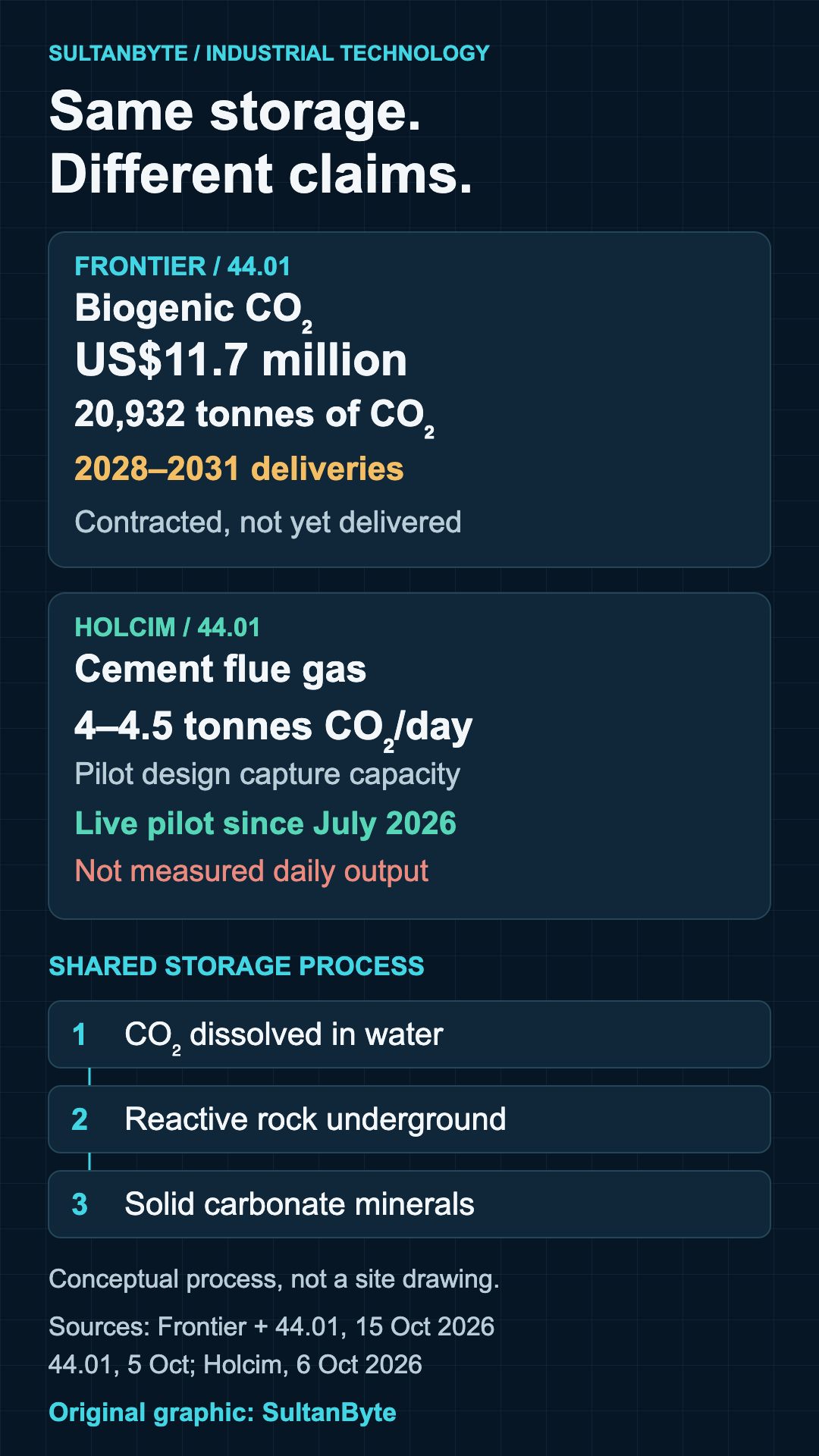
Original infographic: SultanByte. Sources: Frontier and 44.01, 15 October 2026; 44.01 commissioning announcement, 5 October 2026; Holcim, 6 October 2026. Contract quantities and pilot design capacity are different measures, not achieved removals.
The next test is continuous operation
Frontier says 44.01 has already completed short-duration injection pilots. The new project is intended to test sustained injection rates, water requirements and operating costs over multiple years.
Its description of the proposed chain is specific: deliver captured CO₂, dissolve it in water, inject the solution into naturally fractured peridotite, and monitor its conversion into carbonate minerals. Frontier describes wellhead mass-flow meters, samples from a monitoring well and geophysical sensors. These observations serve different purposes; a meter reading alone cannot show that all injected carbon has mineralised.
A useful operating report should preserve that distinction. Record delivered CO₂, injected CO₂ and evidence of mineralisation separately, with timestamps, instrument calibration and uncertainty. Keep the original measurements available to reviewers rather than publishing only a cumulative dashboard total.
For engineering teams, our recommendation is to make the capture, transport and storage handovers explicit. Assign responsibility for rejected loads, interruptions, measurement discrepancies and missing data. A reliable storage system still needs a dependable upstream supply and a defensible accounting chain.
Local geology changes the commercial comparison
Frontier argues that mineralisation can serve sources poorly placed for conventional geological storage. It says industrial sources near 44.01's existing UAE site are within 50 kilometres of characterised peridotite but more than 300 kilometres from viable conventional storage in the Gulf. Those are Frontier's site-specific comparisons, not distances that apply across the UAE or MENA.
The broader siting issue is well established. The IEA's CO₂ storage handbook, published in 2022, explains that storage resources need appraisal and that not every resource can become an operating site. It also recommends considering capture facilities' proximity to storage and treating monitoring, liability and business models as part of development.
Oman and the UAE provide relevant experience in 44.01's account. That does not establish a ready-made commercial site in Saudi Arabia, Qatar or another neighbouring market. A proposal elsewhere needs its own geological assessment, permissions, water plan and transport economics. National borders do not map the suitability of the rock, and suitable rock does not settle the permission to use it.
For an industrial operator, compare the complete local chain against realistic alternatives. Ask what happens when the capture plant stops, transport is unavailable or injection must pause. The cheapest storage step on paper may not produce the lowest-cost dependable service.
What a buyer should require before scaling
Start with a written claim boundary. Is the purchase for industrial emissions storage or verified atmospheric removal? Which CO₂ sources qualify, and who checks them? Require an explanation of how energy, transport and other project emissions enter the net result before treating gross injected tonnes as net removals.
Then ask for an operating plan that reports water withdrawals and consumption, water quality, energy use, injection performance and downtime. The announcement identifies water requirements as something the project will test; it does not justify assuming a proven low-water outcome.
Finally, agree on evidence and responsibility. Specify the verification method, data access, response to measurement gaps, monitoring obligations and treatment of a delivery shortfall. These are proposed procurement checks, not claims that undisclosed Frontier contract terms omit them.
For technology investors, the next informative update will be a sustained operating record with costs and resource use attached. For industrial buyers, it will be a site-specific service that can accept their CO₂ reliably and support the precise claim they intend to make.
The October deal creates a reason to watch that evidence emerge. It does not remove the need to measure it.
About the author
- I have lead the Engineering for multiple startups in UAE. I also have my own agency qualascend.com.
Comments
Join the discussionNo comments yet. Be the first to comment.