QSTP–Microsoft startup credits: plan beyond the subsidy
What Qatar founders and CTOs should verify about awards, billing limits and the cost of running after Azure credits end.
Qatar's latest startup-cloud announcement is useful for founders, but its largest number is easy to misread. QSTP says its active startup cohort could access Azure credits worth up to $9.4 million. That is potential service credit, not cash invested, credits already committed or a measured saving.
On 19 October, Qatar Science & Technology Park announced its Microsoft for Startups collaboration, reporting 105 nominated startups and 47 active participants. Approved startups can access $100,000 in Azure credits, with an opportunity to extend to $200,000 over two years based on usage. QSTP explicitly says its cohort-value figures are not a commitment of credits.
For a founder, the useful question is what the approved offer will pay for, and whether the product remains affordable when that support ends. For a CTO, it is whether the chosen services can run under the actual subscription, placement and operating constraints.
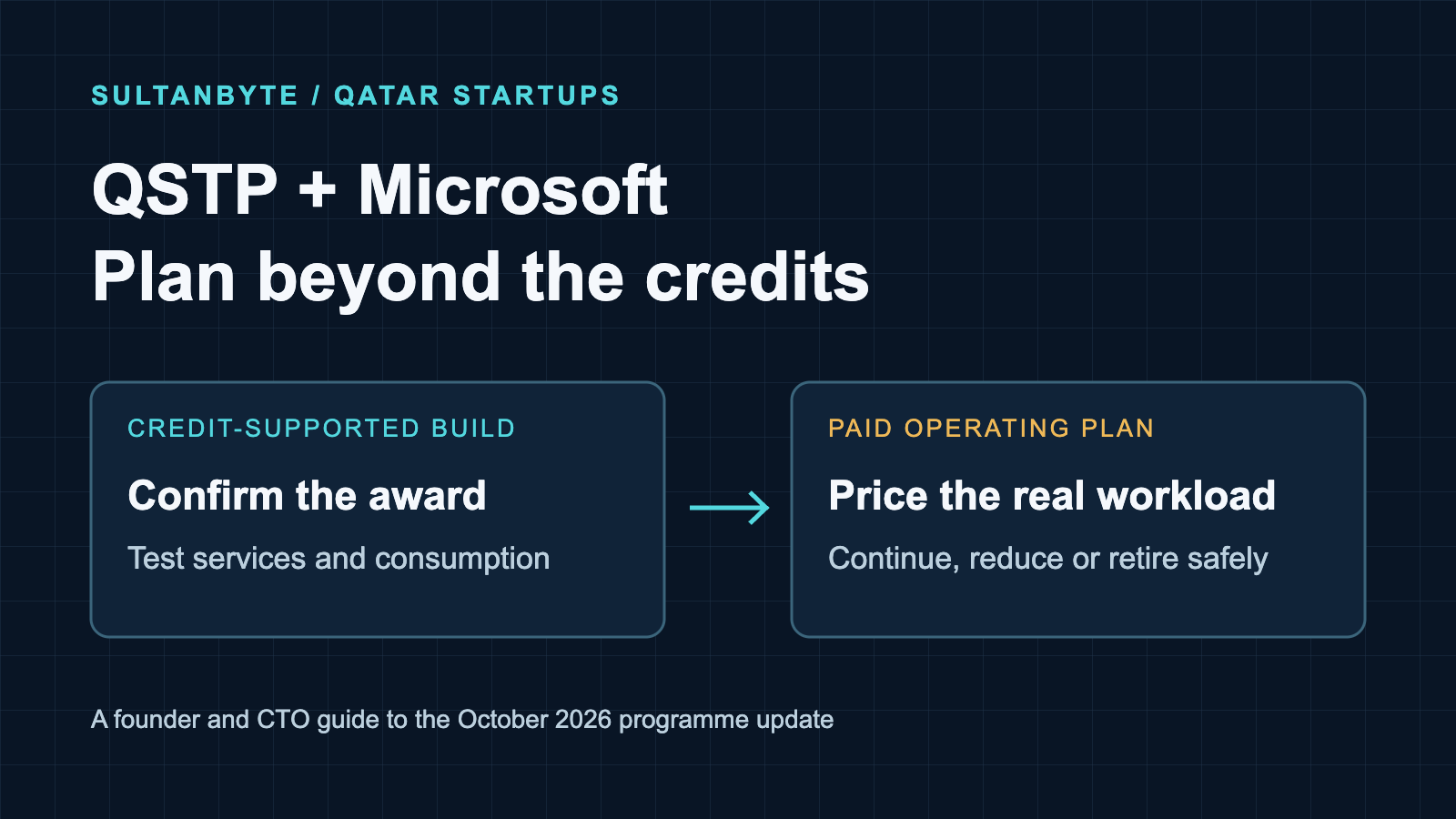
Cover: original SultanByte artwork contrasting a startup's credit-supported build phase with its paid operating plan.
Read this as a participation update, not a first partnership
The relationship predates this week's announcement. Gulf Times reported a QSTP–Microsoft startup partnership on 7 August 2021. The new evidence is the October package description and participation count, rather than Microsoft's first connection with QSTP.
Gulf Times' 19 October report repeats the programme figures and qualifications. It provides a second published account, not an independent audit of credits redeemed or business outcomes. Neither report establishes how much founders have consumed, how many paying customers they acquired or whether their infrastructure became cheaper.
That distinction matters when an accelerator reports impact. Nominations, active participation, approved awards, redeemed credits and successful businesses are different measures. Keep them separate in a board update.
Get the award terms before moving the application
There is a concrete reason to request written confirmation. Microsoft's application guide, updated 10 October, describes additional credits up to $150,000, while QSTP's announcement describes an opportunity to reach $200,000. The public pages do not reconcile those amounts. Do not assume the generic guide overrides QSTP's offer, or that every applicant receives QSTP's upper figure.
Ask QSTP and Microsoft to identify the applicable route, approval conditions and benefit schedule for your company. Record the awarded balance, activation deadline, expiry date and conditions for additional credits. A nomination email is not the same record as an activated benefit.
Microsoft's startup FAQ says credits must be activated within 90 days of accepting the programme agreement and can be used for up to two years once activated. It also says credits cannot be transferred to another Microsoft account and are tied to the subscription created during redemption. Confirm those details against the offer actually issued before choosing the account.
Use a controlled onboarding process with a named owner and documented recovery arrangements. Avoid having a contractor redeem the benefit casually under an account the company cannot reliably administer. Ask support to resolve any existing-account conflict before provisioning production resources.
A credit balance does not buy every dependency
Microsoft's Azure Sponsorship terms exclude support plans, third-party branded products and Azure Marketplace products from the special pricing. A separately included startup support benefit can coexist with those exclusions; it does not mean all support purchases consume the credit balance.
Build a small service ledger before migration. For each dependency, record the service and SKU, region, expected usage, credit eligibility and payer for uncovered charges. Include storage, backups, observability and network transfer rather than costing only the application server or model endpoint. Confirm anything ambiguous with the provider.
The same terms say a quota is not a commitment that resources will be available. Test the actual deployment in the intended subscription. An approved award does not prove access to the required accelerator, model, capacity or service feature.
This is a Qatar pathway for eligible QSTP startups. A UAE or Saudi startup should confirm its own eligibility and commercial route rather than treating it as a GCC-wide entitlement. For a Doha company serving customers in those markets, customer obligations and approved processing locations still need separate review. This announcement does not establish that every credited service processes data in Qatar.
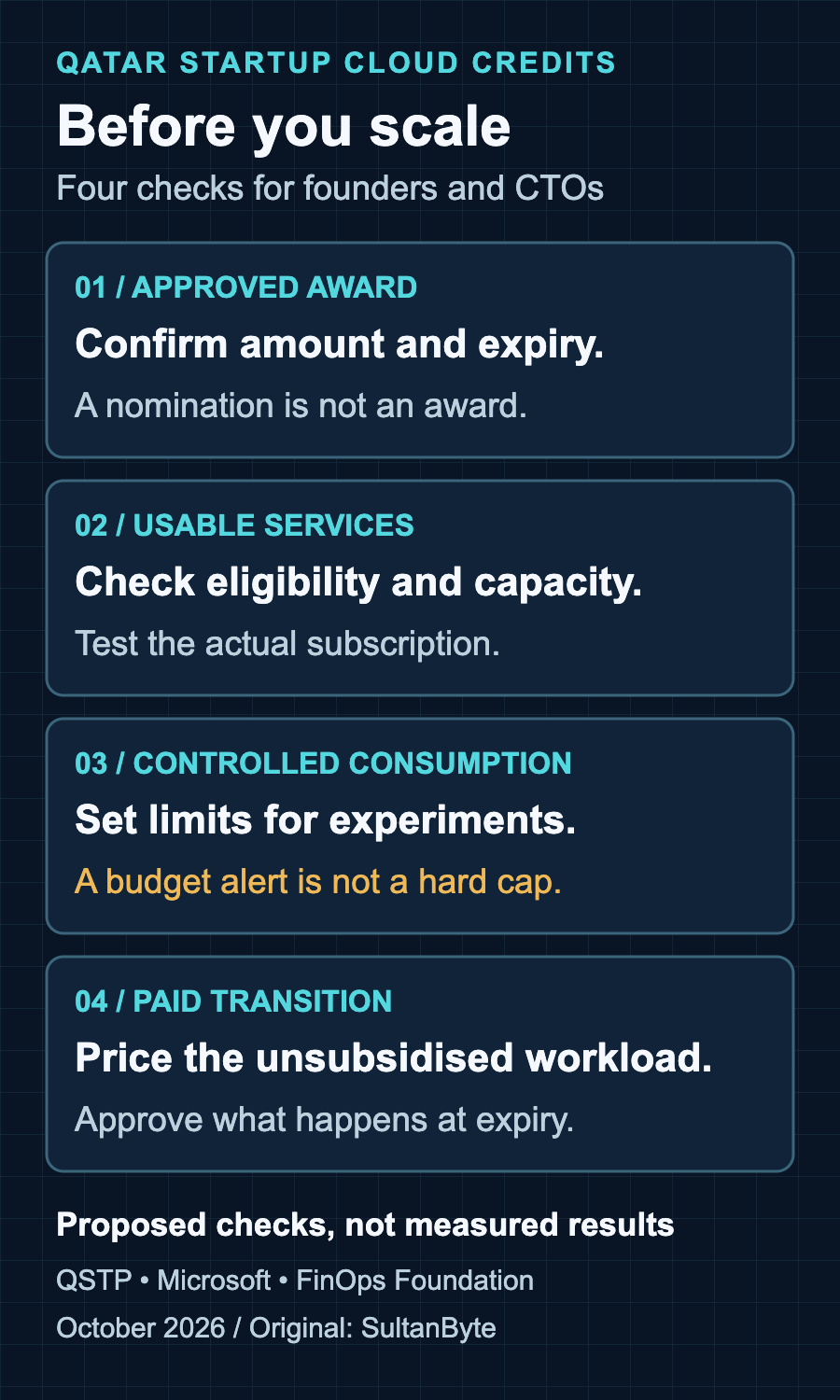
Original infographic: SultanByte. Proposed founder/CTO checks informed by QSTP's 19 October 2026 announcement, Microsoft programme and billing guidance, and the FinOps Foundation. These are planning checks, not measured outcomes.
Treat budget alerts as notifications, not a spending cap
Microsoft's Cost Management budget guide is explicit: crossing a budget threshold does not stop consumption or affect resources. It says cost data is typically available within 8–24 hours and budgets are evaluated every 24 hours. An alert cannot be treated as a real-time circuit breaker.
Our recommendation is to separate monitoring from operational limits. Configure the supported cost views and alerts for the actual account, then test who receives them and what they will do. For experiments, set bounded job sizes, concurrency limits and resource lifetimes. Decide which non-production workloads may be stopped automatically and which production workloads require a person to intervene.
Give each environment an owner. Review unexpected spend while there is still time to respond, and reconcile credit consumption with charges outside the offer. A balance screen alone cannot explain the whole bill.
Avoid designing an emergency shutdown that deletes customer data or interrupts an essential workflow. A cost-control response needs the same operational review as any other production change.
Price a useful customer outcome without the subsidy
The FinOps Foundation's unit-economics guidance distinguishes resource-efficiency measures from business measures such as cost per tenant, transaction or resolved case. That is a useful starting point for a startup whose current cash bill is reduced by credits.
Keep two views: what the company pays now and what the same workload would cost at the expected post-credit rates. Label the latter as a model, with its prices and usage assumptions, rather than an invoice. Add uncovered services and shared operating costs explicitly.
For an Arabic support product, for example, measure cost per successfully resolved case alongside quality and latency. Cheap tokens are not enough if the application retries repeatedly or hands most cases to a person. Compare the same task and quality threshold when assessing another model or provider.
Finance and product owners should agree what paid usage the business can sustain. Engineering should test export and recovery procedures before dependencies become difficult to replace. Neither exercise requires abandoning Azure; both make the choice easier to defend.
Make the paid transition a deliberate decision
The sponsorship terms provide for automatic conversion to pay-as-you-go when the usage cap or end date is reached, subject to the stated exceptions. Plan around the applicable award, not an assumption that the service will simply switch itself off.
Before that point, approve one of three actions: continue at the agreed paid budget, reduce the workload or retire it safely. Assign an owner and allow time for data export, customer communication and any migration.
QSTP's update gives eligible founders a concrete opportunity to reduce early infrastructure expenditure. Use that time to prove customer demand and understand operating costs. The strongest result is a product the company can afford to keep running after the credits end.
About the author
- I have lead the Engineering for multiple startups in UAE. I also have my own agency qualascend.com.
Comments
Join the discussionNo comments yet. Be the first to comment.