UAE financial health challenge: build a measurable pilot
What the new CBUAE programme offers, why regional adoption figures differ, and how fintech teams can test customer outcomes.
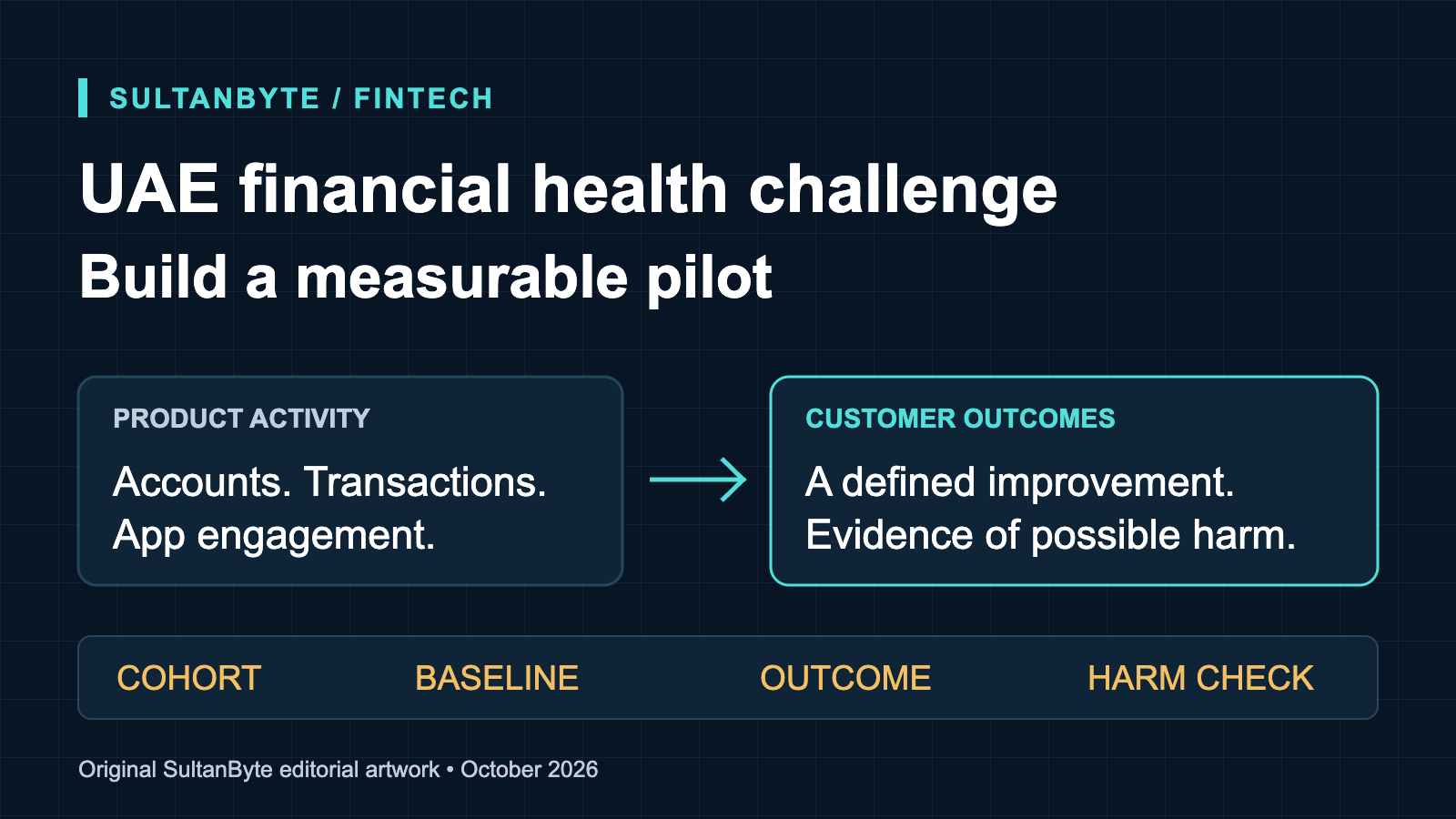
The UAE's new Financial Health Innovation Challenge gives fintech teams a practical test: show that a working product improves a customer's financial life, rather than simply attracting more transactions.
The Central Bank of the UAE's 30 September announcement placed the challenge within the MENA Leaders' Summit on Financial Health, held in Abu Dhabi on 30 September and 1 October. It also announced the National Financial Literacy Strategy 2027–2031. The stated direction is to look beyond account and transaction counts toward resilience, savings and responsible borrowing.
For founders, the immediate opportunity is a potential institutional pilot. For bank product teams, the harder question is what evidence would justify continuing it.
Cover: original SultanByte editorial artwork showing the move from product activity to measured customer outcomes.
What the challenge offers, and what it does not
The programme page from delivery partner Alliance for Innovative Regulation seeks solutions already tested in real settings, ready for adaptation with participating UAE-licensed financial institutions. Applications close on 30 November 2026 at 23:30 GST, the UAE's Gulf Standard Time.
Applicants select one main outcome area: everyday money management, resilience to shocks, longer-term goals, or confidence in financial decisions. The intended audience includes individuals and micro, small and medium enterprises.
AIR explicitly says this is not a regulatory sandbox. Participation does not waive applicable requirements, and progressing through selection does not guarantee a pilot. An institutional match, a viable design and the relevant approvals still have to follow.
Treat the opportunity as a route to testing a proposition, not permission to launch a financial service. Before committing engineering time, identify the institution that would own the customer relationship, the activities the product performs, and who approves access to customer data. Those are proposed diligence steps, not additional programme rules.
Regional progress is measured in different units
Saudi Arabia and Egypt illustrate why a regional fintech dashboard needs more than one headline percentage.
SAMA reports that electronic payments represented 85% of Saudi retail payments in 2025, compared with 79% in 2024. That measures payment adoption. It does not tell a product team whether a household can absorb an unexpected expense.
The Central Bank of Egypt's financial-inclusion indicators put inclusion among citizens aged 15 and above at 79% in June 2026. CBE describes a national-ID-based data hub, alongside demand-side surveys examining barriers to financial services. This is a different population, reporting period and measurement from Saudi Arabia's transaction share.
Do not put those percentages on a league table of financial health. The UAE challenge is another kind of evidence altogether: a programme inviting future product tests, not a reported national outcome. A Saudi payments business, an Egyptian access-focused provider and a UAE pilot applicant may share technology while needing different success measures.
For a cross-country benchmark, use comparable survey definitions and keep the observation year visible. The World Bank's Global Findex 2025 report uses surveys conducted in 2024 and covers financial-service use, financial risk and digital access. Its publication year should not be relabelled as the year the behaviour was observed. National administrative data can add detail, but should remain a separate series unless definitions genuinely align.
Choose an outcome before choosing the feature
CGAP's September 2026 financial-health measurement framework provides a useful starting point. It sets out six measurement constructs and 17 indicators, including arrears, emergency resources, savings and people's sense of financial control. It combines observed financial conditions with what people report about their lives.
That is a measurement reference, not a ready-made product score. CGAP also distinguishes describing a problem from establishing that an intervention caused an improvement. A before-and-after chart alone cannot settle causation.
For an applicant, start with a sentence that names the population and the intended change. For example: help a defined group of small businesses avoid missed supplier payments caused by poor cash-flow visibility. Then choose the feature, evidence and follow-up period that could test that proposition.
A budgeting dashboard may be useful, but dashboard visits are not the outcome in that example. A recommendation to hold more cash also needs a cost check: did the business avoid arrears by delaying another necessary expense? The following framework is an editorial proposal for designing such tests, not the challenge's scoring rubric.
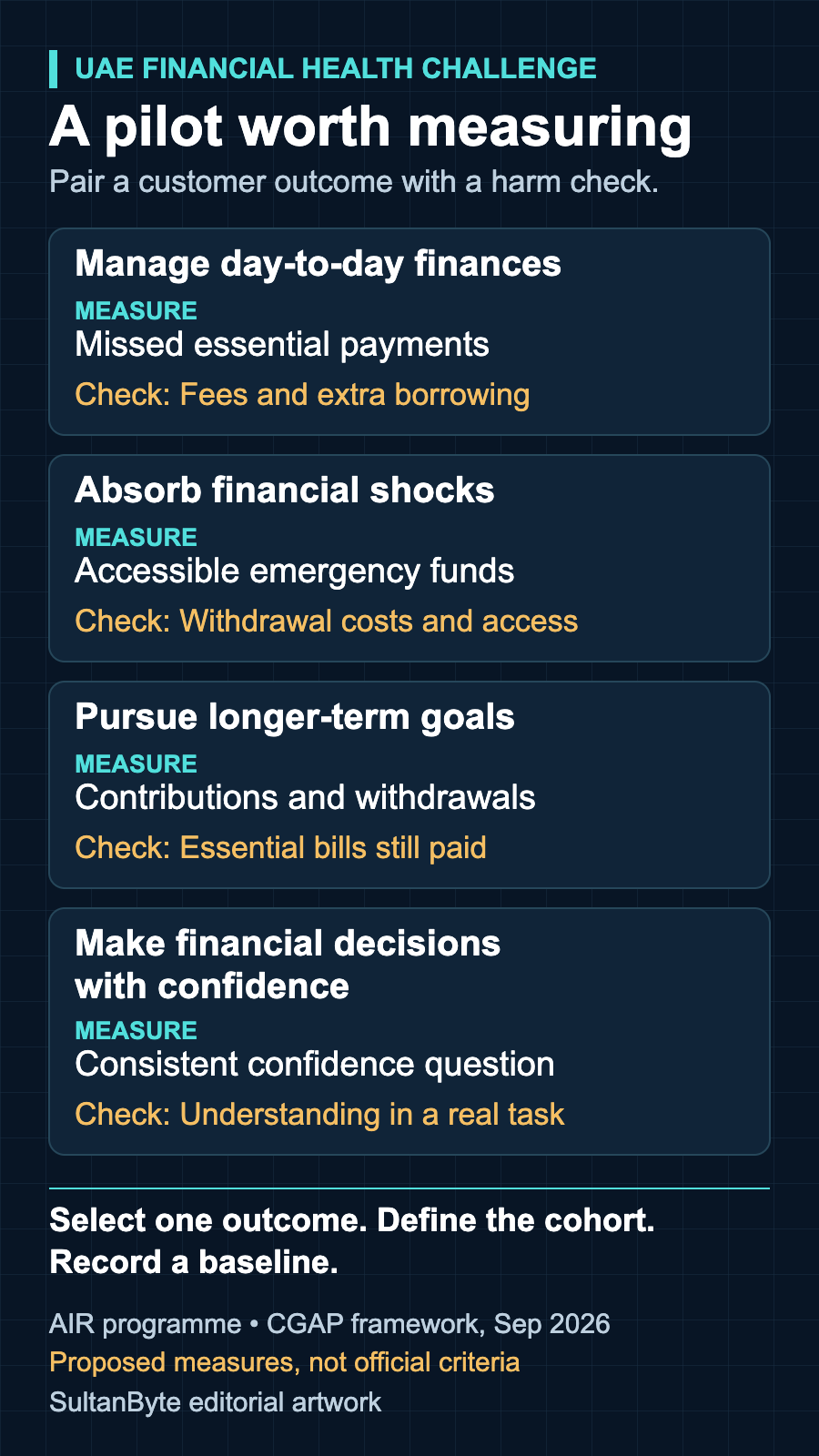
Source context: AIR challenge areas and CGAP's September 2026 measurement framework. Example measures and checks are SultanByte editorial recommendations, not official evaluation criteria. Original graphic: SultanByte.
Pair every improvement with a possible harm
For everyday money management, track missed essential payments in the selected cohort. Pair that with fees and additional borrowing. A lower missed-payment count is less persuasive if the intervention merely pushes people into more expensive debt.
For resilience, examine accessible emergency funds rather than the number of savings pots created. Record whether participants can withdraw when needed and what withdrawal costs them. An inaccessible balance is a poor substitute for money available during a shock.
For longer-term goals, follow contributions and withdrawals over an appropriate period. Check whether increased saving comes at the expense of essential bills. A short pilot can test feasibility and early behaviour; it cannot establish a lasting retirement outcome.
For confidence, use a consistent question before and after the intervention, then check understanding with a realistic task. A user who feels more confident but misunderstands a repayment obligation has not necessarily become better equipped to decide.
These measures need definitions. Specify whose payments count, what qualifies as late, which accounts are visible and how missing observations are handled. Keep the denominator fixed or explain its changes. Report departures from the pilot rather than removing them silently from the result.
Build the evidence into the integration
The engineering work starts with a baseline, not a reporting dashboard added at the end. Agree on event definitions with the pilot institution, version the calculation and preserve enough provenance to reproduce a reported result.
Separate product telemetry from outcome evidence. A notification delivery event proves delivery. It does not prove comprehension or a better decision. Account data may reveal a balance within the connected institution while missing obligations elsewhere. Record that limitation rather than treating a partial view as a complete household balance sheet.
Collect only what the test needs, restrict access and set a retention decision before collecting sensitive records. Give the institution an explicit incident owner and a way to stop the intervention. Have the responsible compliance team assess the actual data flow and service scope; the programme label cannot do that work.
For an AI feature, evaluate the financial decision it influences. Include misunderstood Arabic or English instructions, incomplete account information and inappropriate recommendations in the test cases. An engagement gain should not compensate for a harmful recommendation.
Decide what would justify another phase
Before the pilot begins, agree what would lead to continuation, redesign or a stop. Include operational cost and the institution's ability to support the product after the programme, not just a favourable result among enthusiastic early users.
The useful deliverable is a reproducible account of who benefited, under what conditions, and where the product failed. Keep uncertain findings uncertain. The UAE challenge offers a concrete reason to build that evidence now; it does not supply the evidence on an applicant's behalf.