Secret rotation for MENA SaaS: prove the handover
Test fresh connections, stale consumers and regional recovery before retiring application credentials.
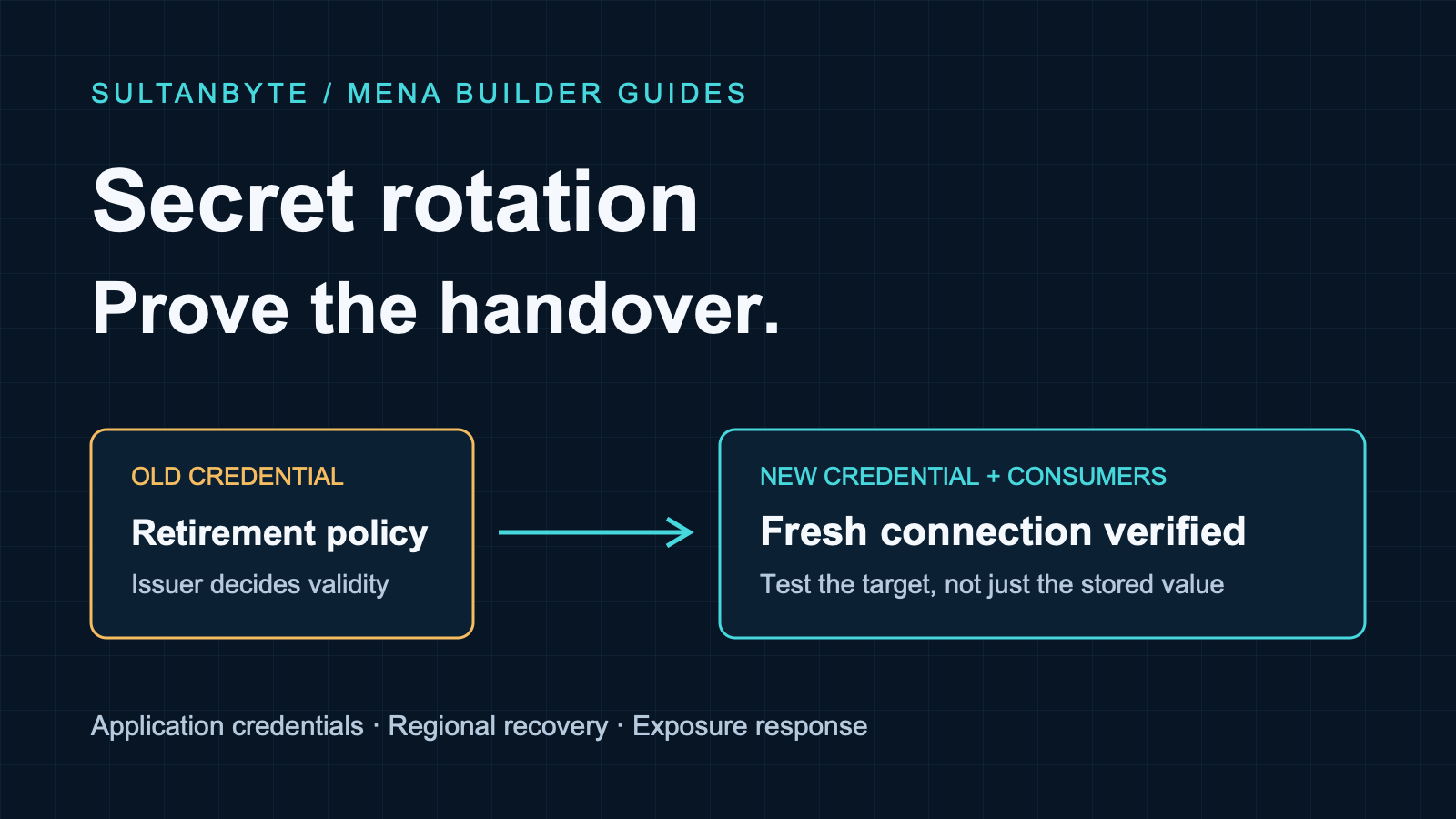
A credential rotation can succeed in the secrets manager while an application keeps using the old value. The operational question is whether every consumer can make a new authenticated connection after the change, and whether a credential marked for retirement has actually lost access.
For a SaaS team serving customers in Saudi Arabia and the UAE, make that a deployment requirement for each approved environment. A healthy UAE service should not be accepted as evidence that a separate Saudi customer environment is ready. Use the same review template, but keep credentials, owners and recovery decisions scoped to the deployment.
This guide proposes a handover process for application passwords and API credentials. It is not a blanket password-expiry policy for people, a cryptographic-key migration guide or a promise of zero downtime. Provider behaviour matters, especially when a service permits only one active credential.
Cover: original SultanByte editorial artwork showing a credential handover between old and new consumers.
Remove the credentials you do not need to rotate
Start with the deployment pipeline. GitHub's OIDC documentation describes exchanging a workflow identity for a short-lived cloud access token instead of copying long-lived cloud credentials into repository secrets. The cloud provider checks claims against its configured trust conditions.
Where your provider supports this, prefer federation for the pipeline's cloud access. Keep the trust definition narrow enough to identify the intended workflow and deployment context. Do not replace a static administrator key with a federated administrator role and call the job complete. Review what the job is allowed to change, not just how it authenticates.
That does not eliminate a downstream vendor's API key or a database password your application still needs. Put those remaining credentials in an inventory with a named owner. For each one, record the issuer, consumers, approved locations, retrieval method, target account and replacement procedure. Record references and version identifiers, never the secret values themselves.
OWASP's secrets-management guidance distinguishes creation, rotation, revocation and expiration. Use those as separate controls. A newly generated value is not evidence that its predecessor has been revoked.
Choose the handover from the issuer's actual rules
Ask the system that validates the credential what it supports. Can two credentials be valid together? Can you test a replacement before making it the default? Does revocation terminate existing sessions, or only prevent new authentication? What permissions are required to perform the change?
For database secrets rotated through Lambda, AWS documents single-user and alternating-user strategies. Single-user rotation changes one user's credentials. AWS notes a short mismatch window between the database password change and the secret update, and says open database connections are not dropped.
Alternating-user rotation switches between an original user and a clone. AWS says both sets of credentials remain valid after rotation. It also warns that later permission changes to the original user must be applied to the clone. These are documented service behaviours, not measured availability results for your application.
For a service that supports overlapping credentials, our recommended decision rule is to validate the replacement, move consumers, then retire the old credential under a defined policy. For a single-active-credential service, plan explicitly for the mismatch window: controlled reconnects, bounded recovery and, where necessary, an announced interruption.
Do not bolt a generic “delete the old user” step onto a managed alternating-user strategy. Its next rotation expects the pair to exist. Distinguish retiring one password version from removing the account, and follow the managed rotation contract.
Make consumers prove they have changed
The handover should have a consumer register, not just a successful rotation event. List web processes, queue workers, scheduled tasks and recovery jobs separately. A service that runs nightly needs an explicit test; waiting for tomorrow's failure is a poor acceptance check.
For each consumer class, require evidence of a fresh authenticated connection using the intended version. A successful request through an already-open connection can miss the problem that appears after a restart. Test the permission the application needs as well as the login: a replacement that authenticates but cannot perform its intended operation is not ready.
Separate three observations in the deployment record: the replacement exists, the running consumer has loaded it, and the target accepts it. Give each observation a timestamp and a non-secret version identifier. Avoid logging connection strings, authorization headers or raw SDK responses to establish that evidence.
Treat configuration delivery as its own dependency. Kubernetes documents eventually consistent updates to Secret-backed volumes and says subPath mounts do not receive automated Secret updates. A changed file also needs an application path that reads the new value; file delivery alone should not be your acceptance test.
If a process reads its credential only at startup, make replacement or restart part of the rollout. For a process designed to reload, test the reload path under concurrent work. Require a clear outcome if the replacement cannot be read, rather than silently switching to a second, undocumented source.
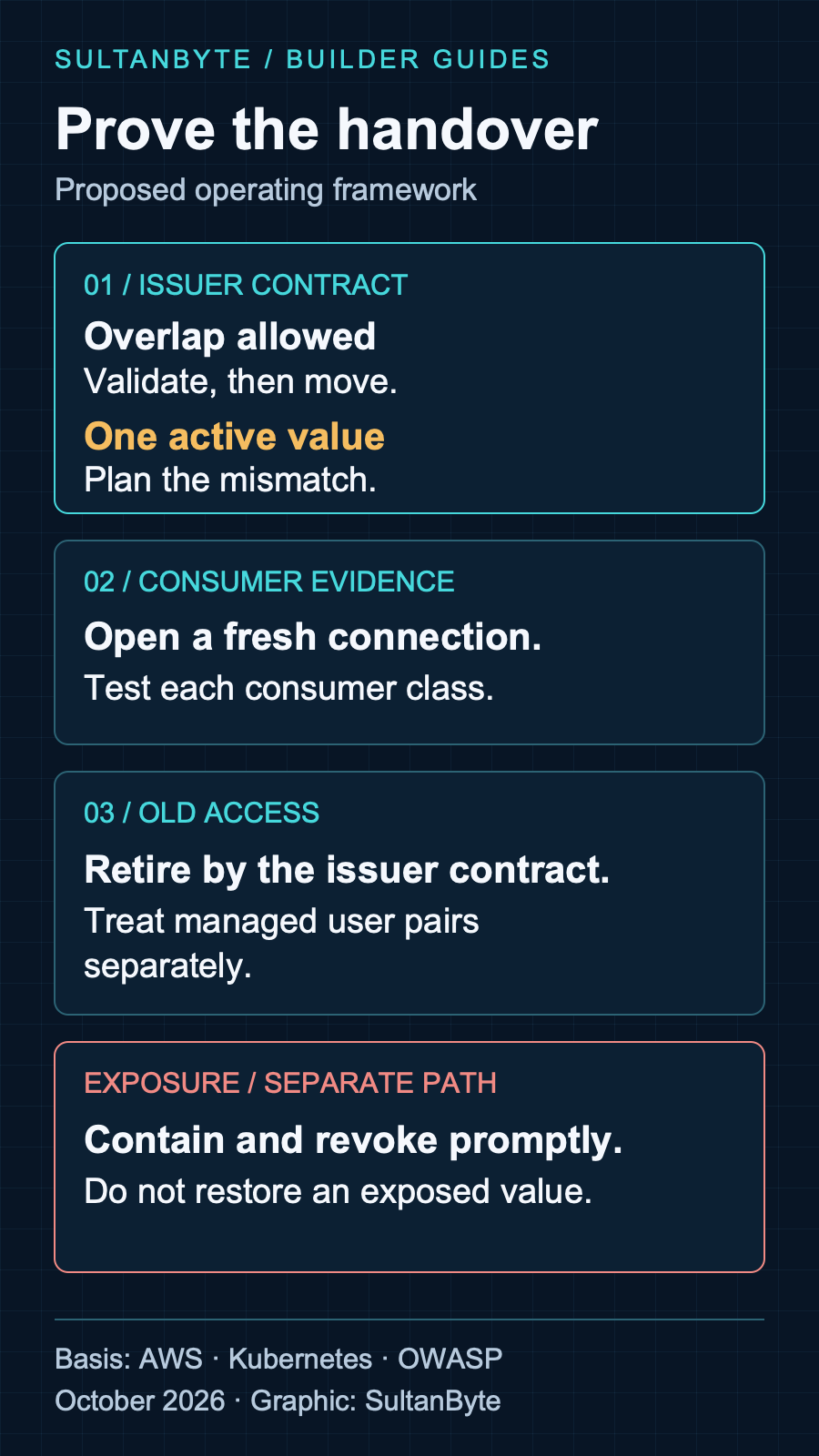
Original infographic: SultanByte. Proposed operating framework informed by AWS Secrets Manager, Kubernetes and OWASP documentation, October 2026. It describes recommended checks, not a measured rollout.
Give caches and retries a bounded job
A cache changes how quickly consumers see a replacement. For example, AWS's Python caching-component documentation specifies an hourly default refresh and says the implementation does not include cache invalidation. That is a property of that component, not a universal AWS SDK guarantee.
Record the actual refresh policy for every client library you deploy. Decide how a forced rotation reaches consumers before the normal refresh interval. Test a secrets-manager outage during that transition, including what a newly started worker does when it has no cached value.
For a recognized authentication failure, consider one coordinated refresh and a bounded attempt to establish a new connection. Do not turn every application error into a credential refresh. A permissions error, network timeout and rejected password need different diagnosis.
Also separate connection recovery from replaying business work. Refreshing credentials must not quietly resubmit a payment or rerun a partially completed export. Keep the application's idempotency and reconciliation rules in force; SultanByte's payment-webhook guide explains that separate boundary.
Agree on a stopping condition before rollout. If fresh connections fail or a consumer remains on the retiring version, pause the handover and alert its owner. Do not extend an overlap window indefinitely merely to keep a green dashboard.
Keep regional recovery inside the approved boundary
For a proposed Saudi/UAE deployment, prepare a separate credential map for each customer environment. Include the secrets store, validating service, application consumers and emergency operator. Have the customer approve any cross-border recovery dependency through the appropriate security and privacy review. This is an architecture recommendation, not a statement that one hosting pattern satisfies either country's rules.
AWS's replication documentation says rotation happens in the primary Region and the new value propagates to replicas. It also says a replicated database secret retains the source connection information unless you provide additional regional information.
That means the recovery review must inspect the destination endpoint as well as the credential version. Our recommendation is to rehearse a fresh recovery-environment connection and check which service it reaches. A readable replica secret should not be accepted as proof that the recovery database is ready.
Use SultanByte's regional disaster-recovery guide for the wider exercise. Keep this acceptance record narrower: which credential authenticated to which endpoint, from which approved environment, under whose authority?
Exposure needs a different runbook
A routine availability-preserving handover is the wrong default when a credential is known to be exposed. OWASP's incident-response guidance prioritises revocation and containment, followed by replacement and removal from the exposed system.
Create a separate emergency path with a named incident owner. It should state how to revoke at the issuer, restrict access and investigate sessions or derived credentials according to the affected service's capabilities. Do not assume changing a stored value ends every existing session.
For a routine rollout, rollback may mean returning consumers to a still-valid, uncompromised version. During an exposure incident, make the default recovery direction a new trusted credential. Restoring an exposed value for convenience would undo containment.
Keep the evidence without retaining the secret: the affected identifier, detection time, revocation result, replacement version and unresolved consumers. Restrict access to the incident record, and check that troubleshooting has not copied the credential into another log or ticket.
A release gate the on-call team can use
Before enabling unattended rotation, run a staging exercise against the actual issuer and client libraries. Require the owner to show that:
Every consumer class can open a fresh connection with the replacement and perform an approved test operation.
A stale consumer is detected, including one that was stopped during the change and starts afterwards.
Cache refresh failure and target authentication failure produce bounded recovery rather than an endless retry loop.
The previous credential's access matches the chosen retirement policy, with managed alternating-user behaviour tested separately.
The recovery environment reaches the intended endpoint, and an exposure drill follows the containment path rather than routine rollback.
Record failures as release blockers with owners. Choose the rollout window and overlap limit from those results and the issuer's contract, rather than copying an arbitrary duration from another service.
The useful completion signal is a verified handover across consumers and the system that authenticates them. A rotation timestamp is one piece of that record. It cannot replace the connection test or the decision about when old access must end.