GBM’s UAE AI lab: what Gulf buyers should test
A practical evaluation plan for the new Cisco–NVIDIA lab, from Arabic workloads and data boundaries to failure tests and operating costs.
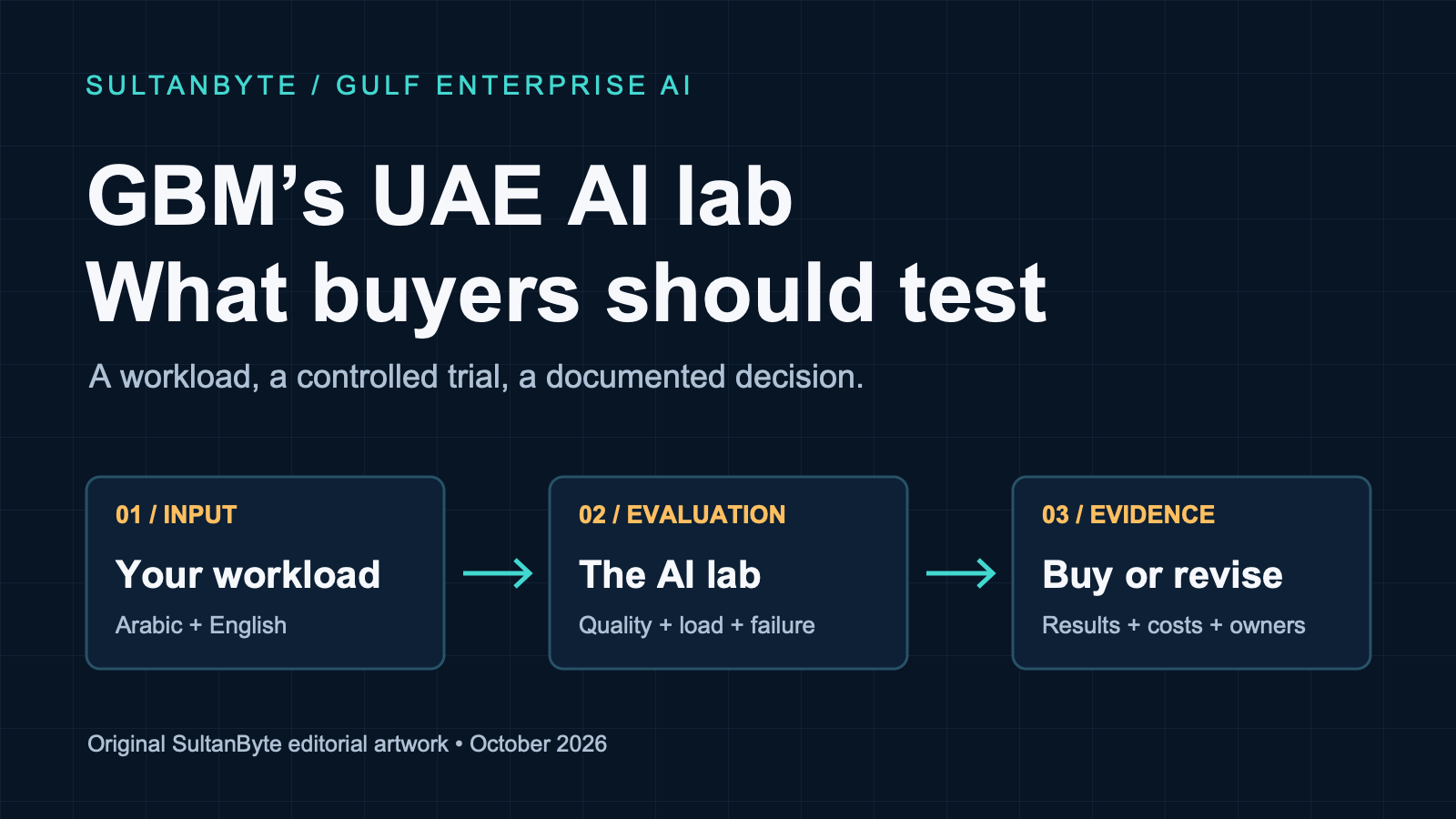
GBM has opened an AI lab in the UAE built on Cisco Secure AI Factory with NVIDIA. For Gulf technology buyers, its most useful role could be testing a real workload before committing to infrastructure. A polished demonstration alone would leave the expensive questions unanswered.
GBM's 7 October announcement says customers can test on-premises and hybrid AI use cases. It describes deployment in weeks rather than months and positions the lab around sovereignty, data residency and security. Those are supplier claims. The release provides no reproducible customer benchmark or priced configuration that would let a buyer validate the promised speed or economics.
The opportunity is to make the lab answer a narrower question: can the proposed system run your application, under your controls, at a cost your organisation can sustain?
Cover: original SultanByte editorial artwork.
What the lab adds, and what it does not establish
The launch offers a place to evaluate an integrated architecture rather than assemble a proposal entirely from component specifications. GBM describes NVIDIA AI Enterprise software alongside compute, networking and security capabilities. Its release does not identify the exact GPU configuration installed in the lab, so buyers should request that inventory rather than assume it contains every system in the wider portfolio.
Cisco's architecture overview describes several infrastructure entry points, including air-cooled servers and liquid-cooled rack-scale systems. It also describes networking, security, observability and management as parts of the stack. This is the supplier's product design, not a measurement of the UAE lab.
That distinction should shape the evaluation contract. Ask which hardware, software versions and security features the proposed test will actually use. Require the final report to list any differences between the lab and the equipment being quoted for production. A benchmark on a different configuration is useful context, but it cannot settle the purchase.
UAE and Saudi workloads need separate data decisions
Start the pilot with synthetic documents or an approved non-sensitive dataset. Before bringing customer records, identify the organisation responsible for the data, the processing purpose, retention period and every party with access. Draw the route through retrieval storage, inference, logs and remote support.
The UAE government's data-protection overview describes federal rules for personal-data processing and cross-border sharing, as well as separate instruments covering areas such as healthcare and DIFC. A UAE location does not, on its own, establish which regime applies to the workload or whether the proposed processing is permitted.
For a Saudi organisation, sending personal data to a UAE lab needs its own review. SDAIA's published regulations address transfers outside the Kingdom and obligations around processor selection. GCC geography is not a substitute for that assessment. Have the relevant privacy and sector specialists approve the test arrangement before transferring live records.
This is a procurement boundary, not a conclusion that either country prohibits the pilot. If approval is unresolved, keep the evaluation synthetic and record which questions that prevents it from answering.
Bring a workload the demonstration cannot hide behind
Choose one application with a named owner and a measurable outcome. An Arabic-English internal policy assistant is a useful example: staff ask questions, the system retrieves approved documents, and the answer must cite the right passage or decline to answer.
Prepare a held-out test set before the supplier tunes the system. Include Arabic and English questions, mixed-language requests, outdated documents and questions with no supported answer. Have domain reviewers grade correctness and citation support separately from writing quality. Record the model, tokenizer, retrieval settings and document versions so another team can repeat the run.
NIST's Generative AI Profile recommends evaluating capability claims empirically and warns against extrapolating from narrow, anecdotal assessments. Its discussion of laboratory-versus-deployment gaps is especially relevant here. A lab test should resemble the intended application closely enough to expose its limits.
Set acceptance criteria before seeing the results. For example, define which errors force human review and which unsupported answers block release. Those thresholds belong to the buyer and the use case; they should not be chosen afterwards to make the pilot pass.
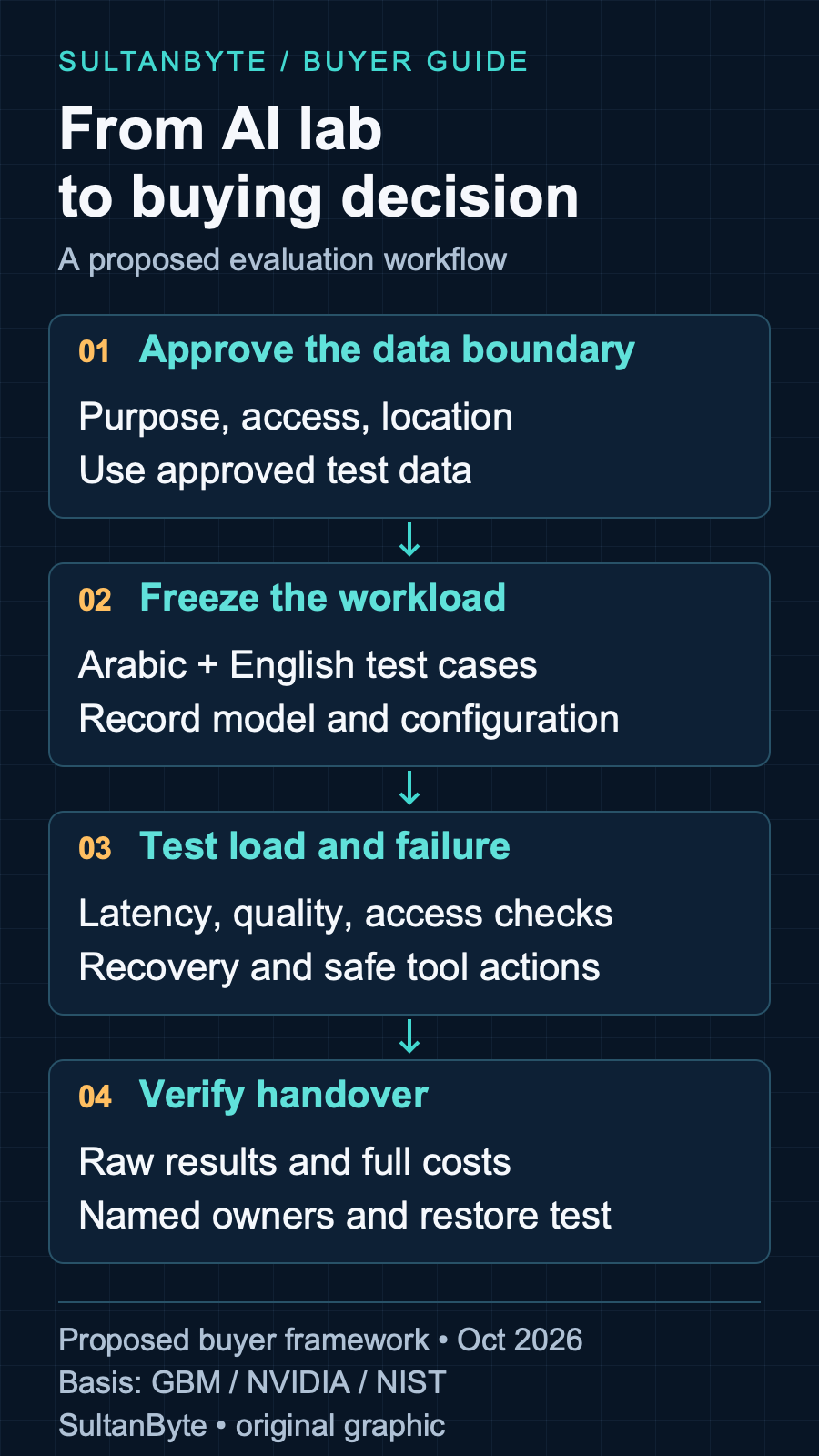
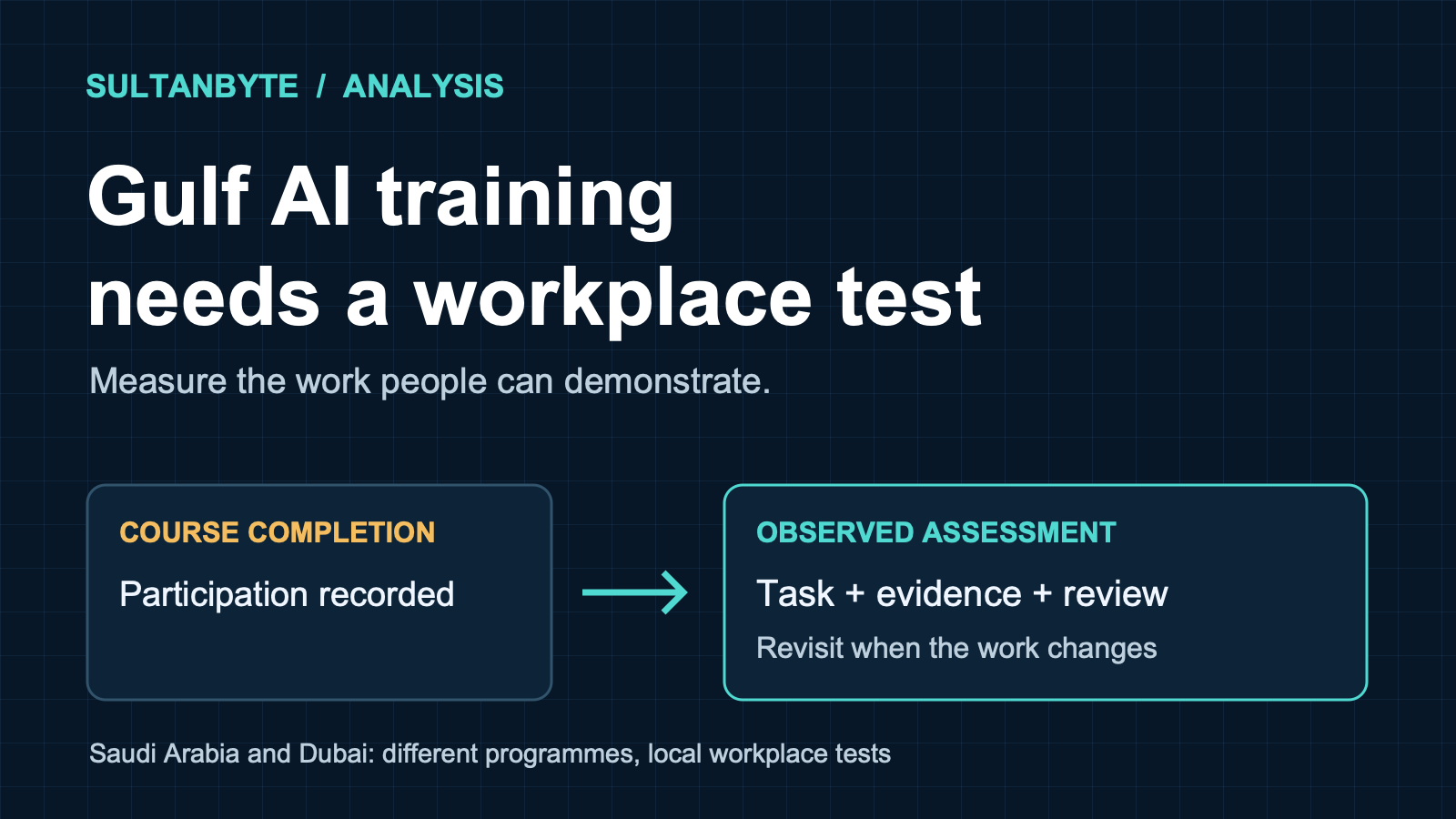
Proposed buyer workflow, not reported lab results. Basis: GBM announcement, 7 October 2026; NVIDIA GenAI-Perf documentation; NIST AI 600-1, July 2024. Graphic: SultanByte.
Measure the busy service, then interrupt it
For performance testing, NVIDIA's GenAI-Perf documentation distinguishes time to first token, inter-token latency, request latency and throughput. It supports specified inputs and load patterns. These are more useful evaluation dimensions than one headline token-rate figure.
Ask for results at the expected mix of prompt lengths and concurrent users. Keep Arabic and English workloads visible in the report instead of hiding them inside one average. Measure the complete application as well as the inference endpoint: retrieval, access checks and any human approval step belong in the user journey.
Then run controlled failure exercises in the agreed test environment. Restart a serving component, make a retrieval dependency unavailable and revoke a test user's access. Record whether requests fail clearly, whether retries duplicate actions and whether an operator can reconstruct the incident. These are proposed tests, not claims about weaknesses in GBM's lab.
Include an authorised security exercise. NIST identifies indirect prompt injection through retrieved content as a risk. Place an adversarial instruction in a test document and check whether the application follows it or attempts a prohibited tool action. A refusal message is not enough if the underlying tool call still executes; inspect the application trace.
Leave with a costed handover, not another demo booking
For procurement, request a cost sheet covering the proposed configuration, licences, support, implementation and the facilities work it requires. Compare costs against completed tasks that meet the agreed quality threshold, while keeping the workload assumptions visible. Avoid treating a low inference price as proof of low operating cost.
For the engineering team, require the test dataset manifest, configuration export, raw results and failure notes. Name the people responsible for patching, incident response and recovery. Ask the intended operators to repeat a restore or rollback without the demonstration team driving the keyboard.
The sensible next step is a bounded evaluation with written acceptance criteria. Approve a production purchase only after the target configuration, data permissions, workload results and operating responsibilities are explicit. GBM's new lab could help buyers reach that decision faster. Whether it does should be visible in the evidence customers take home.