OAuth connectors for MENA SaaS: connect and disconnect safely
Bind OAuth grants to the right workspace, control token refresh and separate local disconnect from provider revocation.
A finance administrator connects a company account to a SaaS product. The consent screen succeeds, the first import works, and the integration appears finished. The harder questions arrive later: which workspace owns the connection, what happens when the administrator leaves, and whether pressing Disconnect stops a queued worker.
For a product serving Saudi and UAE customers, those questions belong in the connector design before launch. This guide proposes a server-side architecture for delegated OAuth integrations, such as importing customer-authorized files or synchronizing business records. It does not cover machine-to-machine credentials or prescribe a particular provider's permissions.
The objective is a connection whose owner, permitted work and stopping behaviour remain understandable after the setup tab closes.
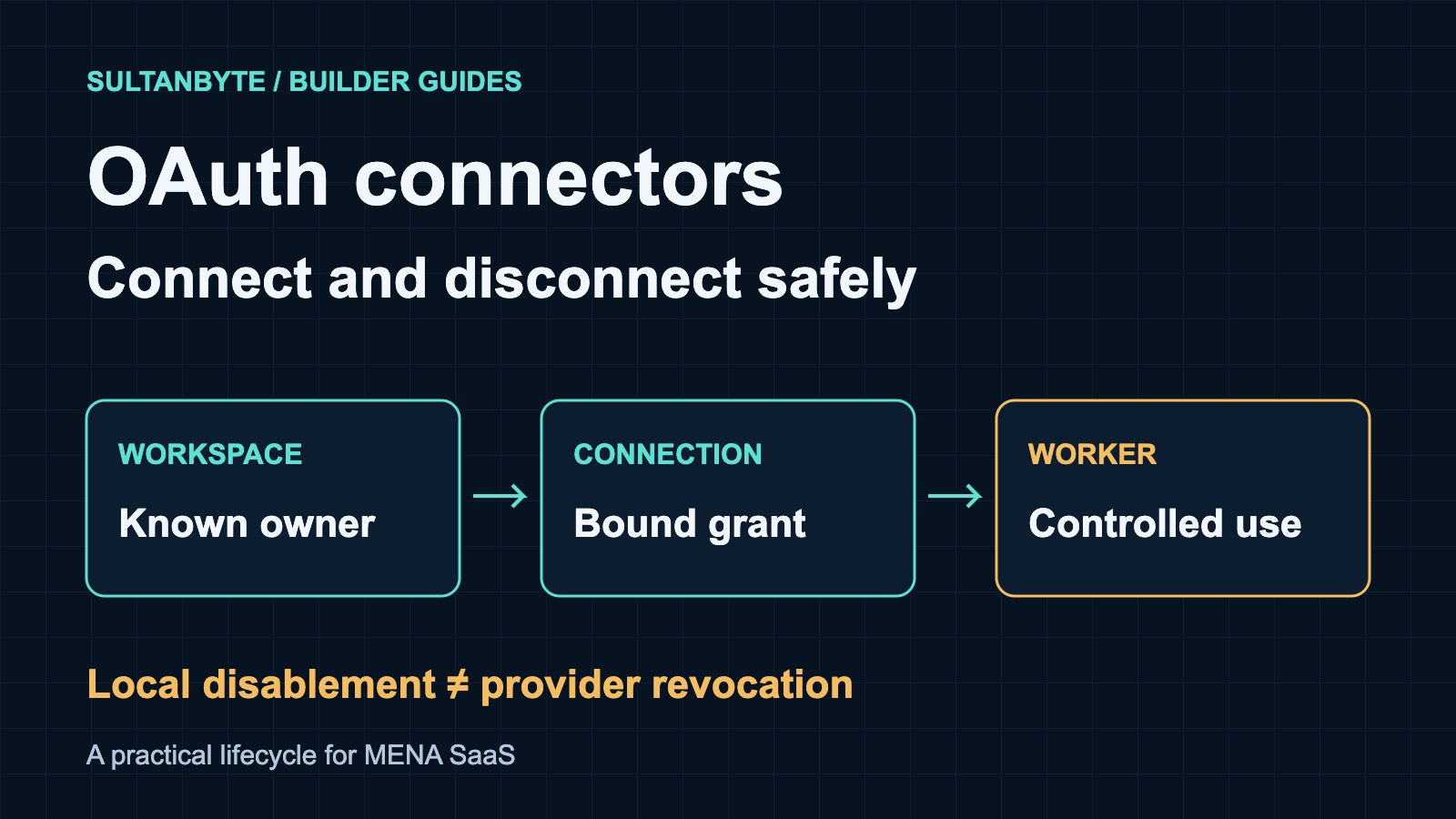
Cover: original SultanByte artwork showing a customer workspace, an OAuth connection and a separately controlled worker.
Give the connection an owner before opening consent
Keep the product's workspace, the connecting person and the external account as separate identities. A consultant may administer two customers. An external account may expose several organizations. A matching email domain is not a sufficient rule for deciding which customer receives imported records.
For the proposed design, create a pending connection inside the selected workspace before redirecting to the provider. Require the initiating user to have integration-management permission there. Record the intended provider, requested capability, initiating session and an expiry for the attempt. Do not infer ownership from whichever workspace is open when the browser returns.
Use a server-generated transaction identifier to find that record. Keep stored tokens, client secrets and customer details out of the callback URL and avoid using an unverified tenantId query parameter as an instruction to attach tokens. If the user switches workspaces during consent, show the original destination explicitly or require a new attempt.
After the callback, resolve the provider's account or organization identity through its documented mechanism. Show a confirmation such as “Connect this external organization to this workspace” before enabling background work. Use stable provider identifiers for the binding; keep names and email addresses as display information. Where several external organizations are available, make the selection explicit.
This narrows the broader tenant-isolation review to the moment an outside capability enters the product.
Bind the callback to the attempt and the provider
Use a maintained OAuth library rather than assembling the protocol from a successful demo. RFC 9700 requires PKCE for public clients and recommends it for confidential clients. Its advice applies to web applications too. Use the S256 challenge method and a fresh verifier for each attempt, with server support verified rather than assumed.
For this architecture, retain a one-use, session-bound state value as well. Store its association with the pending connection on the server. Reject an expired, reused or mismatched attempt; recheck that the actor can still manage the destination workspace before attaching the grant. These workspace checks are application policy, not something PKCE decides.
A multi-provider connector also needs a mix-up defence. RFC 9207 defines an authorization-response iss parameter and requires comparison with the expected issuer. A mismatch must stop the flow. Track whether the provider supports this mechanism; do not silently accept a missing value from a provider configured to supply it.
RFC 9700 also describes distinct redirect URIs as an alternative where issuer-based options are unavailable. Choose and test the defence for each integration. Never let a callback select an arbitrary token endpoint: the authorization endpoint, token endpoint and expected issuer must come from the trusted provider configuration associated with the attempt.
Keep the post-connection destination constrained to approved application routes. The OWASP OAuth guidance warns against open redirectors and reinforces the need to bind the authorization response to the originating interaction. A convenient returnTo parameter must not become a route for leaking credentials.
Separate consent from a working capability
A successful callback should move the connection into a checked setup state, not automatically activate every feature labelled with that provider's logo.
Google's web-server OAuth documentation describes incremental authorization and handling the permissions actually granted. For a Google connector, inspect those grants before enabling the corresponding operation. Do not treat the requested scope list as proof that the user approved everything.
Create a capability record for each supported workflow. For example, a read-only import and a write-back feature should have separate enablement decisions even if the provider represents them in one grant. Explain the additional permission when a customer activates write-back rather than requesting it for a feature they have never used.
Keep a short connection record that support staff can inspect without seeing secrets:
- Workspace ID and provider account or organization ID.
- Connection generation and lifecycle state.
- Granted capabilities and the relevant provider scopes.
- Connecting actor, accountable workspace owner and reconnect contact.
- Last successful operation, current failure category and revocation status.
Store token material behind a restricted credential reference in an encrypted secret store with audited access. Redact authorization codes and tokens from callback telemetry and support exports. In this proposed server-side design, browsers receive status and connection identifiers, not refresh tokens. Workers obtain credentials only through a component that checks the workspace, connection generation and active state.
Assign responsibility for reconnecting before the connecting employee leaves. Review that person's provider-side grant during offboarding; do not assume that changing the local workspace owner transfers an external authorization.
For a Saudi deployment and a UAE deployment, review the connector's route separately: credential store, worker location, external API, imported-data storage and operational logs. Language preference must not choose that route. This is a deployment review, not a claim that OAuth consent satisfies either country's data-transfer requirements. Any legal assessment must address the actual data and services involved; this guide is practical information, not legal advice.
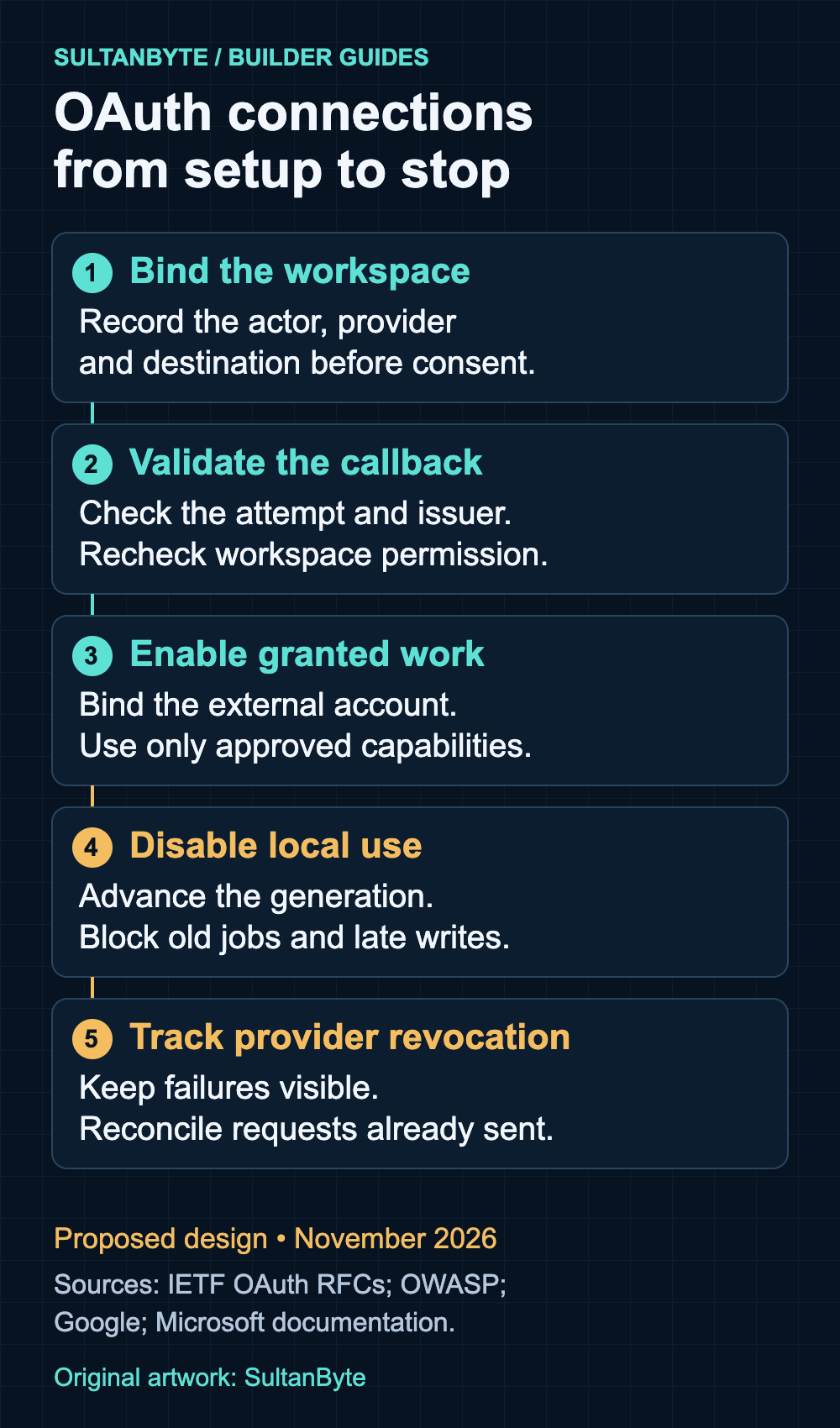
Original infographic: SultanByte. Proposed connection lifecycle informed by IETF OAuth standards, OWASP, Google and Microsoft documentation, November 2026. The sequence is design guidance, not measured performance.
Make refresh a controlled write
Treat token refresh as an update to shared connection state. A web request and two workers should not independently read the same credential and overwrite each other's result.
For this design, serialize refresh per connection or use a provider-aware library with a concurrency-safe token cache. Persist a replacement credential with an atomic conditional update that requires the connection generation to remain active and unchanged. A disconnect or reconnect must prevent a late refresh response from restoring an obsolete connection. Send any late-issued credential through the restricted revocation path rather than making it available to workers.
Provider behaviour matters. Microsoft's refresh-token documentation says that using a refresh token to obtain new tokens does not revoke the old refresh token. It instructs clients to securely delete the old token after obtaining its replacement. Receiving a new value therefore does not prove the previous value has become unusable.
The same Microsoft documentation says refresh tokens can expire or be revoked before their expected lifetime. Give the connector a reconnect_required state instead of retrying an invalid grant indefinitely. Stop dependent jobs, preserve their business-operation identifiers and tell an authorized administrator what needs attention. Do not erase pending work merely because the credential needs replacement.
For each provider, document which failures are transient, which require renewed consent and which indicate a permissions change. A generic “integration error” leaves operators unable to distinguish a temporary outage from work that cannot safely continue.
Disconnect locally before waiting on revocation
Make Disconnect an authenticated, authorized state change. First disable the local connection and advance its generation. Stop issuing credentials for it, cancel queued work where possible and reject results that belong to the old generation. Then perform the provider-specific revocation procedure.
Keep the two outcomes separate in storage and in the interface: “disabled in this workspace” and “provider revocation pending” are different facts. If revocation needs retrying, retain only the credential material required in a restricted revocation queue with an explicit retention deadline. Ordinary workers must not be able to use that queue as a fallback credential store.
RFC 7009 specifies HTTP 200 both when revocation succeeds and when the submitted token is already invalid. The response is not proof that the token was previously live. The RFC also recognizes propagation delay and provider-dependent effects on related tokens.
Do not assume revocation affects only one feature. Google's revocation guidance states that it removes the user's OAuth scopes granted to the project and invalidates issued tokens for clients registered under that project. It also warns that full effect can take time. Review that shared-grant impact before presenting Disconnect as an isolated toggle for one module.
There is a limit to what local cancellation promises. A worker may already have sent a request when disconnect commits. A generation check can stop later local writes; it cannot undo an external action already accepted by the provider. For write integrations, record the operation before dispatch and reconcile uncertain outcomes instead of blindly replaying them after reconnection.
Disconnect also needs a separate imported-data policy. Tell the customer whether previously copied records remain, become inaccessible or enter a deletion workflow. Revoking future API access is not a deletion receipt for data already stored in your product.
Review the lifecycle with deliberate failures
Use synthetic workspaces and test provider accounts. The following cases are proposed acceptance tests, not reported benchmark results:
- Start consent in workspace A, switch to B, then return. The connection must not silently attach to B.
- Replay the callback, alter its state or present an unexpected issuer. No new active connection should appear.
- Grant fewer permissions than requested. Enable only the workflows supported by the actual grant.
- Remove the initiating user's integration permission before the callback. Require a fresh authorized setup decision.
- Race two refresh attempts with Disconnect. Neither a late token nor a late worker result may reactivate the old generation.
- Make provider revocation fail temporarily. Local work must remain disabled while the revocation status stays honest.
- Disconnect after a write request leaves the worker. Reconcile the external outcome before any retry.
- Reconnect to a different external account. Old jobs must not migrate to the replacement account without a new, explicit business decision.
For a CTO, these cases define what the connector must prove before launch. For a buyer, ask the supplier to demonstrate the same lifecycle, including the failed revocation and changed-account cases. A successful first import proves only the first import.
The release decision should rest on whether the team can identify the owner of every connection, explain each enabled capability and stop local use without depending on a provider outage ending first.
About the author
- I have lead the Engineering for multiple startups in UAE. I also have my own agency qualascend.com.
Comments
Join the discussionNo comments yet. Be the first to comment.
Builder Guides
Practical architecture, engineering, security and implementation guides for teams building technology in MENA.