Zacua’s $135m fund: Dubai’s construction robotics test
DFDF backs a global fund while Dubai plans a robotic villa. Contractors need accepted work and repeat-job economics before scaling.
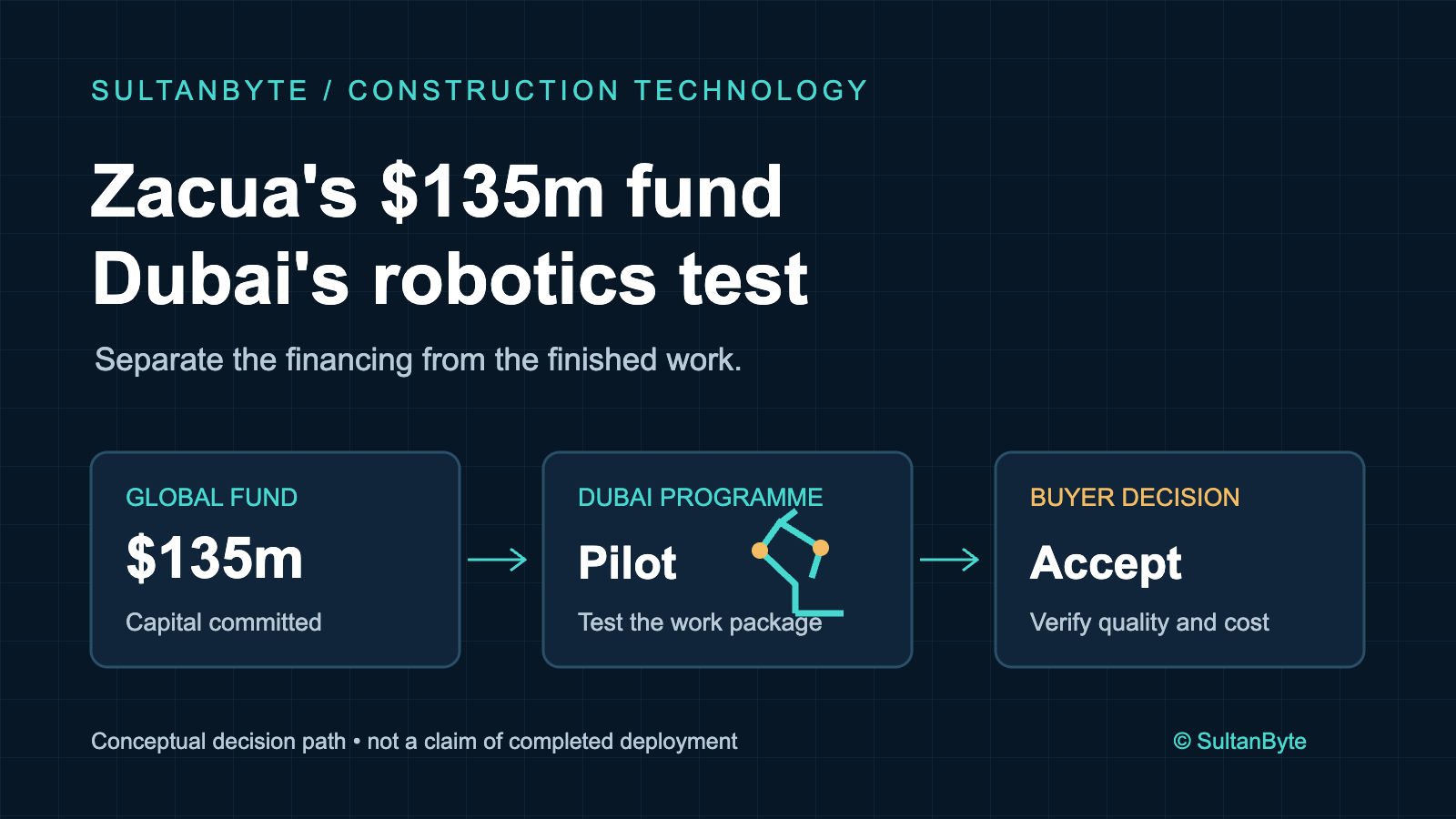
Zacua Ventures has announced a $135 million second fund, with Dubai Future District Fund among its backers. For Dubai's construction sector, the useful connection is that the same investor is already involved in the city's construction-technology programme. More capital could help suppliers reach local projects, but a fund close does not show that their equipment can finish a job reliably.
The distinction matters for developers considering robotics, contractors being asked to host pilots and founders trying to turn a demonstration into recurring revenue. Dubai has a public test programme to examine. Its published plans should be read alongside the financing announcement, not mistaken for completed construction results.
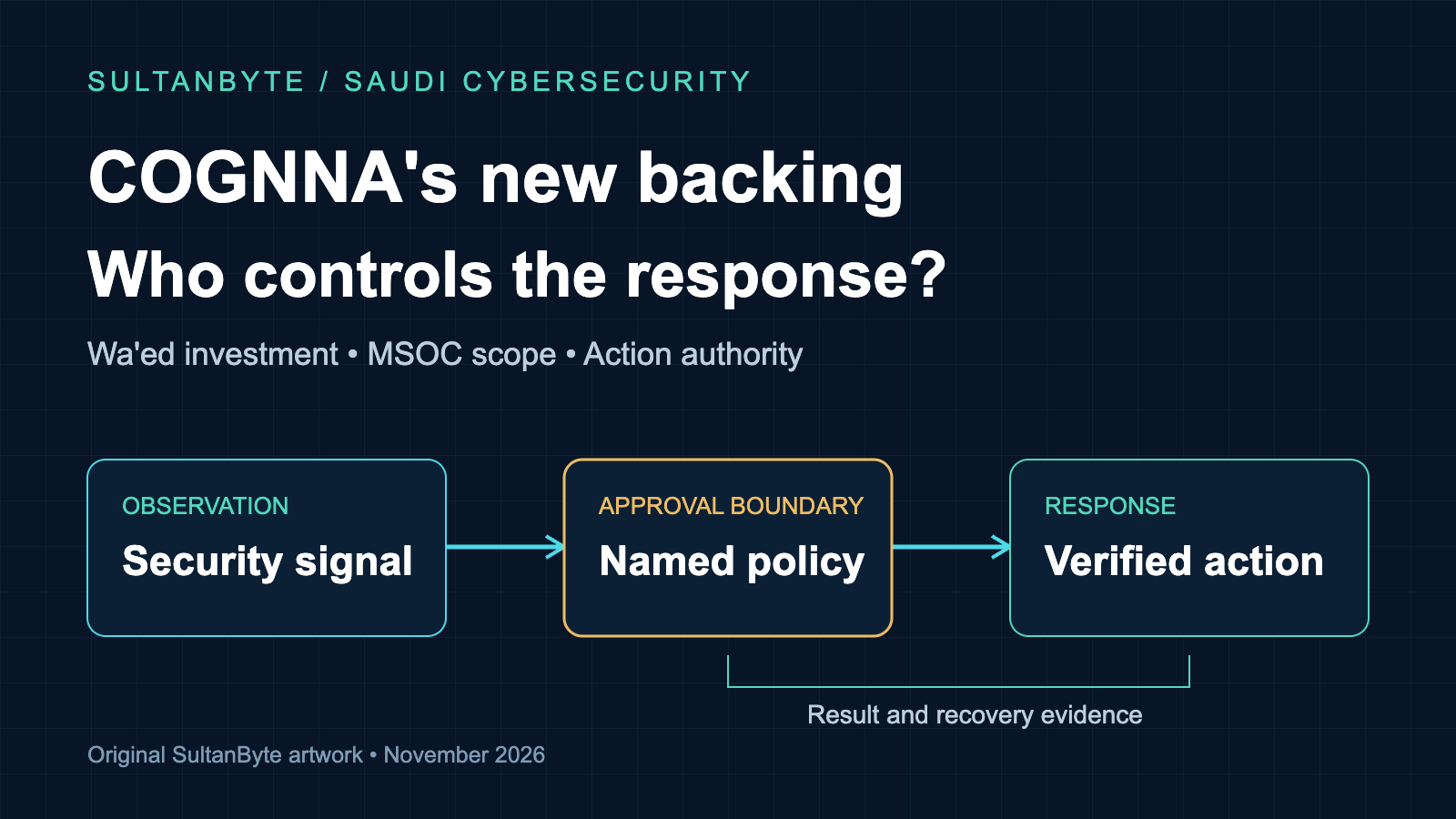
Cover: original SultanByte artwork showing the separate decisions between venture funding, a construction pilot and an accepted job.
What the new fund establishes
In its 10 November announcement, Zacua says Fund II closed at $135 million. It names Dubai Future District Fund alongside corporate investors including Volvo Group Venture Capital, Hilti Venture and Trimble Ventures. The strategy extends beyond construction into infrastructure, manufacturing, energy and mining, with an emphasis on technologies such as robotics and alternative materials.
The Next Web also reported the close on 10 November. Its coverage supports the announcement record, but the fund's portfolio-performance claims remain manager-reported. Neither article provides an audited return history or a Dubai deployment allocation.
This is a global fund total. It is not a $135 million commitment to UAE startups, a Dubai construction budget or the amount DFDF invested. The announcement does not disclose DFDF's individual commitment. Buyers should also separate the corporate investor network from commercial availability: an investor's participation does not make every portfolio product supported equipment on its projects.
Dubai's connection predates this raise
DFDF describes its strategy as investing in funds and startups across sectors aligned with Dubai's economic agenda. Its fund-of-funds work includes regional and international managers. Zacua appears in its portfolio, although that listing does not disclose the investment amount or terms.
There is also a project-side relationship. In its January robotic-villa announcement, Dubai Municipality named Zacua and Würth as partners. It described a consortium of technology companies and academic institutions, and separate cooperation agreements with Zacua, DFDF and LAB Ventures intended to improve startup access to projects and investment.
That gives the new fund a concrete local connection rather than a generic Gulf expansion narrative. Capital providers, construction firms and the municipality have publicly described ways to bring technology into a testing environment. Whether that arrangement produces repeat purchases is a different question.
The evidence is Dubai-specific. It does not establish UAE-wide procurement approval, and it says nothing about a supplier's permission or support capability on a Saudi project. A regional contractor should maintain a separate deployment decision for each jurisdiction and site rather than carry a Dubai demonstration over as an approval.
The villa is still described as a test programme
Dubai Municipality's 20 October WETEX update describes plans for the robotic villa. It sets out an eight-month innovation challenge followed by two months for documenting and evaluating results. The site is presented as a living laboratory for testing construction robotics under practical conditions.
That wording is important. It describes planned implementation and evaluation, not a completed villa with independently measured productivity. Nor should the municipality's "world's first" framing be treated as an independently established ranking.
The DXB Contech programme page supplies more specific project information, including an Al Barsha First location and a Q2–Q4 2026 timeline. It also invites technology-provider participation. That timeline and October's duration-based description do not establish a verified completion date. A buyer should request the current work-package schedule and results, rather than assume a calendar label proves the project has finished.
The useful next publication would be a task-level account: what the robot did, what people still did, which conditions stopped it and whether the resulting work passed inspection. An attractive finished building would not answer all of those questions.
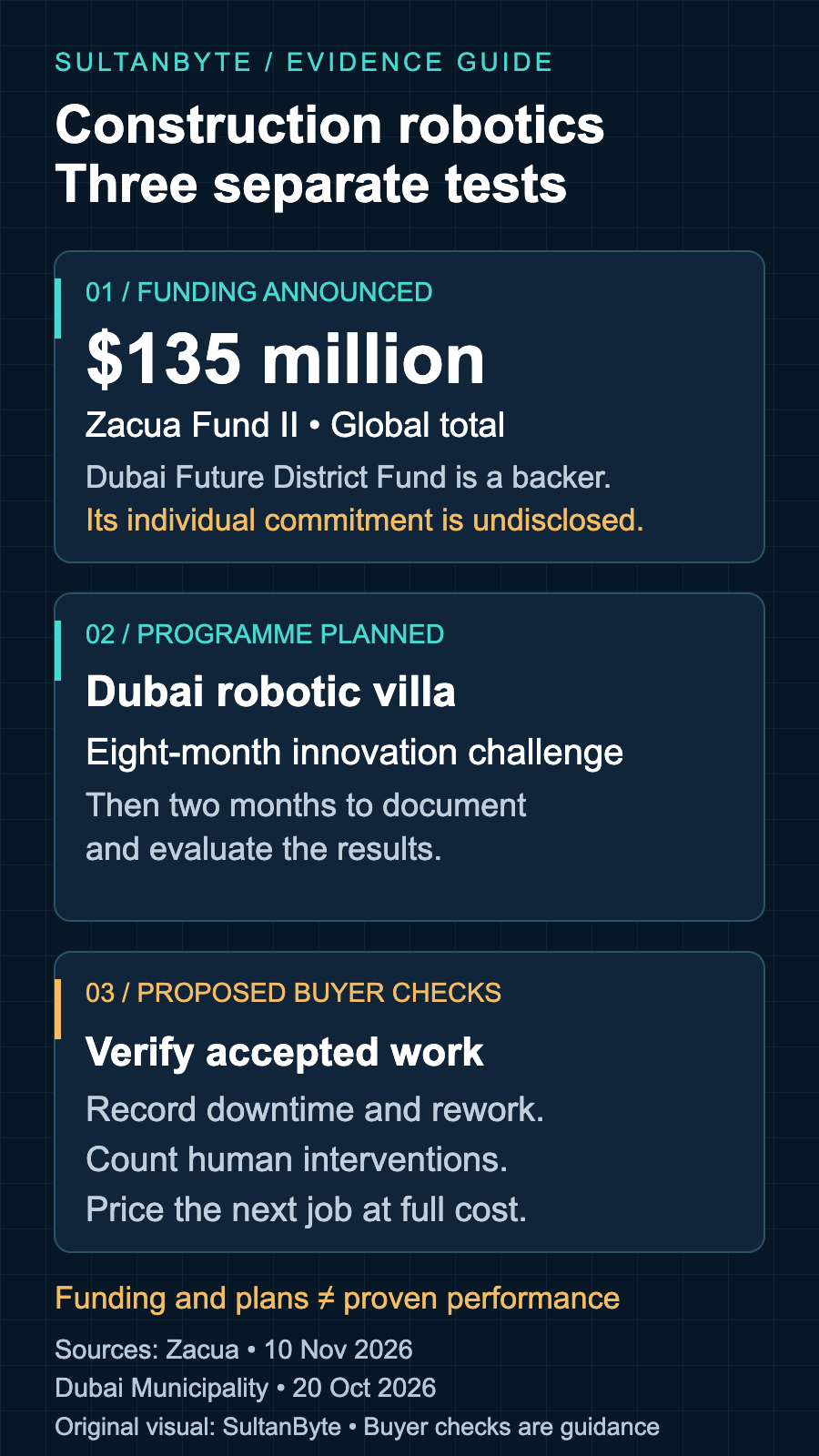
Original infographic: SultanByte. Funding announcement: Zacua, 10 November 2026. Programme status: Dubai Municipality, 20 October 2026. Buyer checks are proposed acceptance criteria, not reported results.
Buy an accepted work package, not a robot-hour
For a contractor, a useful pilot starts with a bounded task. Specify the work area, required finish, permitted operating conditions and inspection method before discussing headline speed. Identify who prepares the area and who corrects rejected work.
Compare the proposed system with the process it would replace on a comparable work package. Count mobilisation, setup and calibration, then include operator attention and downtime. Record manual completion and rework separately. A machine's active operating time is not the same as the elapsed time needed to hand an accepted area to the next trade.
Agree who can stop the trial and what happens after an interruption. The supplier should explain its operating limits and recovery procedure; the project's responsible safety and engineering teams should decide what is acceptable. This is a procurement framework, not a substitute for a site-specific safety assessment or equipment approval.
Keep the evidence exportable. Ask for task logs, inspection outcomes and a record of interventions in a form the contractor can review after the supplier leaves. If the pilot depends on remote support or an external service, document that dependency and its failure behaviour. A local demonstration team can conceal support costs that appear only on the second project.
Founders need a route beyond the showcase
For a startup, the corporate network can be useful precisely because construction purchasing involves more people than the person who enjoyed the demonstration. Ask which party owns the trial, which budget pays for it and who can approve a subsequent order.
Settle the commercial boundary early. State who supplies site preparation, consumables and operators, who owns the resulting data and how changes to the task are priced. A subsidised trial can produce useful engineering evidence without proving that an ordinary customer will pay the full delivery cost.
Investors should ask the same question in financial terms. Distinguish a paid pilot from a repeat order, and identify how much supplier engineering effort accompanies each deployment. Do not infer scalable revenue from access to a consortium or inclusion in a government-backed programme.
Zacua's new fund expands the financing available to its global strategy. Dubai's existing programme offers a place to test some of the underlying ideas. The decision to scale should come after a contractor can show accepted work, explain the interventions and price the next job without relying on the demonstration team staying indefinitely.
About the author
- I have lead the Engineering for multiple startups in UAE. I also have my own agency qualascend.com.
Comments
Join the discussionNo comments yet. Be the first to comment.