Saudi Arabia's Data Centre Boom Has a $42bn Bankability Test
Saudi Arabia can fund a much larger data-centre market, but announcements must still become contracted, powered and financeable projects.

Saudi Arabia has no shortage of data-centre announcements. The harder test is turning planned megawatts into contracted, powered facilities that lenders will finance.
A new Alvarez & Marsal analysis, published on 6 August, puts numbers around that gap. Its forecast base case requires \(7-9 billion of project capital by 2030. A more ambitious scenario, in which 2.5-3 gigawatts of the announced pipeline is energised, raises the estimate to \)28-42 billion. The upper figure is not a government budget, committed spend or forecast of completed projects. It is a scenario based on global construction-cost benchmarks.
That distinction matters to cloud buyers, investors and operators. Capacity announced on a stage cannot host a workload. Capacity with land but no grid connection cannot earn revenue. Even a completed shell is difficult to finance without customers willing to sign long contracts.
Two build-out paths, not one forecast
A&M estimates that Saudi Arabia has roughly 410 MW of installed IT load across about 40 operating facilities. It forecasts approximately 1 GW by 2030. On a benchmark of \(11-14 million per MW for the shell, core, mechanical and electrical plant before IT hardware, the firm estimates \)7-9 billion of project capital and $3.5-7 billion of debt for its base case.
The arithmetic should be read as approximate. A&M describes the increase from roughly 410 MW to approximately 1 GW as around 620 MW, while the rounded endpoints imply 590 MW. That does not invalidate the range, but it is a useful warning against treating imprecise market estimates as engineering quantities.
The ambitious case assumes 2.5-3 GW is energised by 2030, described as roughly half the publicly announced pipeline. A&M estimates \(28-42 billion of project capital and \)14-32 billion of debt. In an interview with AGBI, Kurt Davis Jr, the firm's regional head of debt and capital advisory, said the funding could come from Saudi banks, sukuk, international lenders and private credit. His argument is that capital is available, but only for projects with bankable contracts and credible delivery plans.

Visual: SultanByte. Estimates and reporting period: Alvarez & Marsal, 6 August 2026. Capacity means IT load. The $42bn figure is an upper scenario, not committed spend.
Big announcements sit at different stages
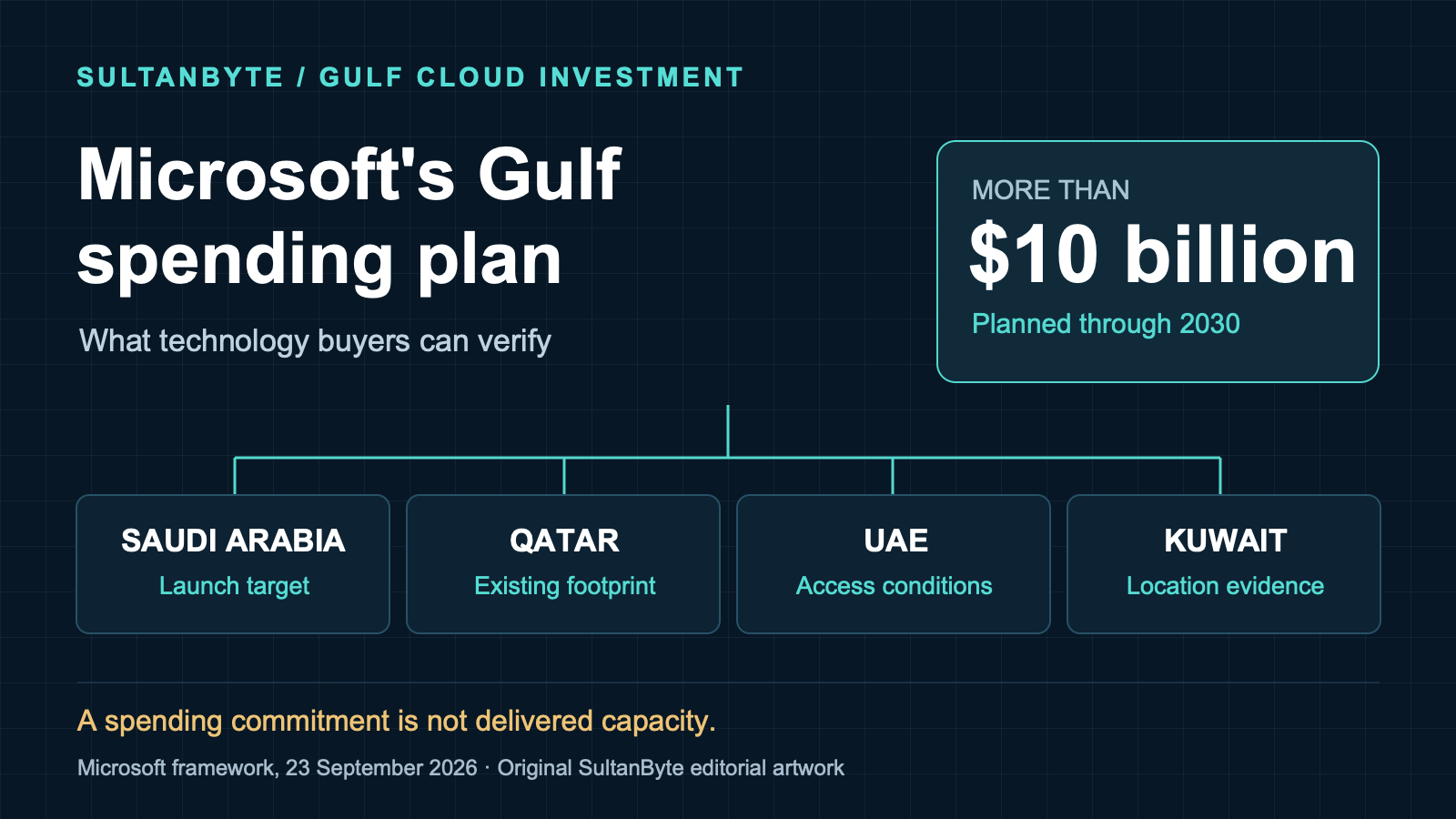
The pipeline combines projects that should not be added as if they were equivalent. DataVolt's agreement with NEOM covers a phased 1.5 GW campus at Oxagon. The company says an initial $5 billion first phase is expected to operate in 2028. Reuters reported the same headline terms in February 2025, while noting that Saudi Arabia had reprioritised parts of its wider project portfolio as costs rose. For now, the 1.5 GW remains planned capacity, not an operating asset.
AWS announced in 2024 that it would invest more than $5.3 billion in a Saudi cloud region with three Availability Zones. Its original announcement said the region would launch in 2026. As of 15 August, AWS's live infrastructure page still lists Saudi Arabia among future regions and gives no public launch date. Buyers should therefore plan around current availability, not the announcement year.
HUMAIN, the Public Investment Fund's national AI company, adds another type of pipeline. PIF describes its scope as data centres, cloud infrastructure, models and applications. A January agreement with the National Infrastructure Fund set out non-binding financing terms of up to $1.2 billion for up to 250 MW. The words "non-binding" and "up to" are doing real work. This is evidence of a financing route, not proof that 250 MW is funded and under construction.
The UAE comparison shows demand, not destiny
A&M estimates Saudi installed capacity at about 12 watts per person, compared with roughly 50 watts in the UAE. That supports the case for more Saudi capacity, but it does not prove that every announced site will find an anchor customer.
The UAE entered the current cycle with a denser base of colocation, cloud and connectivity infrastructure. Saudi Arabia has a larger population, major public-sector demand and stronger pressure for in-country processing. Those conditions can support growth, but they also make delivery dependent on procurement timing, data-location rules, utility connections and the availability of specialist operators. Our earlier GCC cloud-region comparison explains why a provider's local presence and service catalogue still need to be checked workload by workload.
What lenders will test first
A&M's financing sequence starts with the customer contract. Davis told AGBI that an investment-grade or sovereign-linked customer taking 60-80% of a facility's capacity can change the leverage, tenor and price available. A forecast showing rapid AI adoption is not a substitute for contracted revenue.
Construction comes next. Grid energisation is the critical milestone because revenue cannot start without power. Lenders will also examine fixed-price construction terms, delay protections, certification and whether electrical and cooling equipment can be installed in phases as customers commit.
Only then does the capital stack become the main question. A project may use construction debt, convert to term financing after completion and later refinance through sukuk or institutional capital. The structure depends on who carries completion risk and how long the customer contracts run.
What technology buyers and operators should do
CTOs comparing Saudi hosting options should ask providers for the facility's current operating status, not its final campus ambition. Confirm the live MW available to your hall, the utility connection, redundancy design, carrier routes, cloud on-ramps and the services available in-country. A future region or campus may belong in a migration roadmap, but it should not be presented to a regulator or board as live.
Operators seeking project finance need an anchor customer before they optimise the debt package. Contracted capacity, pass-through power terms, termination protection and a credible energisation date will matter more to lenders than the size of the national AI market.
For investors, the useful unit is not announced gigawatts. It is contracted megawatts with power, delivery risk allocated and a path to stable cash flow. Saudi Arabia can probably fund far more data-centre capacity than it operates today. Which projects reach 2030 will be decided contract by contract, not press release by press release.
Cover visual: original artwork by SultanByte.