Password reset links for MENA SaaS: a recovery contract
Design Arabic-English password recovery with scoped links, single-use redemption, explicit session invalidation and a tested MFA boundary.
A password-reset email arrives twice. The employee opens the first message on a phone, the second on a laptop, and submits different passwords in both tabs. Meanwhile, an old browser session is still signed in. Which credential wins, and which sessions remain usable?
For a MENA SaaS product with Arabic and English users, that is a release question, not an unusual support case. A reset flow must name the account it changes, limit what the link authorizes and define what happens to existing access. Translating the email is only part of the work.
This guide proposes a recovery contract for application-managed passwords. Enterprise federation, lost MFA devices and suspected account takeover need separate policies. The examples use Saudi and UAE customer workspaces to make those boundaries concrete; they do not prescribe a country-specific identity or hosting requirement.
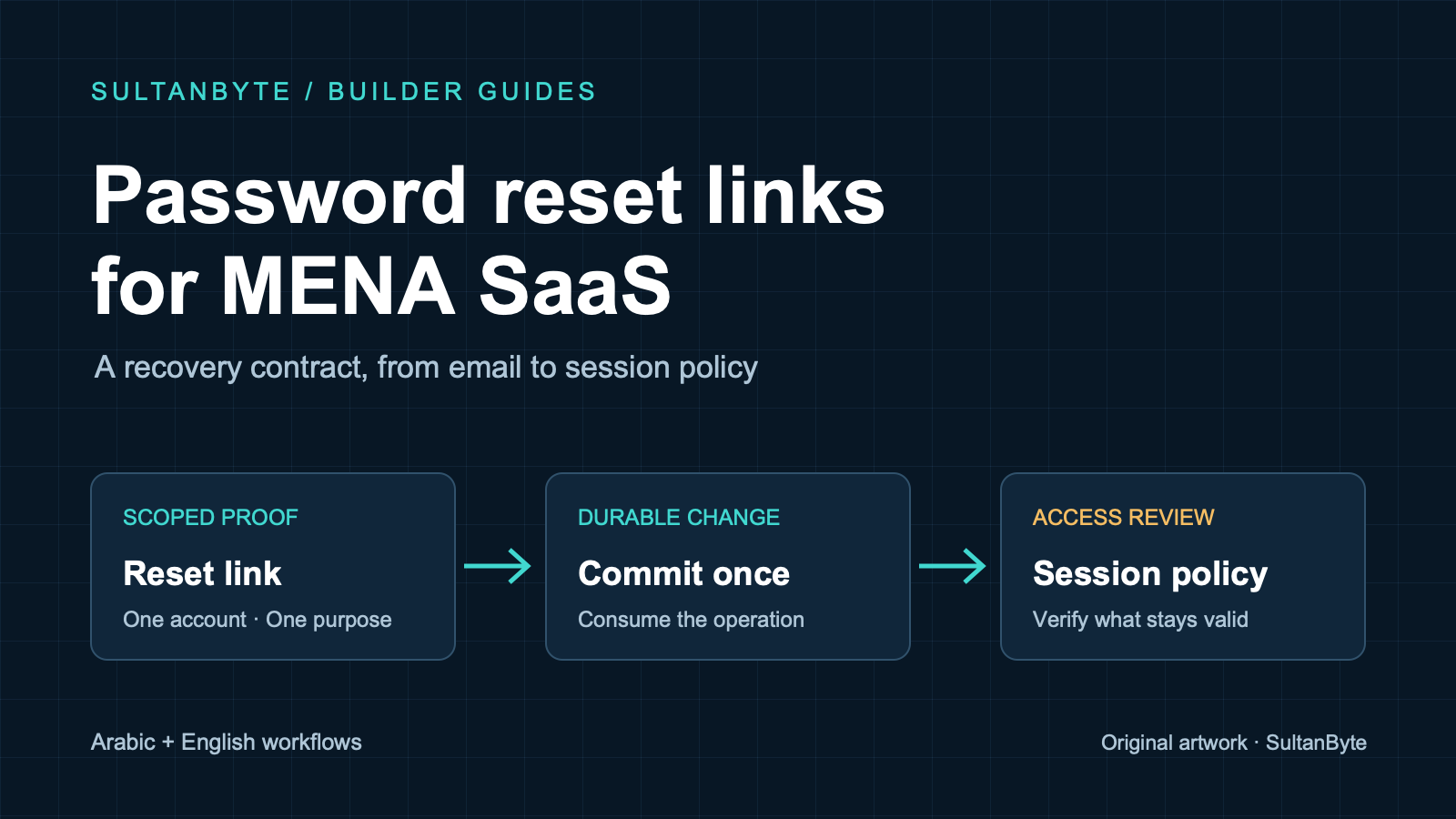
Cover: original SultanByte artwork showing a reset link, a credential update and a separate session boundary.
Identify who owns the password
Start with the authentication authority. In Auth0's documented model, database connections support its password-reset methods; social and enterprise users reset with their identity provider. A product should not create a local password as an accidental escape route around a customer's enterprise login.
Keep the recovery target attached to a stable account ID. Suppose a consultant belongs to a Saudi customer workspace and a UAE customer workspace. Resetting the consultant's application password must not restore a removed membership, change the selected organisation or transfer workspace ownership. Those remain authorization decisions after sign-in.
Record the distinction in the support interface: password authority, account identifier, recovery method and affected sessions. A support agent should be able to explain where the reset happens without receiving the link or choosing a password for the customer.
There is also a difference between replacing a password and recovering an account. NIST SP 800-63B-4 treats replacement of a forgotten password by someone who can authenticate with other bound authenticators as authenticator binding. Its account-recovery requirements depend on assurance level and available evidence. An email link alone should not be described as satisfying every recovery requirement. NIST is a technical reference here, not a statement of Saudi or UAE law.
A request must not disclose or disable the account
OWASP's password-reset guidance recommends consistent responses for known and unknown accounts, comparable response timing, abuse controls, and no account changes before valid reset evidence is presented. In particular, an attacker should not be able to lock someone out simply by submitting their email address.
A suitable public message is: "If this account can use email recovery, we will send instructions." Keep its Arabic equivalent equally noncommittal. Do not follow that response with a status endpoint that reveals whether an account exists or which identity provider it uses.
Uniform wording is insufficient when one branch sends email synchronously and another returns immediately. Django 5.2's authentication documentation explicitly warns about this timing difference. Its reset view also excludes inactive accounts and accounts with unusable passwords while presenting the same completion page.
For the proposed implementation, queue delivery outside the public request path and test the response distributions for both branches. Queuing is an architectural choice, not proof of indistinguishable timing. Apply abuse controls to the request and redemption routes, including controls against repeated mail to one destination. Do not rely exclusively on a source IP: the acceptance suite should include multiple legitimate users behind the same test gateway.
Bind the link to one narrow operation
Use a maintained identity service or framework where possible. OWASP calls for securely generated, sufficiently strong, securely stored, expiring, single-use reset tokens. It also recommends trusted reset origins rather than constructing links from an unvalidated Host header, HTTPS, and a no-referrer policy on the reset page.
For an application-owned implementation, maintain an operation record containing a stable account ID, token digest, purpose, expiry, credential version and state. These are proposed design fields, not a universal provider schema. The redeemable token belongs in the delivery channel, not in application logs, analytics events or support tickets.
Construct the reset destination from controlled configuration. A customer's vanity domain, an arbitrary return URL or a selected interface language must not decide where the secret is sent. If deployments have separate identity authorities, bind the operation to the correct authority; do not search every deployment for a matching email address.
Choose resend semantics explicitly. Auth0 documents that only the latest reset email's link remains valid. Do not assume your framework has the same rule. For the design in this article, a newly issued operation supersedes earlier pending operations for that account. Explain that choice in both languages, since mail can arrive out of order.
Keep the landing page free of unnecessary third-party scripts and redact reset URLs across the reverse proxy, application and error-reporting pipeline. Loading the link should display the password form, not change the password or mark the operation completed. Test this against the link-checking tools used by pilot customers rather than assuming that every visit represents human intent.
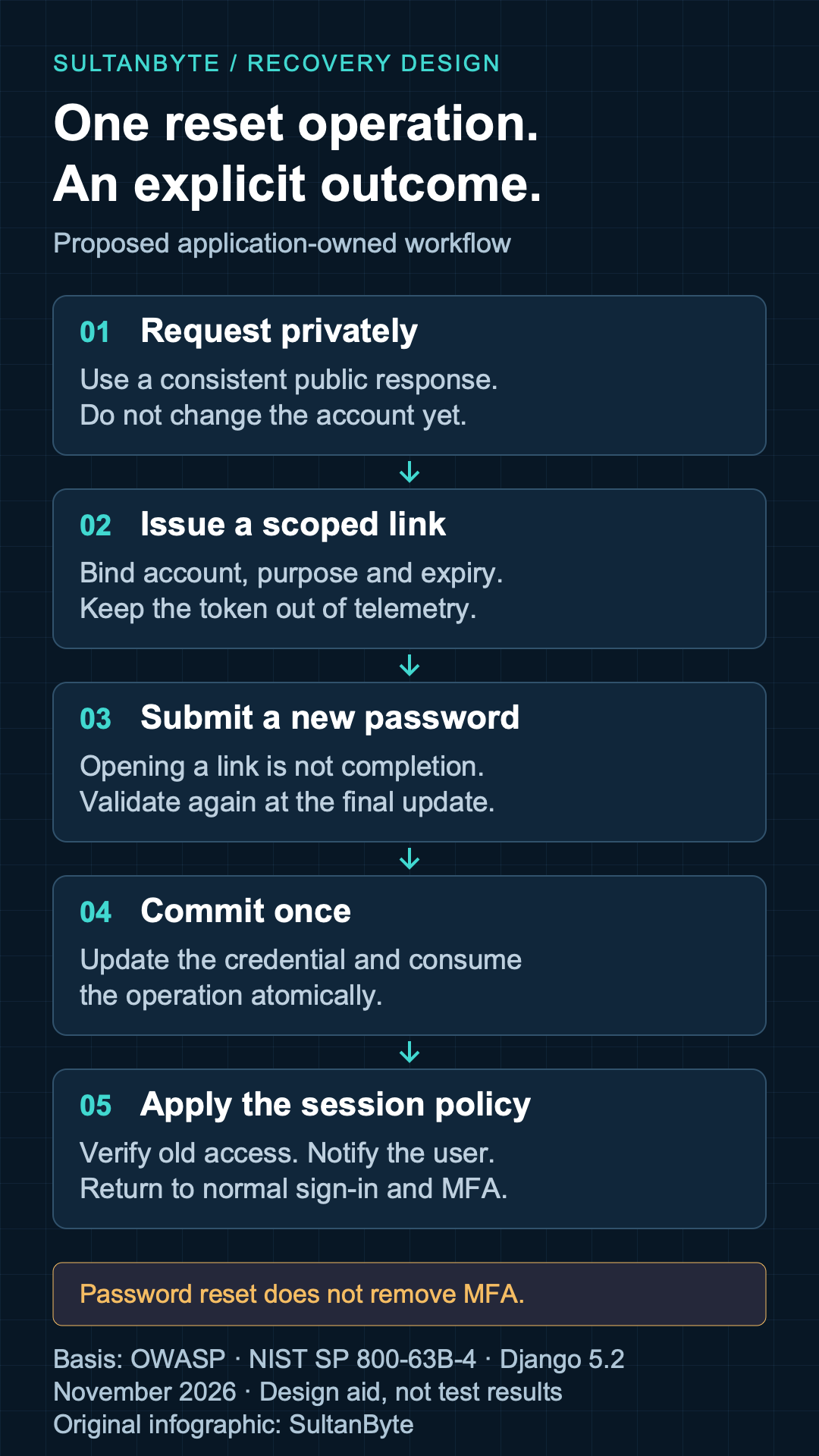
Original infographic: SultanByte. Proposed implementation framework informed by OWASP, NIST SP 800-63B-4 and Django 5.2 documentation, November 2026. It is a design aid, not a measured security result.
Make redemption and session policy agree
The critical moment is the server's final password update. In the proposed application-owned design, validate the new password using the same policy as other password-setting paths. Then atomically verify that the operation is pending and unexpired, check its credential version, write the password through the established password-hashing mechanism and consume the operation. Concurrent submissions must share that concurrency control.
A token check performed before an unrelated database update is not enough to demonstrate single use. Two workers may both pass the earlier check. Require one committed outcome, and verify which password actually works afterward. A second submission should receive a safe expired-or-used explanation rather than silently replacing the first result.
When a provider owns the credential, your local database cannot make its remote update atomic. Use the provider's reset contract and treat a timeout as an uncertain outcome. Direct the user to normal sign-in or a fresh recovery attempt instead of claiming that the password stayed unchanged.
Define what reset completion does to existing access. Django documents session invalidation through a session authentication hash that is checked on requests; its ordinary password-change views can preserve the initiating session. That mechanism does not establish the behavior of an application's separate API tokens or custom session service. Inventory those separately.
For this guide's email-reset flow, choose invalidation of existing application sessions, followed by normal sign-in and any required MFA. Verify that choice against each client and token type. Do not remove MFA merely because the password changed. Auth0 documents session expiry after reset, but integrations still need to establish what happens to their own application cookies and issued API credentials.
OWASP advises notification after a password reset and ordinary login rather than automatic login. Make the notification useful: identify the event and provide a safe way to report an unexpected change, without including the password or a reusable reset credential.
Make Arabic recovery usable at the failure edges
The reset email, landing page, validation errors and final sign-in screen should all follow the user's supported language choice. Keep that choice separate from the operation's identity. Switching from Arabic to English must not issue a fresh token, alter the account target or restart the expiry clock.
Auth0's documentation warns that reset-email language does not automatically follow the language selected in the application; configuration and email templates matter. Test actual messages from the configured tenant instead of relying on a translated preview in your frontend.
For Arabic instructions, isolate dynamic email addresses and organisation names from surrounding text. W3C's inline bidirectional-text guidance describes direction markup and isolation for this purpose. Preserve the stored identifier; visual direction is not an instruction to rewrite it. Show account details only after the appropriate proof, not on the public request response.
Allow password-manager entry and paste. W3C's explanation of accessible authentication identifies these mechanisms as ways to reduce memory and transcription demands. Apply that usability principle to the new-password form as well as login. Provide labelled fields, keyboard-operable controls and an optional password-visibility control; test them with assistive technology rather than treating a visual screenshot as an accessibility audit.
An expired link should offer a clear route to request another message. A completed reset should say that the password changed and explain the next sign-in step. Avoid a generic "Something went wrong" for every state, while keeping account-existence details private.
Release with a recovery test record
Use synthetic accounts in the deployed non-production stack. The following is a proposed acceptance pack, not a benchmark or a claim that these controls have already passed in your product:
- Submit known and unknown addresses. Compare visible responses and timing, then verify that neither request changes the account or active sessions.
- Request two links and open the messages in reverse delivery order. Check the documented resend policy and the text shown for the superseded link.
- Submit one operation concurrently with different passwords. Require one durable update and one consumed operation; verify the resulting credential through normal login.
- Replay a used or expired link. Require no password change and no new authenticated session.
- Complete a reset while another browser, mobile client and API token are active. Check each against the approved invalidation policy rather than inferring success from one logged-out tab.
- Exercise enterprise-only and MFA-enabled accounts. Confirm that password recovery does not introduce a local-login bypass or disable the second factor.
- Repeat the journey in Arabic and English on a narrow screen, using keyboard navigation and a password manager. Include delayed mail, a scanner visit and a lost final response.
Record the expected result, actual credential state, session behavior and owner for each case. Keep synthetic token values out of the report. Product and support teams should agree on the explanations for expired, superseded and completed operations before launch.
If a customer reports an unauthorized reset, move to a compromise-recovery procedure. Review authenticators and recovery destinations, revoke affected access and use independently established evidence. A second password change alone cannot demonstrate that the attacker has lost every route back in. SultanByte's passkey recovery guide covers that broader problem.
The release decision is specific: demonstrate who can change the password, which operation commits, and what access survives. Until those outcomes are tested, a successfully delivered reset email proves only that the message arrived.
About the author
- I have lead the Engineering for multiple startups in UAE. I also have my own agency qualascend.com.
Comments
Join the discussionNo comments yet. Be the first to comment.
Builder Guides
Practical architecture, engineering, security and implementation guides for teams building technology in MENA.