Live updates for MENA dashboards: SSE recovery
Design snapshot cursors, replay, permission changes and honest freshness states for Arabic-English operations portals.
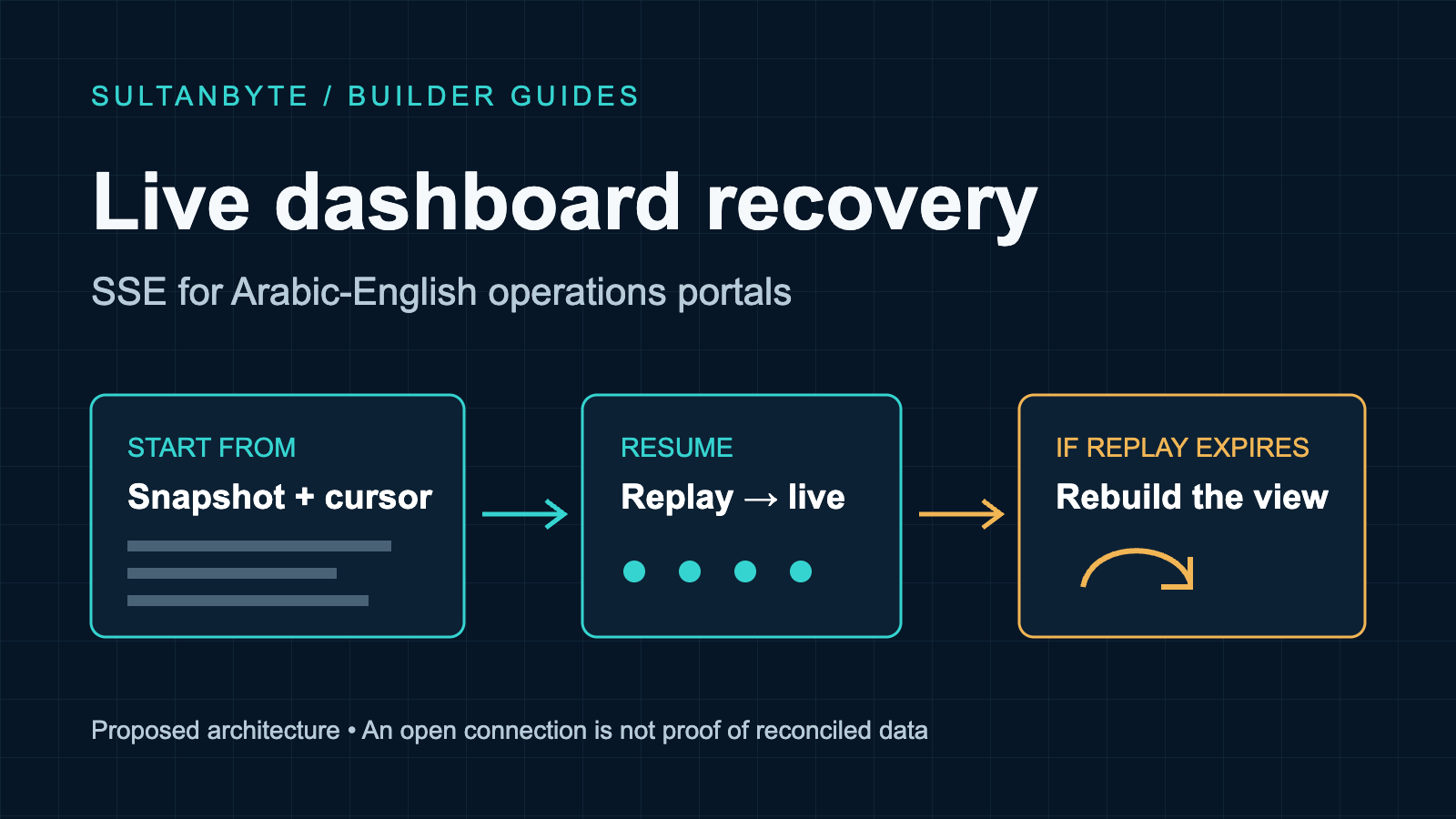
A dispatch dashboard loses its connection while a supervisor is reviewing a job. When the connection returns, a green indicator appears, but the queue still contains an assignment that has moved to another team. The socket recovered; the screen did not.
For Arabic-English operations portals serving Saudi and UAE customers, live updates need an explicit recovery design. This guide proposes one for server-sent events (SSE): load an authoritative snapshot, resume from a defined position, and rebuild the view when the server can no longer fill the gap. It is an architecture proposal, not a performance benchmark or a claim about either country's hosting requirements.
Cover: original SultanByte artwork showing a dashboard recovering through a snapshot and an event stream.
Choose what the stream is responsible for
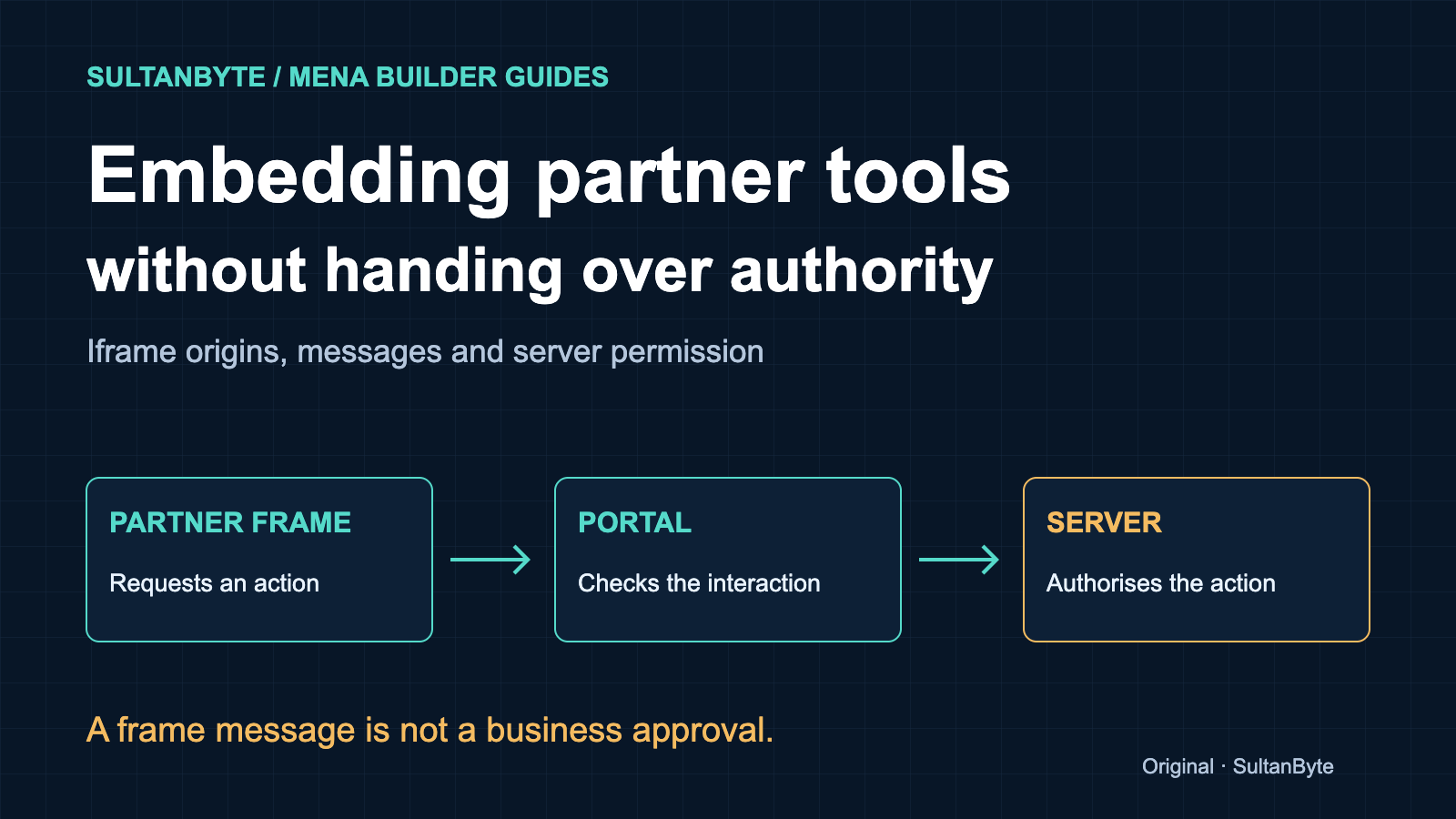
Use SSE here for a mostly server-to-browser work queue. Keep commands such as assigning or approving a job on ordinary authenticated request endpoints. The stream informs the screen; it does not grant permission to perform those commands.
The HTML Standard defines EventSource and the UTF-8 text/event-stream format. It defines reconnection and the Last-Event-ID header, but does not supply an application event store or acknowledgement of completed business work.
Before implementing it, decide how fresh the queue needs to be. If a manual refresh or periodic fetch meets that requirement, start there. Reserve the persistent stream for a product need worth operating: prompt assignment updates, for example, rather than movement added to make the dashboard feel busy.
This is a different job from web push notifications. The proposed stream updates an open work screen. It is not the mechanism this design uses to bring someone back to the application.
Close the gap between snapshot and subscription
For this architecture, make the initial snapshot and its cursor a single consistency contract. The server returns the authorised queue at a consistent position in the same ordered history used by the stream. Snapshot state corresponds to cursor C; replay delivers subsequent relevant changes. Joining the live tail must not introduce a second subscription gap.
Do not fetch the queue, wait, and then start listening only for future changes. That leaves an interval in which a committed update can disappear from the user's view. Nor should the snapshot endpoint invent a cursor by reading an unrelated counter after it has finished reading the rows.
The implementation depends on the database and change-log design. Choose a transactional snapshot, a compatible change-data-capture boundary, or another method whose consistency you can demonstrate. Document how a committed state change becomes available to the event reader, including what happens if that publication step is interrupted.
Use a stable ordering scope, such as a tenant's dispatch feed. An opaque cursor should identify that scope and its generation, with server-side validation. Do not assume that subtracting consecutive cursor values tells the client how many events are missing; filtered feeds and opaque positions need their own rules.
For the first connection, this design passes the snapshot cursor through a documented after parameter. It is a resume hint, not a credential. Subsequent automatic reconnections can use Last-Event-ID; define which input wins if both arrive, and reject inconsistent scope or generation rather than guessing. A page reload or a newly created EventSource starts a fresh application bootstrap.
Give replay an expiry path
A retained event history needs a retention policy. For this proposed queue, the server accepts a cursor only if it can supply the complete required interval and still authorises the caller to receive it. If the cursor is too old, invalid or belongs to another feed, the server directs the client to rebuild from a new snapshot.
Use a named application event such as reset-required for that instruction. It is a convention in this design, not a standard SSE event. The client closes the old source, marks the view as refreshing and runs the snapshot flow again. It must not quietly skip to the newest event and label an incomplete queue current.
Separate transport progress from application progress. The browser's last-event position is not a receipt that your asynchronous handler successfully updated its state. Serialize state application or provide equivalent ordering safeguards. If parsing or applying an event fails, close the source, invalidate the view generation and resynchronise, rejecting outstanding handlers from the old view.
Make repeated delivery harmless. For this design, use versioned replacements for changed records rather than instructions such as “increment the job count.” Ignore an already-applied record version, and represent removals explicitly. After a full rebuild, replace the view as a unit instead of mixing old rows with a new snapshot.
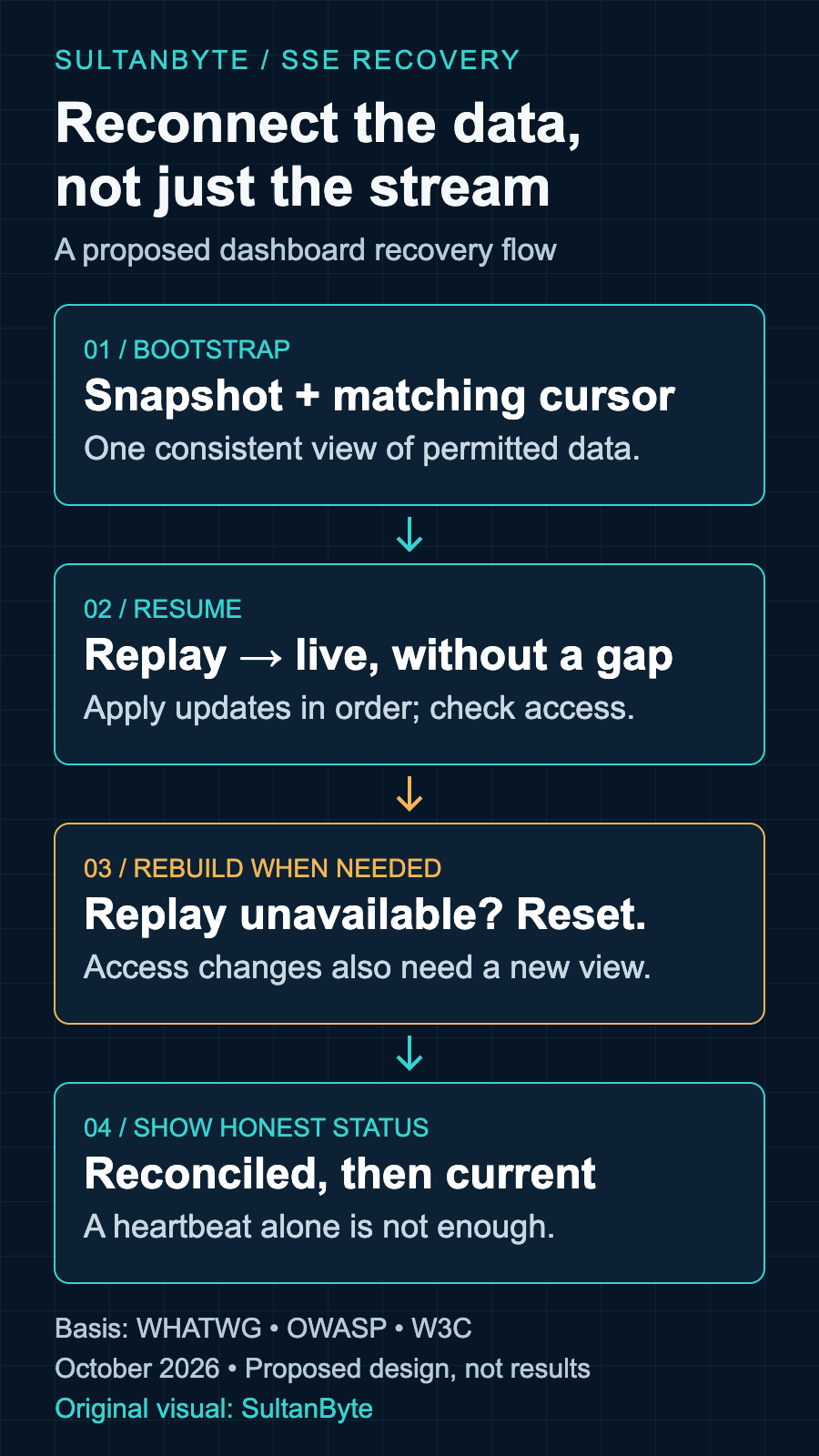
Original infographic: SultanByte. Proposed recovery framework informed by WHATWG EventSource, OWASP authorization guidance and W3C status-message guidance, October 2026. The diagram shows design responsibilities, not measured delivery results.
Keep authorisation active while the connection stays open
OWASP recommends validating permissions on every request. Apply that to the snapshot, initial connection and every reconnect. Then address the extra problem introduced by a long-lived response: a permission can change after admission.
For this design, bind the feed to the verified user and tenant on the server. Filter each delivery through current entitlement state, or use a reviewed revocation mechanism with a documented bound that includes queued deliveries. Removing a supervisor from a team must stop protected updates on an already-open connection, not merely prevent the next login.
Permission changes also trigger a view reset: clear inaccessible rows and obtain a new authorised snapshot. A new grant may expose old records that have not changed since the cursor. Rebuilding handles that case without waiting for another record mutation. Clearing the screen cannot recall information already seen.
Keep the cursor separate from access control. Possessing another tenant's cursor must not reveal whether its records exist. Apply bounds to cursor input, replay volume and connection count, and make rejection messages suitable for an unauthorised caller.
Prefer a same-origin endpoint for this cookie-authenticated portal. The native EventSource constructor does not expose an arbitrary request-header option. If the product requires another authentication model, choose and review that client design explicitly; do not put a long-lived bearer token in the stream URL to avoid the work.
On sign-out or tenant change, close the source and invalidate the current view generation. Reject callbacks and snapshot responses belonging to the old generation. Server revocation remains necessary even if the browser performs that cleanup correctly.
Test the entire HTTP route
A working application handler is not enough to establish that events reach the browser promptly. Review every intermediary on the deployed route.
NGINX documents response buffering as enabled by default. It supports disabling that buffering through configuration or the X-Accel-Buffering response header, unless the relevant header processing is disabled. Its proxy_read_timeout applies between successive reads from the upstream, not to the total response duration. These are NGINX behaviours, not universal settings for every proxy.
For an AWS Application Load Balancer, AWS distinguishes idle timeout from client keepalive duration. It also says HTTP/2 PING frames do not reset the idle timeout. If that is your deployed route, test application traffic through it rather than assuming protocol-level keepalives solve the problem.
Choose heartbeat and stale-view thresholds from the actual route and business tolerance, then test quiet periods as well as busy ones. SSE comments do not dispatch JavaScript events; use a named heartbeat event if the UI must observe it. A received heartbeat shows activity, not proof that the database-to-event publication path is healthy.
For this private queue, apply Cache-Control: no-store to both the stream and authenticated snapshots, with intermediary settings that honour it. RFC 9111 distinguishes no-cache from no-store: the former requires validation before reuse, while the latter prohibits storage by compliant caches. Neither replaces authentication or encryption. Inspect the deployed response policy instead of relying on an endpoint's name to make it private.
Also impose a bounded per-connection send queue. In this design, a client that cannot keep up is disconnected and recovers through replay or a new snapshot. Avoid an unbounded memory backlog for a screen that may have stopped consuming updates.
Make freshness understandable in Arabic and English
Use separate states for connecting, catching up, current and interrupted. “Connected” should describe the transport only. This design uses a server-defined catch-up marker; show “current” only after all preceding events have finished applying. A stale-data policy is still needed if later updates stop.
Keep the time of the last successful data reconciliation distinct from the last heartbeat. Let the user refresh explicitly, and explain when the displayed queue may be stale. Decide which actions remain available in that state; the command endpoint must check the current record regardless of what the screen shows.
W3C's status-message guidance explains how important updates can be exposed to assistive technology without moving focus. For this dashboard, announce a concise connection or refresh status rather than reading every incoming row. Preserve the keyboard user's position while the list changes.
Have Arabic and English reviewers check the actual states, timestamps and recovery controls. Keep job identifiers distinct from translated labels, and avoid rearranging the focused item during a refresh. The same business event should not acquire a different identity when the interface language changes.
Maintain separate route and recovery records for Saudi and UAE deployments where the product operates them. Test each customer's actual network path and hosting arrangement. Interface language must not choose the deployment, and this design does not imply identical local requirements.
Review failure cases before adding more live screens
Use synthetic tenants to exercise the recovery contract. Commit a change between snapshot creation and stream attachment; the recovered view must include it. Interrupt the connection during replay and deliver a record version twice; the queue must converge without duplicated counts.
Then expire the retained cursor and require a full rebuild. Grant and revoke access without changing any records: verify that the view rebuilds and protected delivery stops within the agreed bound. Switch tenants while a snapshot request is in flight and confirm that its late response cannot repaint the new workspace.
Run the same exercise through the production-shaped proxy chain, including a quiet interval, a slow consumer and a server restart. Record the build, route configuration, interruption and observed result. These are proposed acceptance tests, not results already demonstrated by this guide.
Start with one work queue whose recovery behaviour support staff can explain. Expand only after a disconnected screen can return to an authorised, reconciled view without asking the user to guess whether its green indicator is telling the truth.
About the author
- I have lead the Engineering for multiple startups in UAE. I also have my own agency qualascend.com.
Comments
Join the discussionNo comments yet. Be the first to comment.
Builder Guides
Practical architecture, engineering, security and implementation guides for teams building technology in MENA.