Dubai's Chamber AI Hub: check the cost of a completed task
The new Dubai marketplace offers 22 agents. Clarify billing and measure reviewed outcomes before expanding paid use.
Dubai Chambers has opened an AI-agent marketplace with a practical offer for smaller businesses: try specialised tools before paying for broader use. The buying decision now needs more detail than the launch headline provides, particularly around billing and what the platform counts as success.
The 26 October announcement describes 22 agents across seven functional areas, with sandbox trials, complimentary credits and paid usage afterwards. The services include invoice checking, supplier evaluation and IT help-desk support. Dubai Chambers says they support Arabic and English.
For an SME owner, the useful test is whether one of these services completes a real job at an acceptable total cost. A subscription price, an activation count and a completed request each answer different questions.
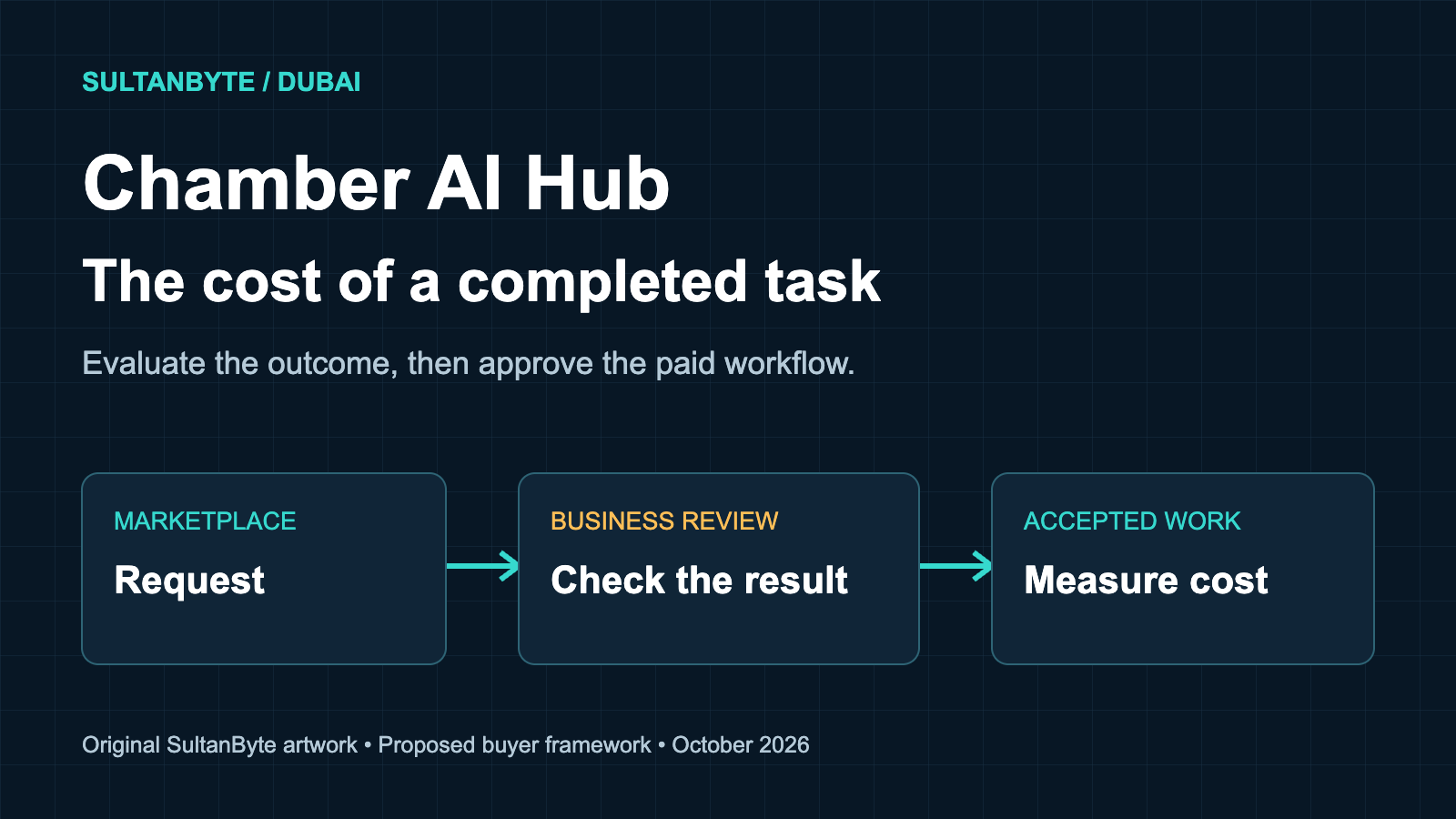
Cover: original SultanByte artwork showing a marketplace request moving through review to an accepted business outcome.
What has launched, and what remains a target
The launch gives Dubai Chambers members a specific place to explore agents, rather than another announcement about a future partnership. The public marketplace displays the catalogue, describes business verification through UAE Pass and trade-licence checks, and presents a readiness assessment as part of onboarding.
Keep the programme's ambitions separate from its present catalogue. Dubai Chambers plans to expand to 100 agents over two years. Its wider programme aims to enable more than 295,000 private-sector companies, with training tracks intended for 14,000 companies. Those are programme objectives, not counts of paying marketplace customers or successful deployments.
Gulf Today's 27 October report, credited to WAM, repeats the launch figures. It provides another published account of the announcement, not an independent measurement of customer savings.
SultanByte previously covered the Dubai–India agentic-AI agreement. This launch changes the immediate purchasing question: buyers can inspect a concrete catalogue and commercial presentation. The next step is to reconcile that presentation with an offer their company can actually accept.
Resolve the billing contradiction before subscribing
The public pricing section needs clarification. It says prices are shown per month and billed annually, while each displayed plan says it is billed monthly. The cards show Starter at AED 295 per month, Growth at AED 530 and Enterprise at AED 916. Elsewhere, the site describes a pay-as-you-go wallet that companies can top up.
Those statements do not establish a single, unambiguous billing contract. They may describe different components of the offer, but the public page does not explain the relationship clearly enough to build a reliable budget. Treat the displayed amounts as advertised prices, not a confirmed all-inclusive quotation.
Before activating paid use, request written answers about the billing interval, included credits, consumption unit and charges after the allowance. Confirm whether membership and wallet consumption are separate, which agents the chosen tier includes, and how cancellation affects prepaid balances. Ask whether the displayed prices include tax rather than assuming either treatment.
Have finance review the accepted order terms, not a screenshot of the headline price. Do not multiply the monthly card into a purported annual contract value while the billing cadence remains inconsistent.
The complimentary balance is useful for evaluation. Keep it separate from the cost estimate for sustained operation: a pilot funded by credits can conceal the recurring bill that arrives later.
A completed request is not necessarily a finished job
Dubai Chambers says the platform shows success rates for requests submitted to each agent. The announcement does not define the denominator or explain whether success includes a business owner's acceptance of the result.
For an invoice-checking pilot, distinguish a request that returned an answer from an invoice that was checked correctly. A response can arrive without identifying a duplicate. A flagged discrepancy can be wrong and create more work for the finance team.
Define the accepted outcome before testing. For example, require the reviewer to confirm that the agent matched the supplied invoice to the correct purchase order, identified the relevant discrepancy and preserved the supporting evidence. Keep payment approval outside this pilot. That is a proposed evaluation design, not a description of controls already verified in Chamber AI Hub.
NIST's AI RMF Playbook recommends documenting test sets and metrics and demonstrating performance under conditions similar to deployment. Apply that principle to a representative set of ordinary cases and known exceptions. Include Arabic and English documents from the intended workflow, with permitted or synthetic data.
Record failed requests, retries and cases requiring manual correction. Do not remove difficult cases from the denominator because the agent could not handle them. Separate inability to process a document from a confident but incorrect result; the operational consequences differ.
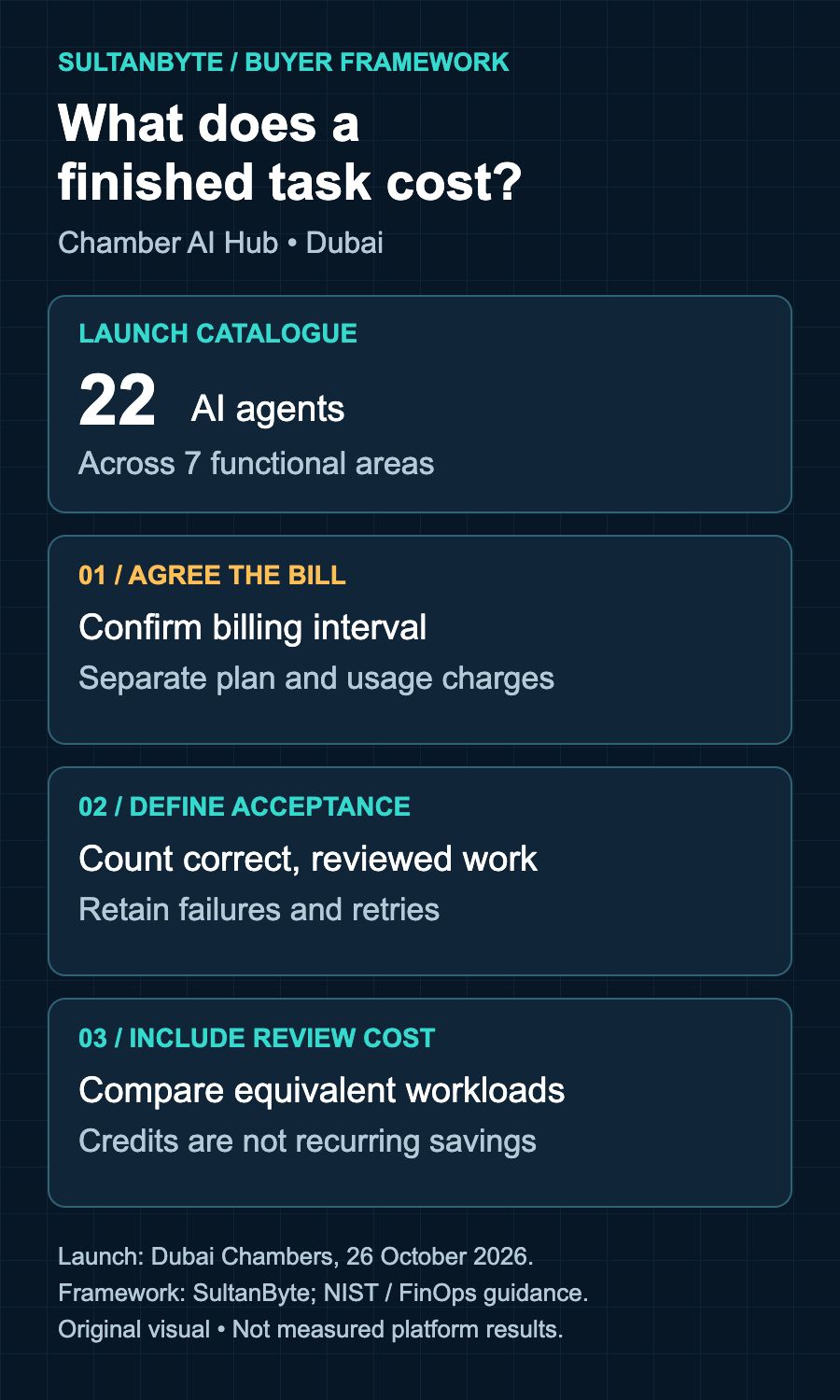
Original infographic: SultanByte. Proposed buyer measurement framework informed by Dubai Chambers' 26 October 2026 launch, the marketplace's October 2026 presentation, NIST and the FinOps Foundation. It shows measurement responsibilities, not measured platform results.
Measure the cost after review
The FinOps Foundation's unit-economics guidance separates resource-efficiency measures, such as cost per token, from business measures, such as cost per resolved case. The distinction is useful here: cheap requests can still produce expensive work if people spend substantial time checking and repairing them.
For the proposed invoice pilot, record paid platform consumption alongside the allocated subscription cost and reviewer time. Keep setup and integration expenditure visible as separate items, with an explicit allocation method if you include them in a per-invoice figure. Compare equivalent workloads and the same quality threshold against the existing process.
Report both total workload and accepted outcomes. A lower average cost achieved by handling only easy invoices may be useful, but it is not proof that the entire finance process has become cheaper. Name the eligible subset and retain a reliable manual route for everything else.
The marketplace also displays monthly savings claims beside individual agents. The public presentation does not provide enough calculation detail to reproduce those amounts. Ask for the baseline workload, labour assumptions, review effort and observation period before using a card's savings figure in a business case.
Time released is not automatically cash saved. Finance should decide whether it reduces overtime, avoids a planned hire or gives existing staff capacity for other work. Record that interpretation rather than treating every minute as an immediate reduction in expenditure.
Keep the trial inside an approved data boundary
Dubai Chambers says data is hosted in the UAE and company information is separated. Those are platform statements, not a customer-specific assessment of every integration or processing path. Request the applicable data terms and clarify retention, support access, export and deletion before submitting sensitive records.
Start with the least access required for the selected task. OWASP's excessive-agency guidance recommends limiting tool functionality and permissions, enforcing authorisation downstream and requiring human approval for consequential actions. A document-review trial does not need authority to pay suppliers or change bank details.
This is a Dubai-focused marketplace offer. A Saudi affiliate should not assume that a Dubai company's membership, eligibility or approved data arrangement covers its own operation. Assess each entity and workflow separately; Arabic support does not establish identical operating requirements across countries.
Approve one useful workflow, then review the bill
An SME owner should ask for a short decision record: the accepted commercial terms, the workflow tested, the observed outcomes and the full operating cost. The technical owner should attach the permitted data and access scope, with a practical way to stop the trial and recover its records.
Expand only when the chosen task meets the agreed quality threshold and the paid economics remain acceptable after review effort. If the billing terms or success definition remain unclear, continue evaluating with non-sensitive test cases rather than connecting the agent to live business authority. The marketplace can shorten supplier discovery; the buyer still has to establish what a finished job costs.
About the author
- I have lead the Engineering for multiple startups in UAE. I also have my own agency qualascend.com.
Comments
Join the discussionNo comments yet. Be the first to comment.