YouTube Shopping arrives in Saudi Arabia, UAE and Egypt
Amazon is the first partner. Check creator access, country-specific requirements and final earnings before scaling a campaign.
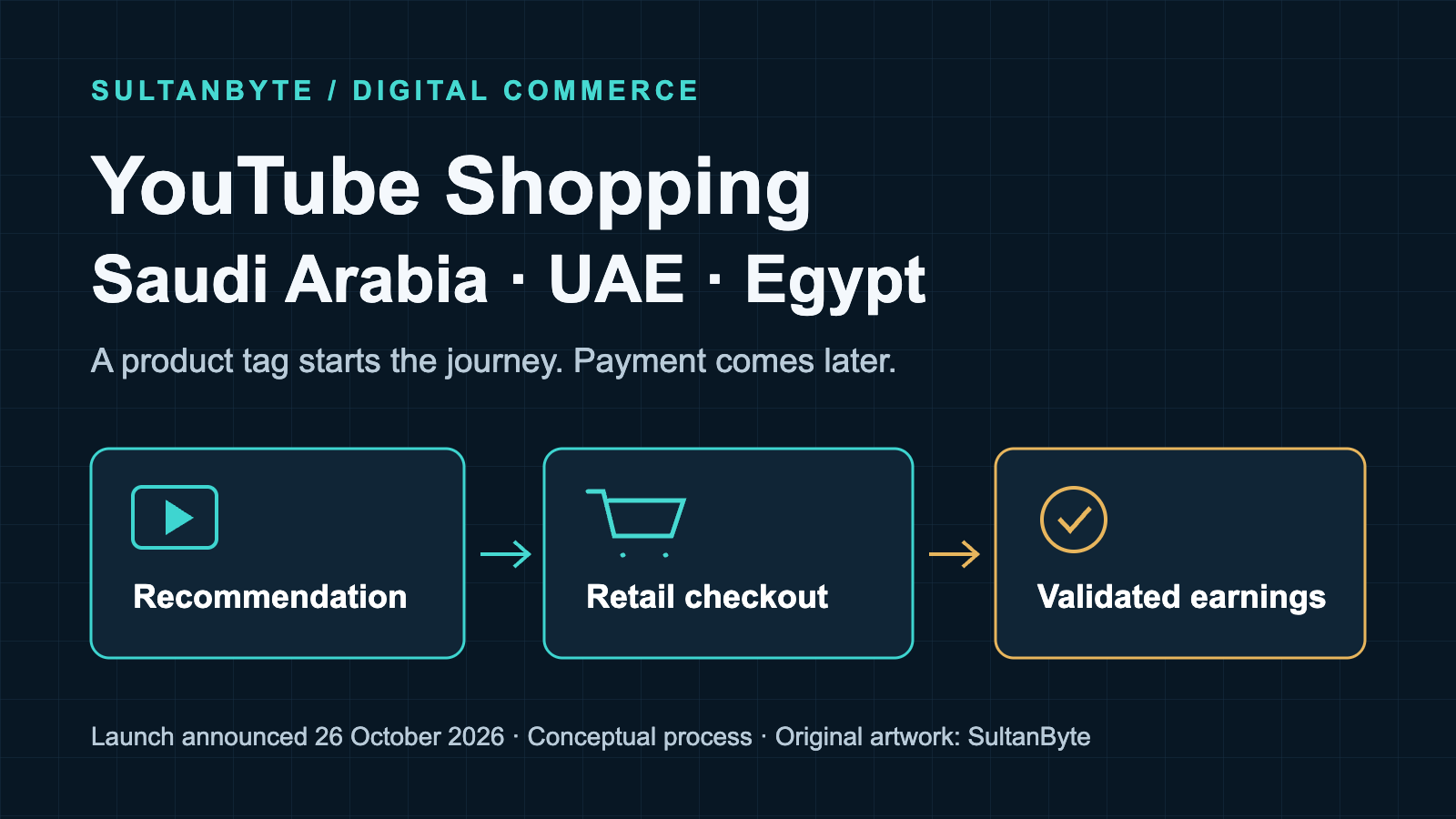
YouTube has opened another route from a product recommendation to a retail checkout in Saudi Arabia, the UAE and Egypt. For brands, the useful question is how to run that route without confusing audience reach with sales or estimated commissions with cash.
Google's 26 October announcement names Amazon as the first affiliate partner in the three markets. Eligible YouTube Partner Program creators can tag products in long-form videos, Shorts and livestreams. Google says qualifying channels can participate with as few as 500 subscribers.
That makes the launch relevant beyond celebrity campaigns. A specialist creator with a small audience could test whether detailed product demonstrations generate qualifying purchases. It does not establish that every small channel can enrol, every Amazon listing can be tagged or every viewer can buy the same offer.
Cover: original SultanByte artwork showing a video recommendation leading to retail checkout and a separate commission-validation stage.
Check access before booking a campaign
There is a documentation mismatch worth resolving before spending money. Google's regional launch announcement explicitly includes Saudi Arabia, the UAE and Egypt. The general affiliate eligibility page, however, does not yet list those countries in its location requirements. The Amazon-specific help page also lists other markets rather than these three.
Those pages do not cancel the regional announcement. They do mean a buyer should avoid treating the announcement as proof that a particular account is ready. Ask the creator to confirm the Shopping programme in YouTube Studio, the applicable terms and the actual product offers available to tag. The general help page says eligible accounts can join through Studio and notes that pilot eligibility may differ.
Treat 500 subscribers as part of the announced eligibility story, not a standalone admission rule. Before agreeing a launch date, require evidence that the intended creator can select the intended product. Keep an alternative campaign plan if access has not appeared.
Campaign Middle East's launch coverage confirms the announced market scope and Amazon partnership. Its reporting draws on the announcement; it is not independent evidence of conversion performance. Plans to add retailers should likewise stay outside a campaign's committed inventory until those offers become available.
Keep checkout and commission separate
The content carries the product discovery experience, but the transaction has another owner. YouTube's affiliate overview describes viewers buying on the retailer's site. Google's regional announcement also describes a connected-TV journey in which viewers scan a QR code with a phone to complete checkout on Amazon.
For a retailer or agency, that means reviewing the destination as carefully as the video. Check the product variant, seller, delivery destination and return terms. A successful tap is not evidence of an available item, a completed order or an approved commission.
Google says AI-assisted tagging can identify products on screen and suggest affiliate links. Review those suggestions against the product actually demonstrated. A visually similar accessory or a different storage configuration can make an otherwise accurate review misleading. Give someone responsibility for checking tags after publication, especially if offers change.
International matching also needs restraint. The Amazon help page says YouTube may match a tagged product to a local merchant offer for an international viewer. It describes fallback behaviour when no local match exists. Because that page's eligibility list does not yet cover the newly announced markets, confirm how routing works for the actual regional account rather than promising identical destinations worldwide.
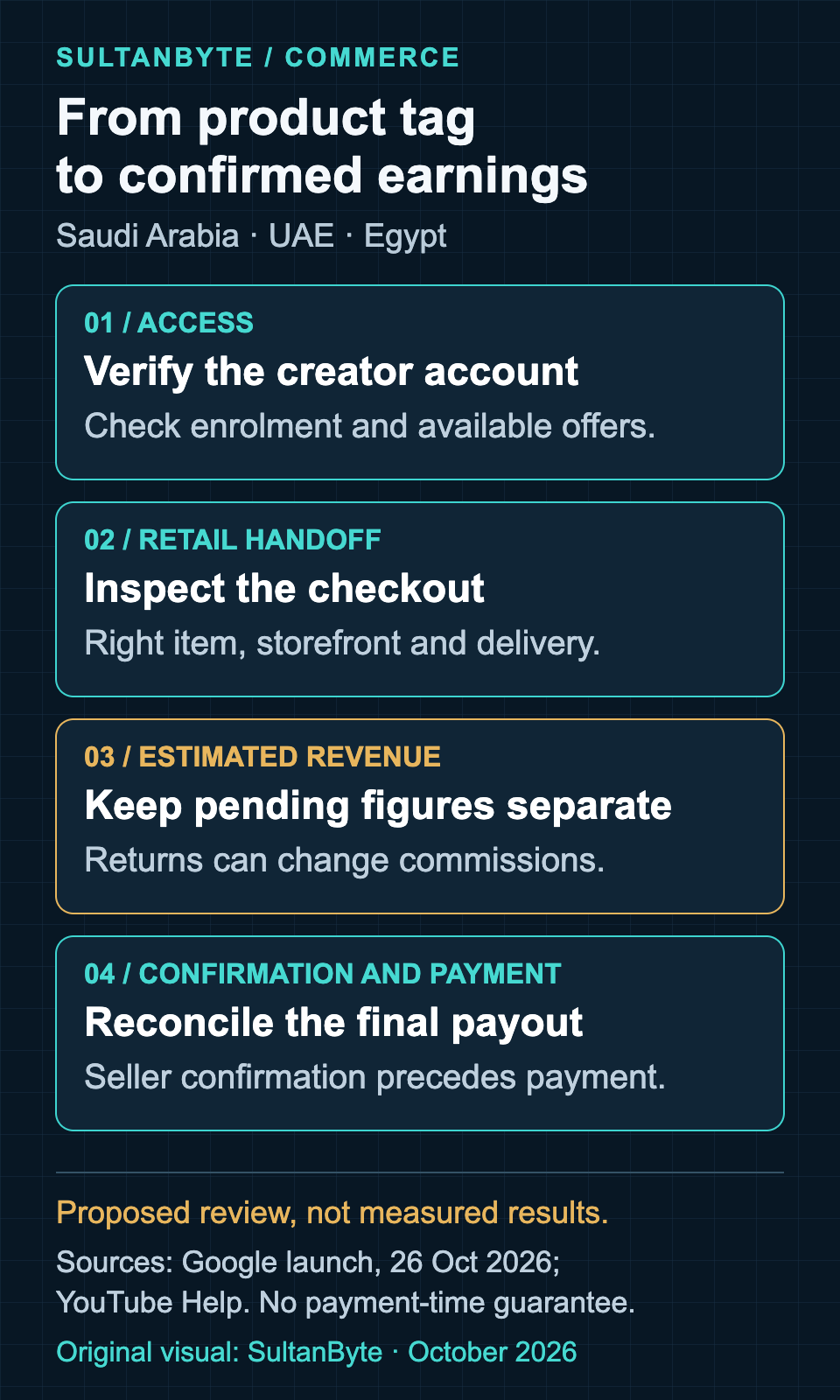
Original infographic: SultanByte. Proposed campaign review informed by Google's 26 October 2026 launch announcement and YouTube Help. Estimated and earned revenue are different reporting stages; this is not a payment-time guarantee.
Run separate country checks
The same programme announcement covers three markets. A sensible campaign should still keep a separate record for each destination, including the creator account, tagged offer, storefront, delivery terms and applicable advertising requirements.
For Saudi Arabia, the General Authority for Media Regulation's Mawthoq service covers licensing individuals to provide advertising content through social media. Have the campaign owner review the relevant licence and account details rather than assuming YouTube enrolment supplies local advertising permission.
In the UAE, the National Media Authority's Advertiser Permit guidance says individuals engaged in social-media advertising require a permit whether or not they receive financial compensation. It also lists exemptions, including individuals advertising their own products or services, or those of a company they own, through personal accounts. Visiting creators have a separate permit route. An agency should check the creator's circumstances rather than copy one requirement across every participant.
For Egypt, the platform announcement establishes inclusion in the launch, not equivalence with either Gulf licensing system. Obtain a local review of the proposed advertising arrangement and verify the Egyptian retail journey separately. This article does not establish the permissions needed for a particular Egyptian campaign.
These are procurement checks, not legal determinations about a specific creator. Platform access, advertising permission and permission to promote a particular product are separate questions. YouTube's own branded-content rules also remain relevant; the affiliate overview directs creators to its disclosure requirements where applicable.
Do not promise reporting the programme cannot provide
A brand may want to know which video sold which product. That is a reasonable commercial question, but the current Amazon help page sets a narrower reporting boundary: it describes aggregate daily revenue, clicks and sales, while saying creators cannot check which specific videos or products drove Amazon purchases.
Confirm the reports available to the regional account before writing video-level sales attribution into a contract. Do not infer that a generic analytics breakdown exists for every seller simply because another help page describes it.
YouTube's affiliate metrics documentation separates estimated revenue from earned revenue confirmed by the seller. It identifies AdSense as the source for finalised payouts and explains that seller validation and returns affect the timing. The Amazon guidance says returns can produce deductions and temporarily negative balances.
A practical pilot should therefore keep content costs, observed engagement, available sales reports and final payments distinct. Record the reporting period and status beside each revenue figure. Avoid publishing a single return-on-investment number while the underlying commissions remain provisional, or implying that all observed purchases are incremental sales caused by the campaign.
Start with an offer that can survive the handoff
For a first campaign, choose products that the creator can demonstrate accurately and that buyers can obtain through the intended storefront. Agree who checks tag changes, who handles a withdrawn offer and what happens if the creator loses programme access. Test the phone journey and, where used, the TV-to-phone handoff before promoting it heavily.
Founders and product teams can use the launch to test a focused acquisition channel rather than commission a broad integration immediately. Agencies should agree the reporting limitations before committing to performance fees. Creators should compare the work required with the commissions actually available in their account, not an assumed regional rate.
The launch provides a new distribution option. The first useful result is a verified path from the right product in the video to a purchasable offer, followed by a report that distinguishes pending earnings from money received. Expand the campaign only when that path works in each market being targeted.
About the author
- I have lead the Engineering for multiple startups in UAE. I also have my own agency qualascend.com.
Comments
Join the discussionNo comments yet. Be the first to comment.