Robinhood’s DIFC plan: licence scope before the 2027 launch
The DFSA register predates the October announcement. What the arranging permissions establish, and what the regional product still needs to specify.
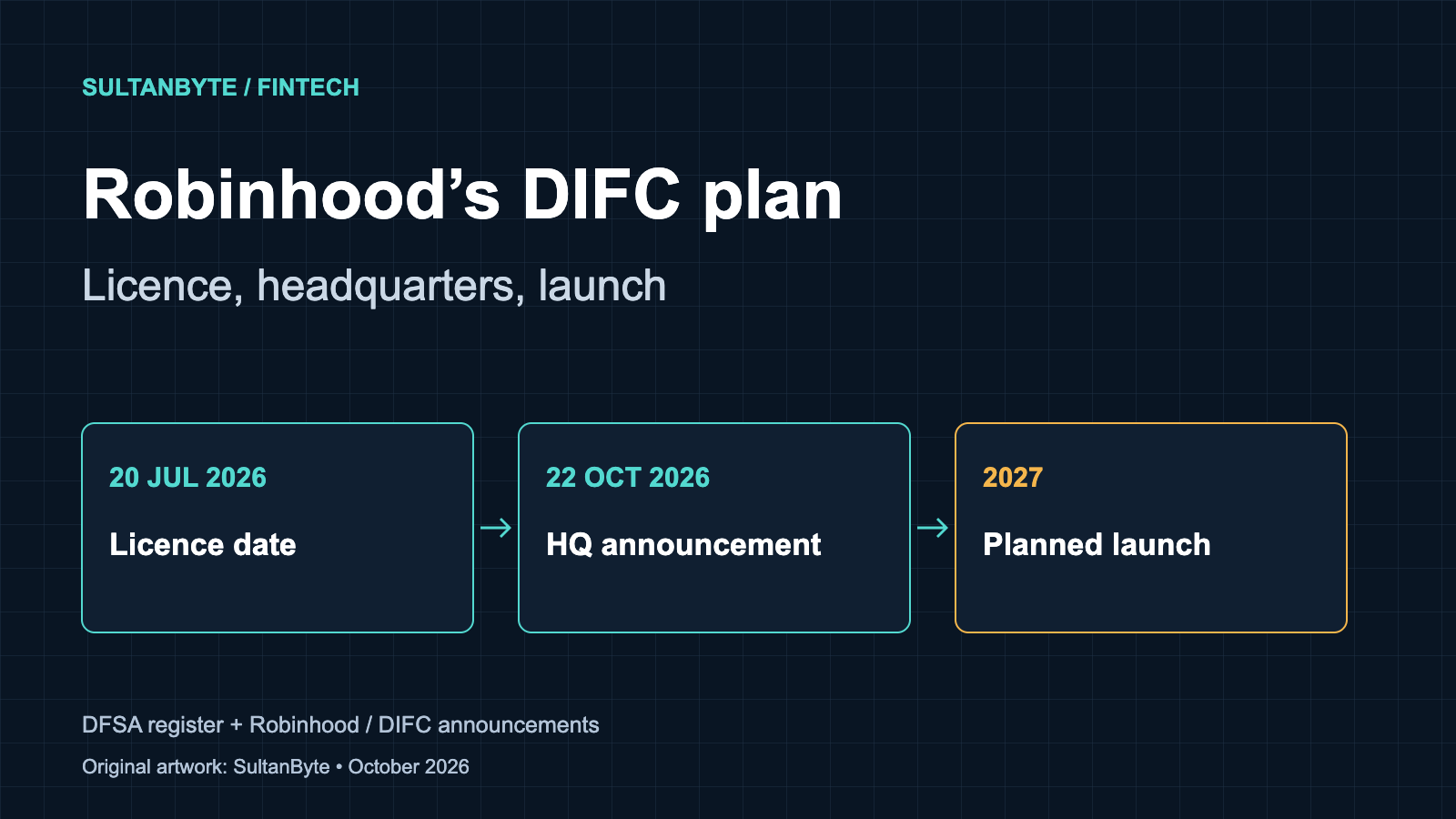
Robinhood's Middle East expansion has three dates worth keeping separate. The DFSA register dates its local licence to 20 July 2026. The company announced its DIFC regional headquarters on 22 October. Its product suite is planned for 2027.
That sequence matters to fintech founders and product teams watching the UAE's retail investing market. There is a regulated local entity and a public expansion plan. There is not, in that announcement, a dated customer rollout or a complete specification of the regional product.
The more revealing detail is the wording of the licence. Robinhood describes access to trading and custody across multiple asset classes. The regulator lists Arranging Custody and Arranging Deals in Investments. Understanding that distinction is a better starting point for assessing the business than importing assumptions from the US app.
Cover: original SultanByte artwork showing Robinhood's licence, headquarters announcement and planned launch as separate milestones.
The licence predates the headquarters announcement
The DFSA public register for Robinhood MENA Limited identifies a DIFC company, reference F012264, with a licence dated 20 July 2026. It also records an endorsement to conduct authorised financial services with or for retail clients.
Robinhood's 22 October announcement sets out the regional headquarters plan and names Salah Kaddoura as Senior Executive Officer and President of Robinhood MENA. The DIFC announcement confirms the location and repeats the planned 2027 product launch.
The October news therefore describes a commercial expansion milestone rather than establishing that the licence was issued that week. The company's forward-looking statement also makes clear that the launch plan depends on assumptions and risks, including regulatory developments and market demand.
For a competitor's roadmap or a prospective partner's budget, record 2027 as the announced target year. Do not turn it into a committed quarter or use the headquarters announcement as evidence that customers can already open the new regional account.
Read the activity names before the asset list
The register lists ten investment categories under each of the two arranging services. These include Shares, Units, Investment Tokens and Crypto Tokens, alongside other instruments. Robinhood's release describes its intended offer through more familiar product labels, including equities, ETFs and crypto.
Those descriptions answer different questions. The asset categories establish the scope shown in the register; they are not a launch catalogue of individual securities or tokens. The activity names describe the authorised services of the named local entity; they should not be silently rewritten as direct execution or direct custody permissions.
This does not establish a defect in the proposed platform. It means a partner needs the operating model. Which entity receives the customer's instruction? Which entity executes it? Who safeguards the assets, and which agreement governs that relationship?
Request a diagram that names the parties and the handoffs, supported by the relevant terms. A familiar brand across the interface does not answer those questions. Nor does a list containing Crypto Tokens establish that every token available in another Robinhood market will be offered locally.
For an engineering team, this becomes a product-modelling requirement: bind an account and its available services to the actual provider arrangement. Avoid one global feature flag called "Robinhood enabled" that assumes every country and account type has the same permissions or products.
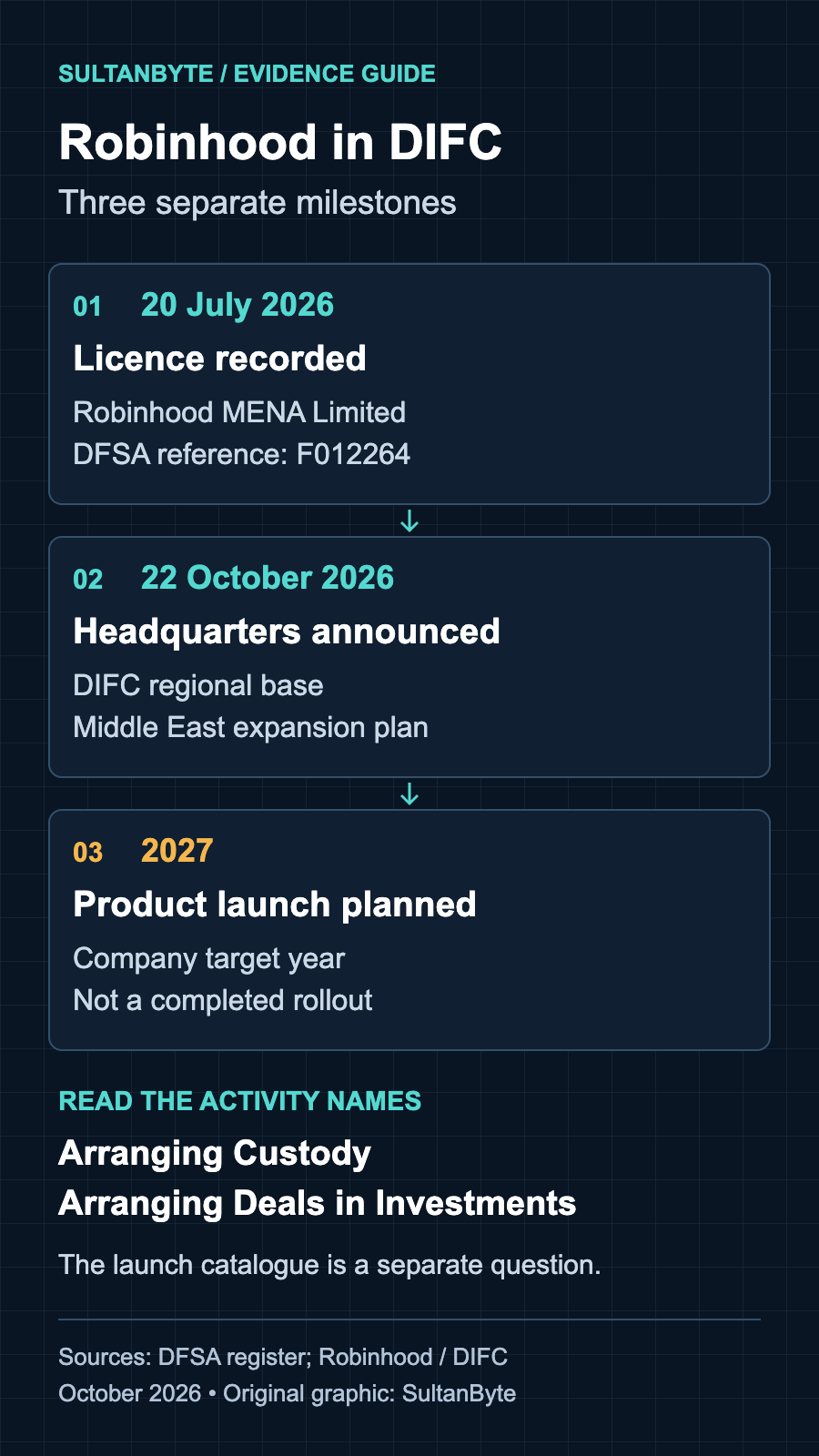
Original infographic: SultanByte. Sources: DFSA public register and Robinhood/DIFC announcements, October 2026. The 2027 launch is a company plan, not a completed rollout.
DIFC is a specific regulatory location
The DFSA record is the appropriate starting point for this entity. It should not be replaced with a generic statement that Robinhood has a "Dubai crypto licence".
VARA's licensing guidance explicitly excludes DIFC from its Dubai remit. That distinction explains why looking only at VARA's register would be the wrong verification path for Robinhood MENA Limited's stated DIFC arrangement.
For founders comparing launch routes, keep the location, legal entity and activity together. Do not compare a DFSA arranging permission with a different firm's virtual-asset permission as though the labels were interchangeable.
The regional headquarters language also does not provide a country-by-country eligibility list. A Saudi customer, a UAE resident and a customer elsewhere in MENA should not be treated as one onboarding category simply because the expansion is described as Middle Eastern. Obtain the applicable customer terms and eligibility rules for each intended market before promising access. This is a diligence question, not a claim that a particular cross-border service is permitted or prohibited.
The competitive benchmark already includes local markets
Finance Magnates' reporting places the announcement alongside established regional competitors, including eToro, Interactive Brokers and Baraka. Its account is useful market context; its description of Robinhood's proposed product scope still comes from the company's announcement.
A concrete comparison comes from Interactive Brokers' December 2025 release. The broker announced access to the Abu Dhabi Securities Exchange and Dubai Financial Market, and described support for AED among its funding and trading currencies.
That is a provider-reported capability, not an independent test of every customer's experience. It nevertheless changes the question a new entrant must answer. Regional relevance can include local securities and local-currency workflows, rather than simply a translated interface for overseas assets.
Robinhood's October release does not specify ADX or DFM access, an AED funding method, regional pricing, or Arabic-language support. Those omissions are unresolved product questions, not evidence that the features will be absent.
For incumbents, the sensible response is to inspect where customers struggle now: unclear charges, unsuccessful onboarding, hard-to-understand statements or slow support. Building against an imagined copy of the US Robinhood app risks solving the wrong problem.
What would make the 2027 plan actionable?
A technology buyer should ask for a launch-specific evidence pack before committing implementation work. Start with the eligible customer population and the contracting entity. Then request the available instruments, account agreements and named execution and custody arrangements.
Commercial evaluation needs the complete cost path: account charges, currency conversion, transfers and any product-specific fees. Do not assume that familiar pricing language from another market applies to the proposed regional account.
Product acceptance should include readable Arabic and English disclosures where supported, accurate transaction states, downloadable records and a documented complaints route. These are proposed evaluation criteria, not features Robinhood has announced or tests SultanByte has performed.
Keep unreleased capabilities outside the committed launch scope. If a partner proposes integration access, obtain its actual interface contract and support obligations rather than assuming an API follows from the consumer-platform announcement.
The next useful milestone is a published regional offer that connects the licensed entity to a defined customer, product and operating arrangement. Until then, Robinhood's DIFC announcement is credible evidence of expansion intent and a local regulatory foothold. It is enough to begin diligence, but not enough to promise a regional product specification.
About the author
- I have lead the Engineering for multiple startups in UAE. I also have my own agency qualascend.com.
Comments
Join the discussionNo comments yet. Be the first to comment.