UAE AI sandboxes: regulatory testing or research support?
Sandbox Dubai and the TDRA/ITU initiative address different obstacles. Match the programme to the evidence your project needs.
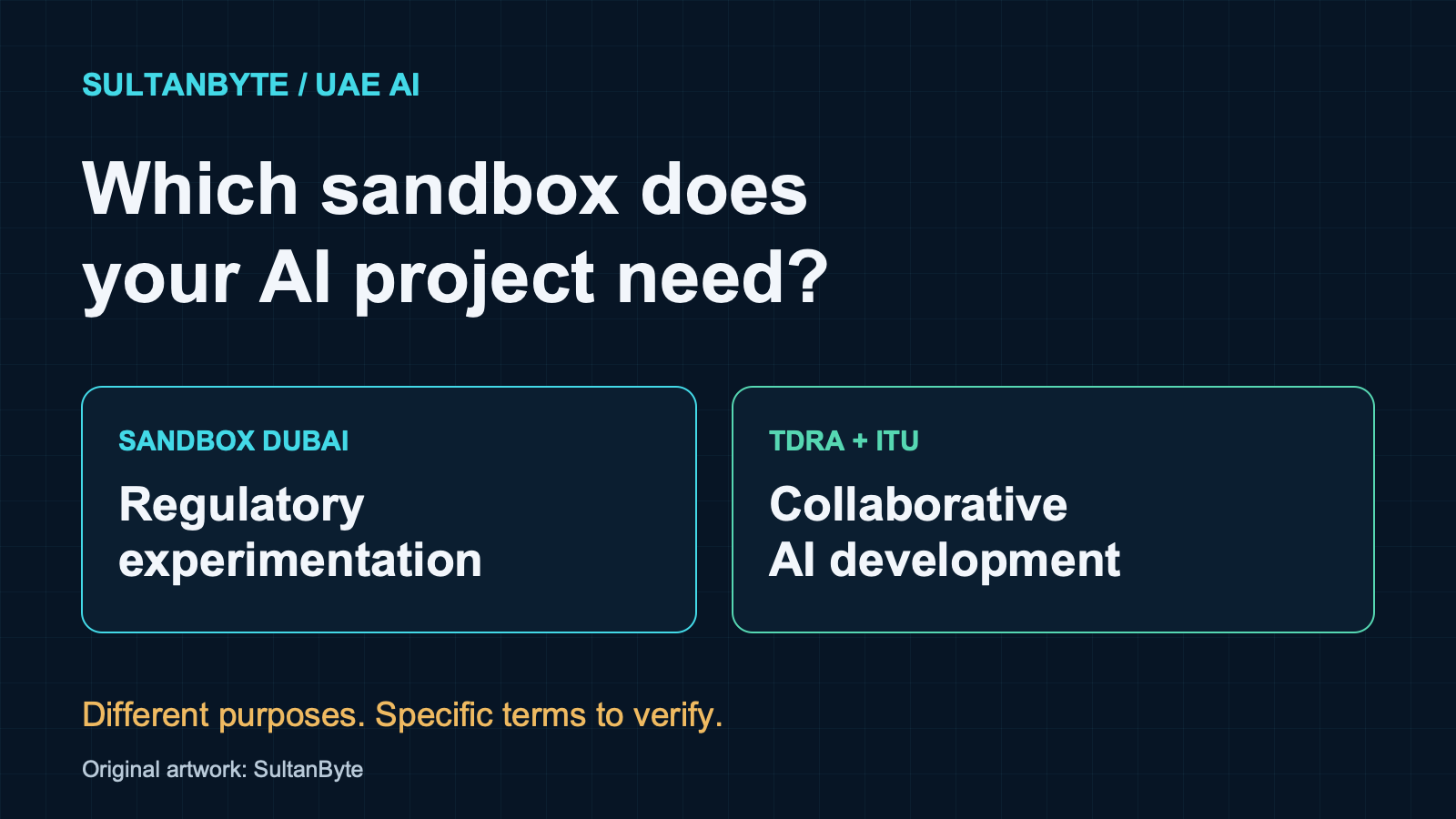
The UAE's AI sandbox announcements describe different kinds of help. A company blocked by an unclear deployment rule needs a different conversation from a research team building an Arabic dataset. Calling both environments a "sandbox" can hide that distinction.
On 21 October, TDRA described its work with the International Telecommunication Union around the UAE's AI for Good Sandbox and a capacity-building week held from 19 to 22 October. Separately, Sandbox Dubai has an AI programme aimed at companies facing regulatory or policy barriers.
For founders and technology buyers, the useful comparison is the problem each programme is designed to address. Neither a workshop invitation nor a sandbox application establishes that a product is ready for unrestricted commercial use.
Cover: original SultanByte artwork contrasting regulatory experimentation with collaborative AI development.
Dubai's route starts with a deployment barrier
The Sandbox Dubai AI programme invites companies with sufficiently mature innovations and material regulatory or policy difficulties. It includes companies already established in the UAE and those planning to establish a presence. The scope spans sectors, with particular emphasis on education, tourism and hospitality, transport and mobility, logistics, media, and government services.
Its stated support includes engagement with relevant regulators and government entities, experimentation and a clearer path towards compliant deployment. Applications are evaluated; submitting one does not guarantee selection.
A useful application would therefore explain the unresolved decision. For example, a hypothetical hospitality company might have a working AI service but uncertainty about an intended use of operational data. Its application should identify that use, the data owner and the specific barrier, rather than simply ask for help "scaling AI".
Be careful with the programme's reference to real-world data. The page explicitly makes access conditional on the data owner's approval. Facilitation is not a promise of a government dataset, and a development plan should not depend on access that has not been agreed.
Regulatory experimentation needs an exit plan
Sandbox Dubai's general FAQ describes tailored, temporary regulatory relief and supervised experimentation. It also says the programme is not itself an investor, incubator, accelerator or grant programme. Those are programme-level descriptions, not the terms of a particular AI company's admission.
Ask for the written scope applicable to the proposed experiment: activities, users, duration, supervision and conditions for ending it. Do not assume that every restriction disappears because the project has entered a sandbox.
The FAQ also describes consequences when an experiment ends without the necessary regulatory requirements being met. That makes the exit plan a business issue from the beginning. A customer-facing pilot needs a way to stop accepting work, explain the change to users and preserve or dispose of records according to its agreed obligations.
For an investor, admission would be evidence of participation in an evaluation process. It would not establish revenue, permanent permission or repeatable customer demand. Those need separate evidence.
TDRA and ITU describe a development environment
The ITU's 21 October UAE workshop page describes a kickoff for implementing the AI for Good sandbox in the UAE. Its objectives include onboarding partners and exploring local language models, agentic systems and open knowledge bases. Technical and policy work appear together in the programme.
The agenda lists a Sandbox Network for Arabic-AI, intended to connect national language-model initiatives through the ITU sandbox, alongside other collaborative announcements. An agenda is evidence of the planned programme. It does not establish a functioning regional service, a released model or measured performance after the event.
That distinction matters for Arabic computing. Regional collaboration could help researchers share evaluation methods and reusable resources. Whether it produces a useful dataset or model depends on what is actually released, under which licence, and with what documentation.
The wider AI for Good Lab description explains the setting: national AI readiness, skills development and public AI infrastructure. ITU describes a technical environment involving compute, datasets, tools and training resources for experimentation. This is the programme's design, not a published resource allocation for every UAE applicant.
A team should ask what it can access now, which support is available, and what it must contribute. Do not put an unspecified compute entitlement into a project budget.
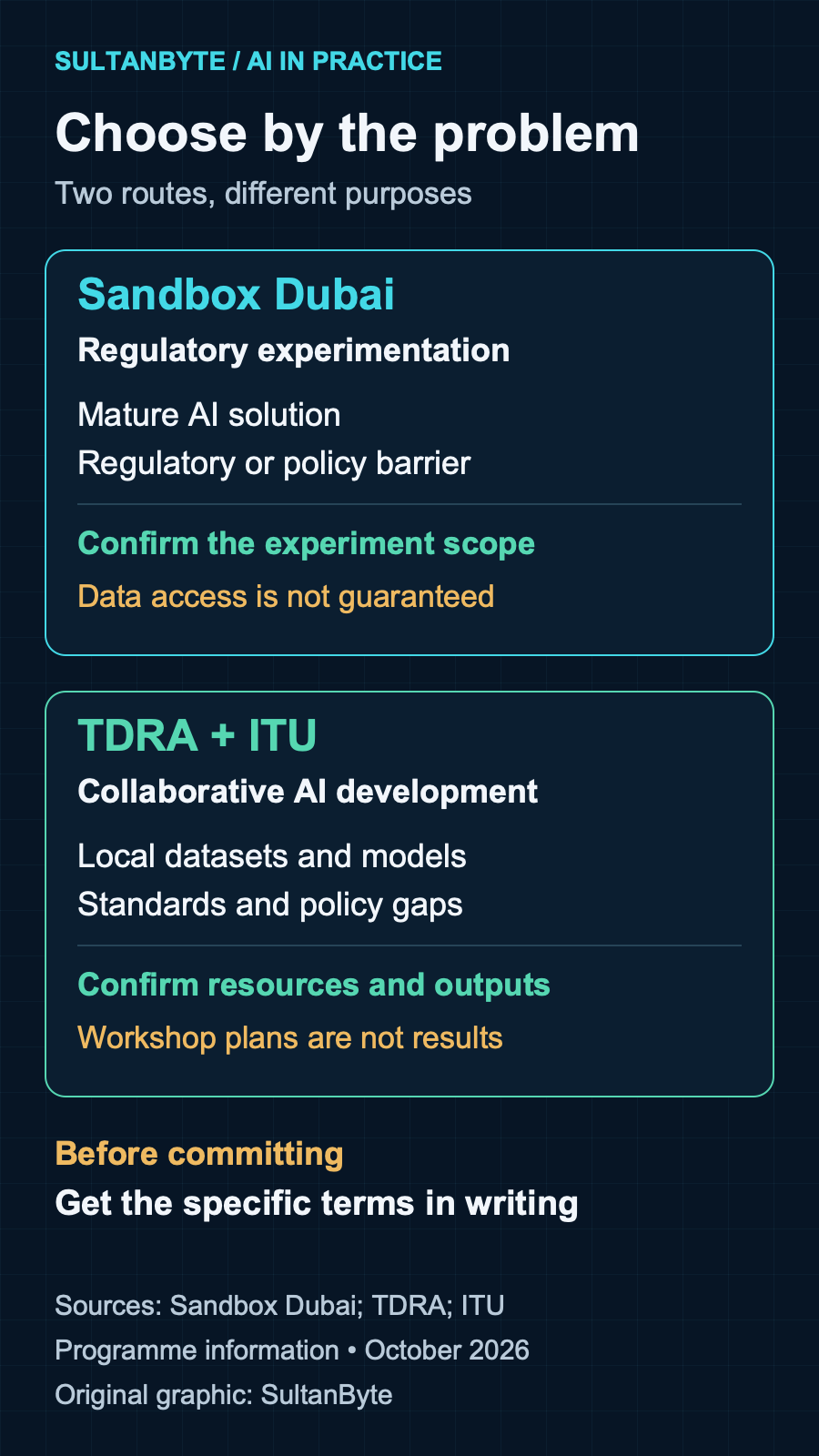
Original infographic: SultanByte. Based on Sandbox Dubai's programme information and TDRA/ITU's October 2026 materials. This compares stated purposes, not measured outcomes or guaranteed benefits.
The proposal form gives teams a practical starting point
The ITU's UAE project-proposal form asks for a proposal summary of no more than five pages. Its evaluation criteria include relevance to agentic government services and AI in telecoms, healthcare and education; regional contribution; open local datasets and model building; standards and policy gaps; and a clear implementation strategy.
Those criteria suggest a more useful proposal than a product brochure. Describe a bounded problem, the intended users, the resources the team already has and the contribution it proposes to make. Separate a research question from a claim that the system already works.
For an Arabic knowledge project, specify the language varieties, source material and evaluation tasks. Explain which material could be shared and which must remain restricted. "Open dataset" should describe an agreed release, not an intention to publish information the team does not control.
Include an achievable output: for example, a documented evaluation set with reviewed answers and a reproducible scoring procedure. This is a proposed application approach, not an additional official eligibility requirement.
Choose by the obstacle, then budget for what remains
A mature company with a concrete regulatory ambiguity should examine the Dubai route against that ambiguity. A team seeking collaborative development around local models, datasets or standards should examine the TDRA/ITU route against the published proposal criteria. Some projects may have both needs, but the work packages and expected results should remain separate.
For a regional company, avoid turning either route into a MENA-wide permission claim. The Dubai programme addresses experimentation and deployment in its stated setting. The ITU workshop's regional ambitions do not establish automatic acceptance by authorities or customers elsewhere. Evaluate each proposed deployment on its own terms.
Technology buyers should also distinguish the sandbox result from their own acceptance decision. Ask which version was tested, what data was used, what failed and which conditions limited the experiment. A successful test under supervised conditions may still leave integration, support and commercial responsibilities unresolved.
Before applying, write down the one decision the programme should help resolve. Then identify the evidence needed to make it: a clarified experiment scope, an approved data arrangement or a reproducible technical result. Fund the next stage when that evidence exists, rather than when the project acquires a sandbox label.
About the author
- I have lead the Engineering for multiple startups in UAE. I also have my own agency qualascend.com.
Comments
Join the discussionNo comments yet. Be the first to comment.