Deloitte’s Cairo expansion: what MENA buyers should check
The reported $40 million remainder puts Egypt’s delivery teams in focus. Buyers still need a staffed scope and a tested handover.
Deloitte's Cairo Innovation Hub plans to invest a further $40 million over the next 12 to 18 months, according to reports published this week. The useful detail is where that money fits: it is the remaining portion of a $110 million programme, not a separate $40 million project on top of it.
For MENA technology buyers, the update is worth watching because it concerns delivery teams rather than another proposed data centre. The hub describes work in AI, cloud engineering and cybersecurity for international clients. Its expansion could widen the pool of teams available to regional businesses, but an investment announcement does not establish the availability or performance of a particular project team.
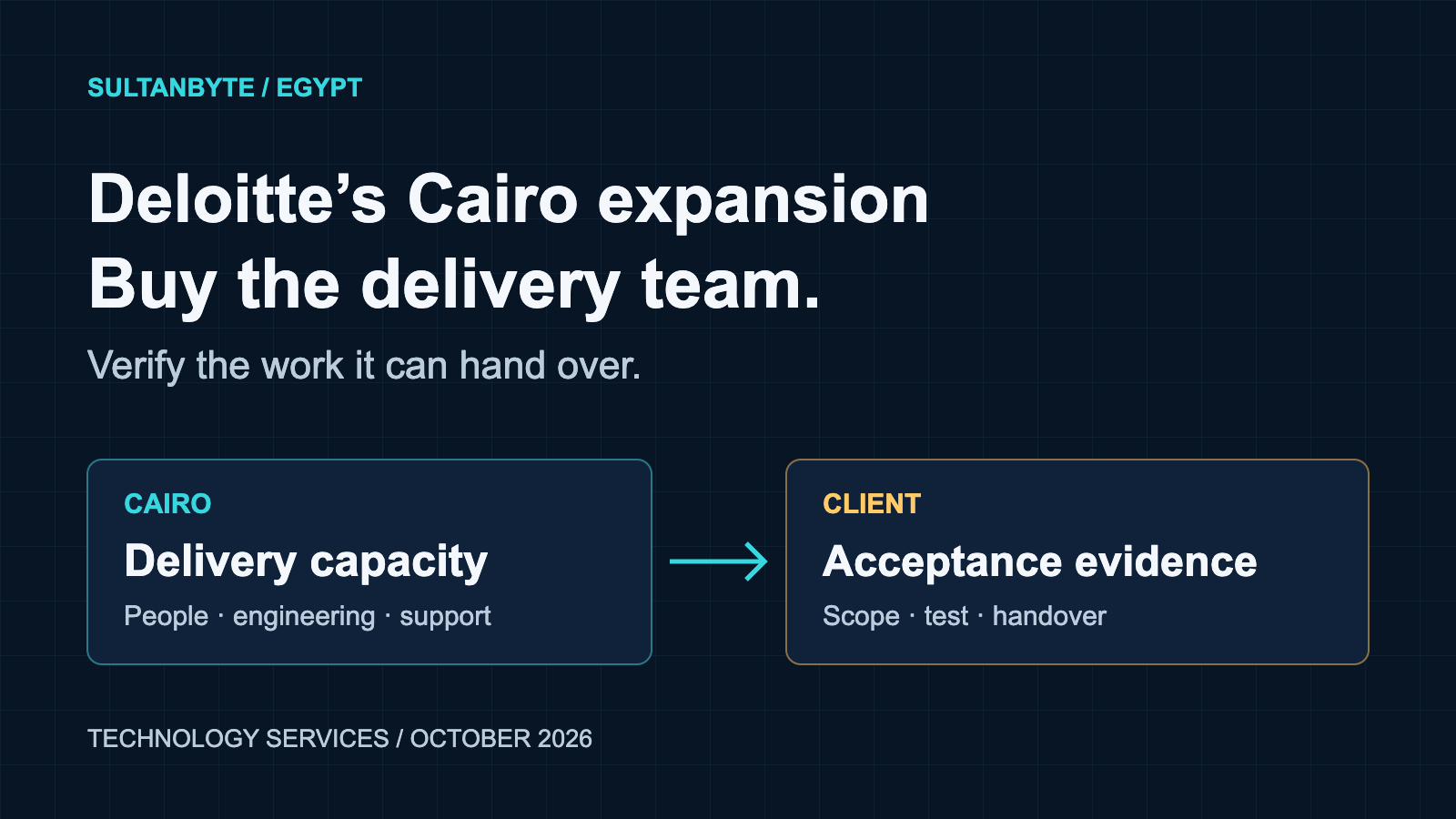
Cover: original SultanByte artwork showing Cairo delivery capacity connected to a separate client acceptance process.
What the investment update establishes
EgyptInnovate's 21 October report attributes the figures to executives speaking at a roundtable: $70 million invested to date, with $40 million expected over the following 12 to 18 months. It describes a five-year programme totalling $110 million. Those are management-reported amounts and plans, not independently audited expenditure established by the article.
TechAfrica News reported the same investment split on 22 October. Its account also attributes the hub's technology capabilities to management. The second publication corroborates what was reported; it does not independently prove delivery quality or spending.
The distinction matters when comparing announcements. Do not add the remaining $40 million to the programme's $110 million total. Nor should the planned spending be presented as already deployed capacity. A buyer needs to know which capabilities are staffed now and which depend on future recruitment.
The latest reporting does not provide a customer-verifiable benchmark, a project-level capacity commitment or a detailed spending schedule. It gives a direction of investment and an approximate window. Procurement should preserve that boundary.
An operating centre with a longer history
This is not a new hub opening. ITIDA's October 2024 inauguration release says operations began in September 2023. That release described an initial $30 million investment over three years and services spanning AI, cloud, cyber and enterprise software.
Deloitte's own account of the hub subsequently described a further $80 million planned over three years. These earlier statements have different reporting dates and horizons from this week's update. They help explain the programme's history, but should not be stacked together as separate new commitments.
The latest update is therefore more useful as an account of progress and remaining intent than as a fresh headline total. For founders and engineering leaders considering a delivery partner, the question is whether that expansion produces a team suited to their workload. A larger organisation may have more specialists, yet a client still needs named technical leadership and a credible staffing date.
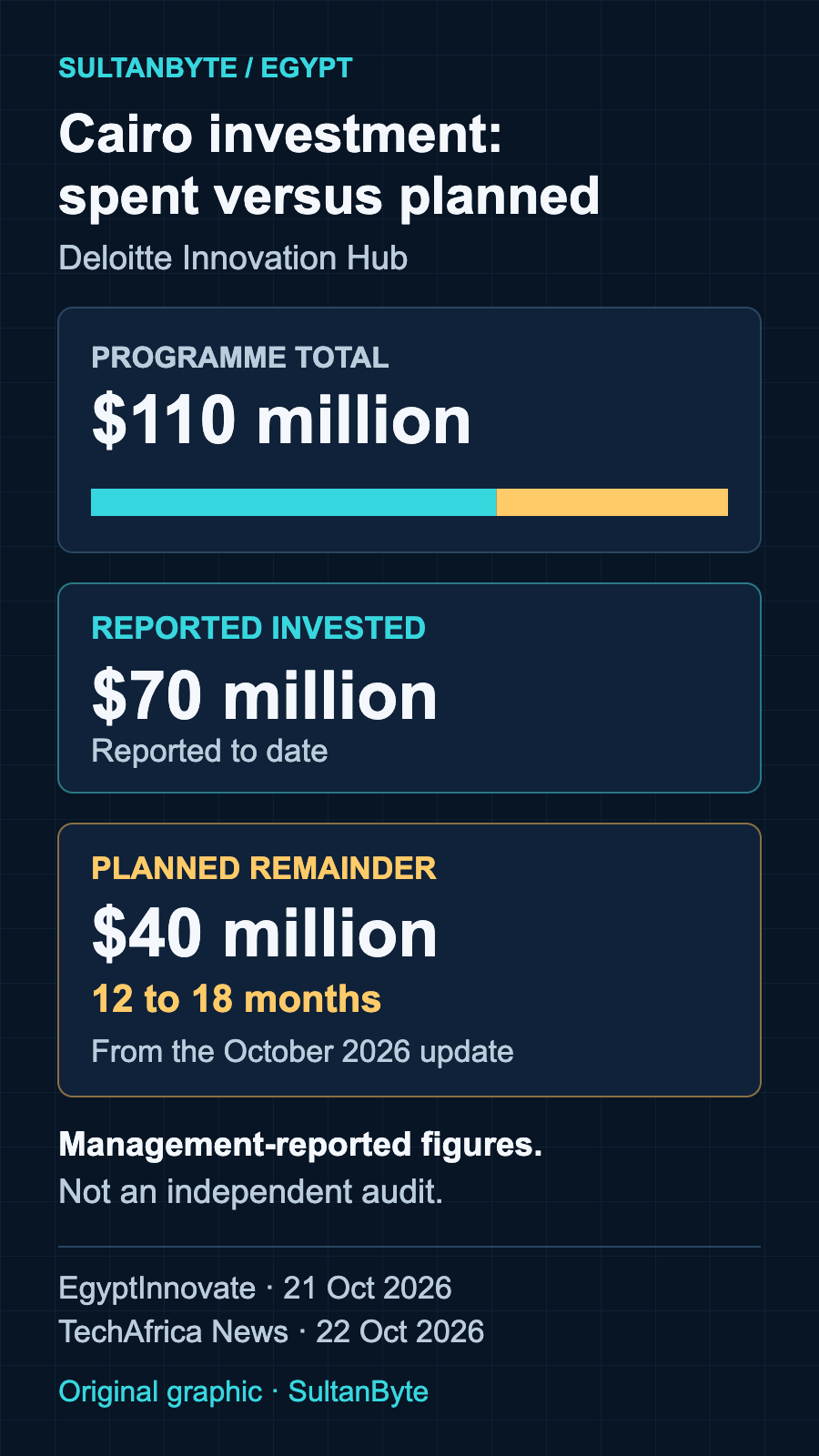
Original infographic: SultanByte. Figures reported by EgyptInnovate on 21 October 2026 and TechAfrica News on 22 October 2026. The future window is relative to that update; it is not a completion guarantee.
Egypt's role is delivery, not a single regional market
There is a useful comparison outside professional services. Alshaya's April 2026 announcement describes its own Global Talent Centre in Egypt, supporting the group's international operations through functions including IT and customer care. That is a company-run shared-services model, whereas Deloitte describes services for external clients. The two should not be treated as interchangeable suppliers.
They do show two ways an organisation can build delivery capacity in Egypt: establish its own operation or contract with a services provider. Choosing between them depends on the work, management capacity and how much expertise the organisation wants to retain internally. Neither announcement establishes a reliable market-wide price advantage or a shortage of particular skills.
For a Saudi or UAE client, a Cairo team also introduces questions that an Egyptian office address cannot answer. Where will production data be processed? Which staff need access? Who owns support outside normal working hours? Assess each destination and workload separately rather than writing one approval for “MENA”.
A development team can work in one country while the application runs elsewhere. Buyers should document the actual arrangement, including remote support and diagnostic access, before sending production records to a proposed team. This article does not determine which legal permissions a particular deployment requires.
An AI experience centre is a starting point
Deloitte's March 2025 description of its Google Cloud AI Experience Centers includes Cairo and describes workshops, demonstrations and access to technologies such as Gemini and Vertex AI. That is useful evidence of an established demonstration and development offering. It is not evidence that every demonstrated application is running successfully for customers.
Use an initial workshop to produce something a buying team can inspect: a workload definition, a proposed architecture and a list of unresolved dependencies. For an Arabic document-search assistant, for example, ask how the team will handle contradictory documents, outdated policies and questions without an answer. The example is a proposed evaluation task, not a reported Deloitte deployment.
Keep the pilot in a client-controlled repository and use approved test material. Require a specialist who understands the actual documents to review answer quality. A convincing demonstration should lead to a testable scope, not an automatic production commitment.
Buy a team and a handover, not a headcount
Before accepting a proposal, ask the provider to identify the people responsible for architecture and day-to-day delivery. Distinguish staff already allocated from roles that must still be hired. Agree how substitutions work and whether the client can reject a replacement whose skills do not match the contracted role.
Then specify what the client receives. For a cloud migration, that might include infrastructure definitions, a tested recovery procedure and an inventory of operational responsibilities. For an AI application, it should include the evaluation set and the process for reviewing a model change. These are proposed acceptance requirements, not claims about the hub's current contracts.
Price the work against those deliverables. Separate provider fees from cloud consumption and licences, and identify who pays when a trial expands. Avoid comparing hourly rates while leaving senior supervision or production support outside the comparison.
A handover exercise should happen before the final acceptance decision. Have the client's team deploy a change, investigate a failed request and recover the service using the delivered documentation. If the provider must perform every step, the client has not yet demonstrated independent operational readiness. That may be acceptable under a managed-service contract, but it should be a deliberate choice.
What would make the next update more useful
The reported $40 million remainder gives buyers a reason to examine Cairo's expanding delivery options. More useful evidence would connect that spending to specialist availability, completed work and customer references that prospective clients can check.
For now, a practical next step is a bounded engagement with an identified team and an acceptance test the client controls. Expand the scope after that team demonstrates it can deliver and transfer the agreed work. The investment programme supplies context; the contract still needs its own evidence.
About the author
- I have lead the Engineering for multiple startups in UAE. I also have my own agency qualascend.com.
Comments
Join the discussionNo comments yet. Be the first to comment.