Emirates NBD and OpenAI: UAE inference and bank controls
The planned UAE deployment puts model location in focus, while data access, decision authority and recovery still need separate review.
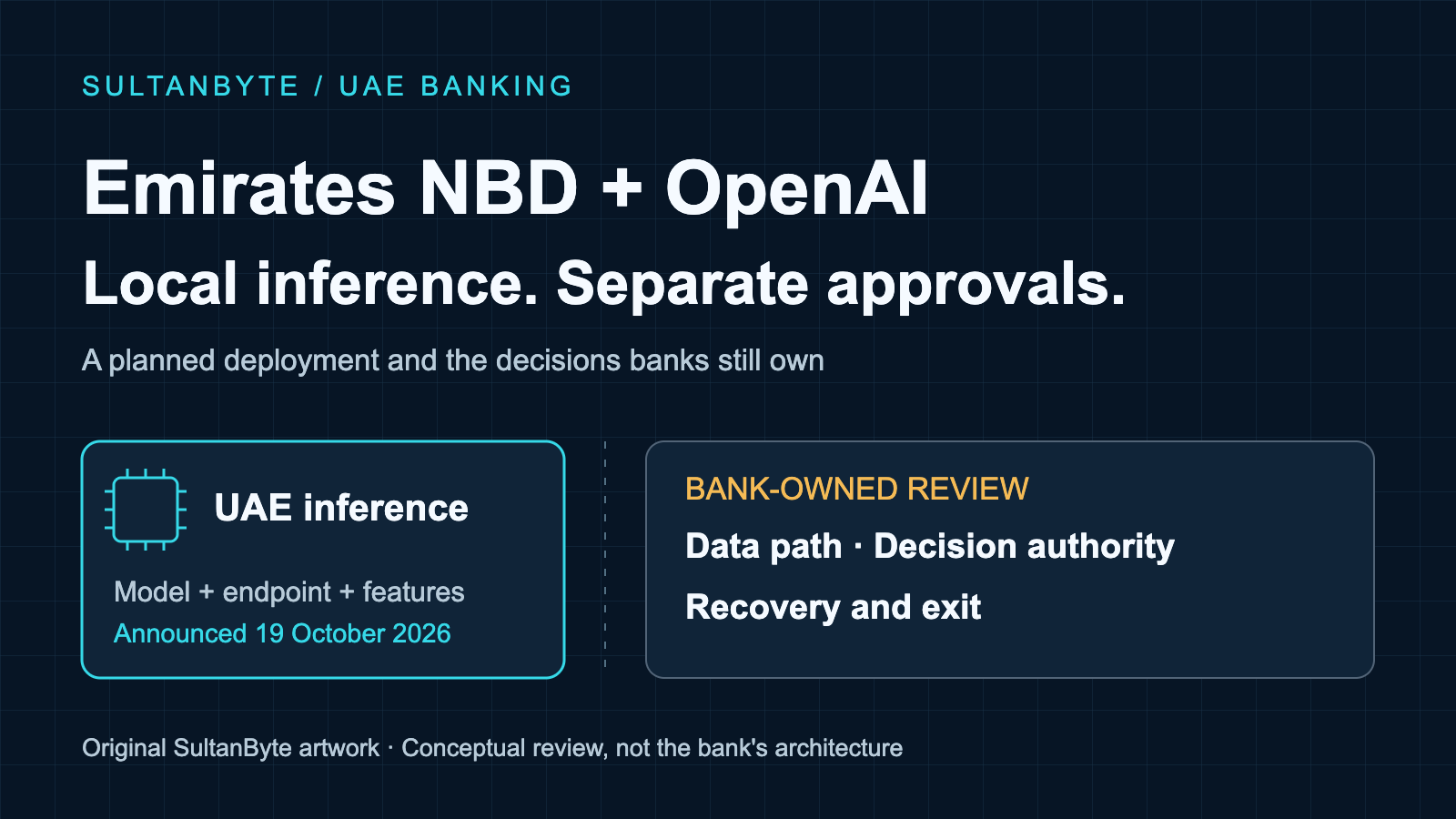
Emirates NBD plans to deploy OpenAI's GPT models using inference infrastructure inside the UAE. For banking technology teams, the announcement raises a useful procurement question: what does local model processing settle, and which decisions still belong to the bank?
The 19 October announcement describes future deployment across customer engagement, risk and compliance analytics, knowledge-intensive workflows and employee productivity. It also proposes connections to internal systems, APIs and enterprise data. Those connections deserve as much scrutiny as the location of the model.
The practical opportunity is a locally processed AI service that can be assessed against specific banking workloads. The public evidence does not yet establish operating results, a rollout timetable or an approved architecture for every use case.
Cover: original SultanByte artwork showing UAE inference beside the bank's separate data, decision and recovery responsibilities.
A deployment plan, not a performance result
Emirates NBD and OpenAI describe the arrangement as the first of its kind for a MENA bank. That is their claim, not an independently established regional ranking. Gulf News's coverage also describes what the bank will deploy; it does not provide customer outcome measurements or independent technical validation.
The release names no model version, production launch date or workload benchmark. It does not say how much staff time the system has saved, how accurately it handles Arabic banking questions, or whether any customer-facing application is already operating under this collaboration.
Buyers can still learn something from the scope. A staff drafting assistant and a system connected to customer records require different permissions. A tool that prepares an analyst's briefing should not inherit authority to change a customer's account merely because both use the same model service. Treat each proposed application as its own approval decision.
UAE processing is available under conditions
OpenAI's platform data-controls documentation lists the UAE as supporting regional storage and processing. It also says UAE selection requires additional approval, and that regional support depends on the endpoint, model and snapshot. A region appearing in the table does not make every feature locally processed.
The same documentation separates customer content from system data, and excludes third-party services from its residency commitment. That distinction matters when an application adds external tools, support systems or telemetry. These are general platform terms, not a description of Emirates NBD's negotiated configuration.
For a bank evaluating a comparable service, request a workload-specific schedule: the exact model, API endpoint, enabled features, retention settings and permitted processing locations. Have the supplier identify exceptions in writing. Make that schedule part of the contractual requirements and require review before changes to the model, features or processing locations take effect.
Then trace an ordinary request and a support incident. Include retrieved documents, generated answers, application logs, backups and any outside tool. Mark who can access each copy. A UAE inference step is meaningful, but it cannot establish the location or access policy of components that sit outside it.
Keep banking responsibility with the bank
The CBUAE Outsourcing Regulation for Banks, shown as in force in the regulator's rulebook, makes banks responsible for the risks of activities they outsource. Article 8 requires prior non-objection for material outsourcing. It also says the Central Bank generally will not permit outsourcing core banking activities and key management and control functions, including risk management and compliance, while considering requests individually.
That makes the announcement's reference to supporting risk and compliance worth reading carefully. Supplying an analytical tool is not, by itself, evidence that the bank has outsourced the underlying control function. Nor does a press release prove regulatory approval for a particular arrangement. The legal and compliance teams must determine the applicable classification and approvals; this article does not assess the bank's compliance.
The regulation also addresses the Master System of Record, confidential customer data and overseas sharing. Procurement therefore needs a data map and a materiality assessment, not a blanket inference that local computing satisfies every obligation.
For the implementation team, translate the approved division of responsibility into permissions. Identify who reviews an output, who can authorise an action and how that authorisation reaches the system of record. Keep the model's ability to suggest an action separate from the application's permission to execute it.
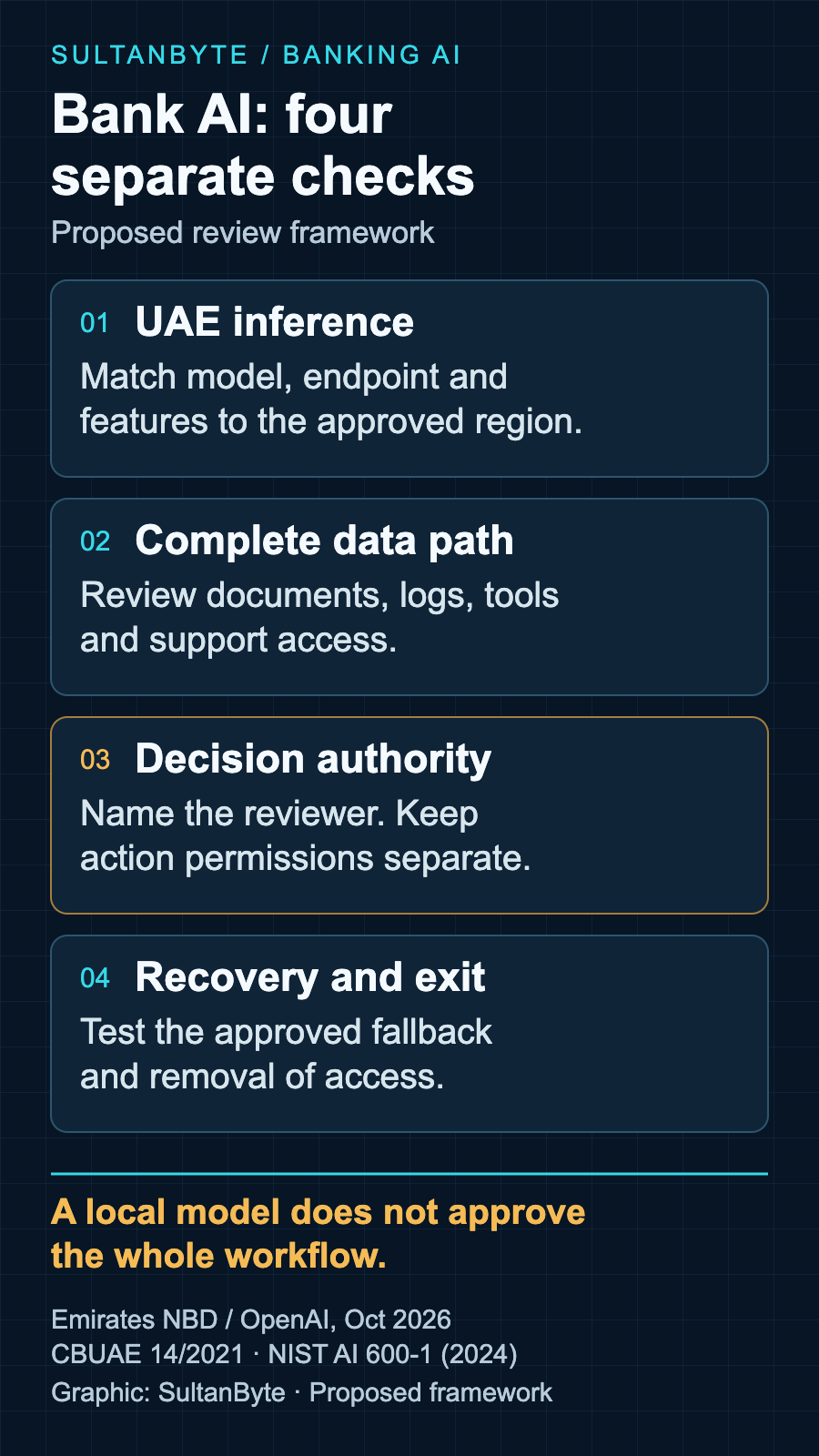
Original infographic: SultanByte. Proposed review framework based on Emirates NBD's 19 October 2026 announcement, OpenAI platform documentation, CBUAE Circular 14/2021 and NIST AI 600-1. It does not depict the bank's implementation or certify compliance.
Test a banking task in both languages
Start an evaluation with an approved, bounded task. One example is helping staff find the applicable passage in an internal product policy, without giving the assistant transaction permissions. Use synthetic or otherwise approved material until the data arrangement has cleared review.
Prepare Arabic and English questions with the same underlying meaning. Include mixed-language requests, outdated documents, similar product names and questions the available policy cannot answer. Have banking specialists check the cited passage and the answer separately. A fluent response can still cite the wrong fee, eligibility condition or policy version.
NIST's Generative AI Profile recommends empirical evaluation of capability claims and testing in conditions resembling deployment. It is voluntary cross-sector guidance, not a UAE banking rule. Here, its useful contribution is to keep the evaluation tied to the intended task rather than a broad model leaderboard.
Measure reviewer corrections and unsupported answers alongside completion time. Decide which mistakes block release before running the trial. A faster draft that takes longer to verify may have little operational value. These are proposed evaluation measures, not reported results from Emirates NBD.
Recovery needs an approved destination
The CBUAE's accompanying outsourcing standards address vendor lock-in, concentration risk, continuity and contingency arrangements. They also specify access-rights management and audit trails. Those requirements reach beyond a successful inference request.
For a proposed staff assistant, rehearse loss of the model service. Staff should still have an approved way to consult the underlying policy. If automated failover is proposed, review the replacement provider, model and processing location before enabling it. An outage should not silently send the same banking records to an unapproved destination.
Procurement should also require an exit procedure covering stored application content, configuration and access removal. Engineering should demonstrate that the fallback works without the supplier's demo team operating it. Keep the test narrow enough that an accountable owner can accept or reject the result.
What to watch next
The announcement gives UAE banking buyers a concrete local-inference proposition to examine. It does not establish equivalent availability or permission for a Saudi, Egyptian or other MENA deployment; those need their own service and regulatory assessments.
The next useful disclosure would name a production workload, its model and processing scope, the human decision boundary and measured results. Until then, a sensible buying decision is to fund a bounded evaluation with an approved data route and a usable fallback. Expand only when that workload's evidence supports the additional access and responsibility.
About the author
- I have lead the Engineering for multiple startups in UAE. I also have my own agency qualascend.com.
Comments
Join the discussionNo comments yet. Be the first to comment.