Kraken's UAE launch: the AED funding test
Payward has an active VARA licence. Its planned dirham launch still needs a working deposit-and-withdrawal journey.
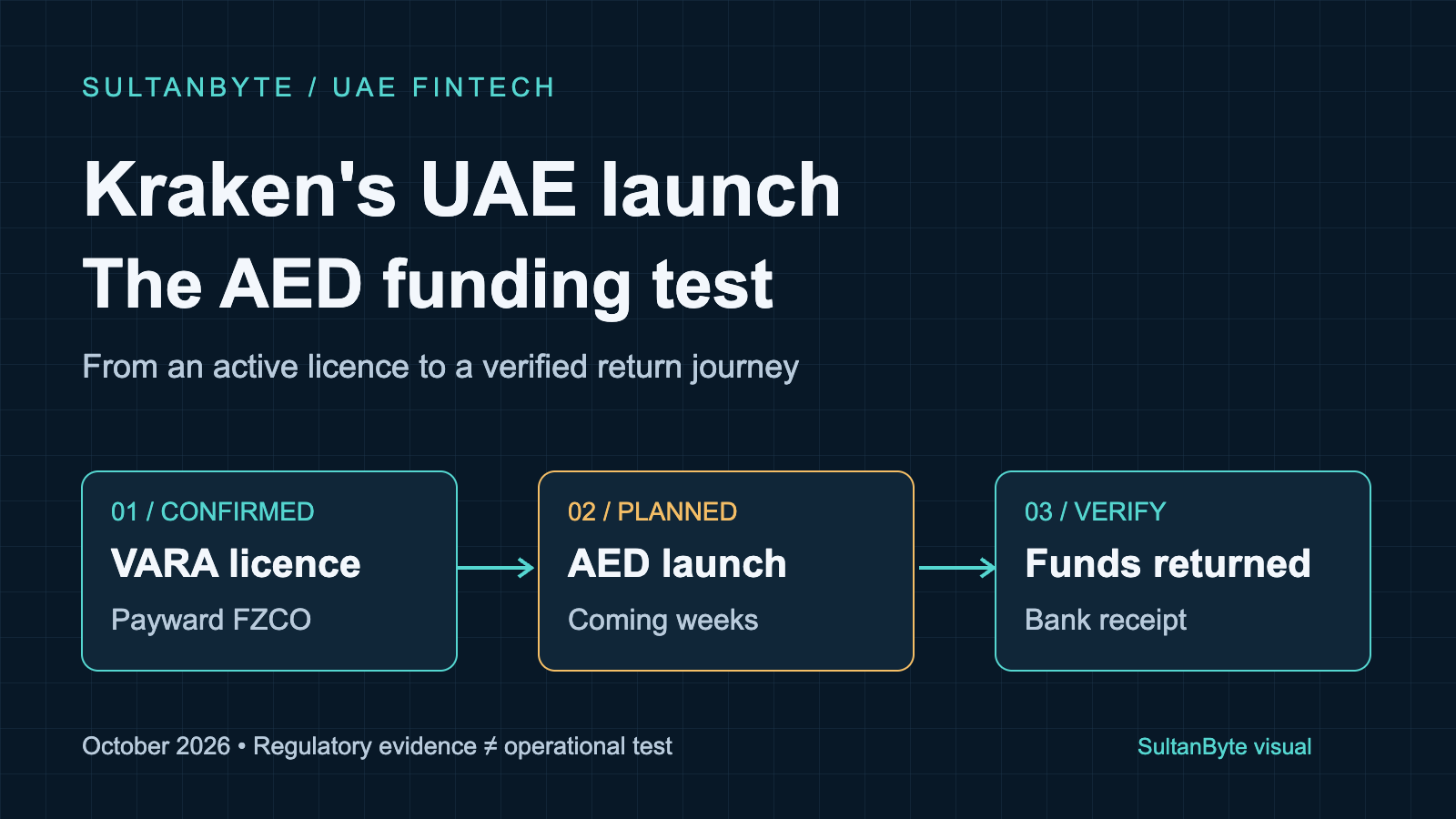
Kraken's planned UAE launch puts a practical question in front of fintech product teams: what must work before a regulated trading service can become a dependable dirham funding route?
Payward, Kraken's parent, announced on 12 October that it had secured Full Market Approval from Dubai's Virtual Assets Regulatory Authority (VARA). It targets a UAE launch in the coming weeks. The announcement is not a statement that the new local service is already live.
The regulator provides the firmer starting point. VARA's record for Payward FZCO shows an active VASP licence, issued on 6 October 2026, covering Broker-Dealer Services and Management and Investment Services. For buyers, the next evidence should be a working customer journey, including the return of funds to a bank account.
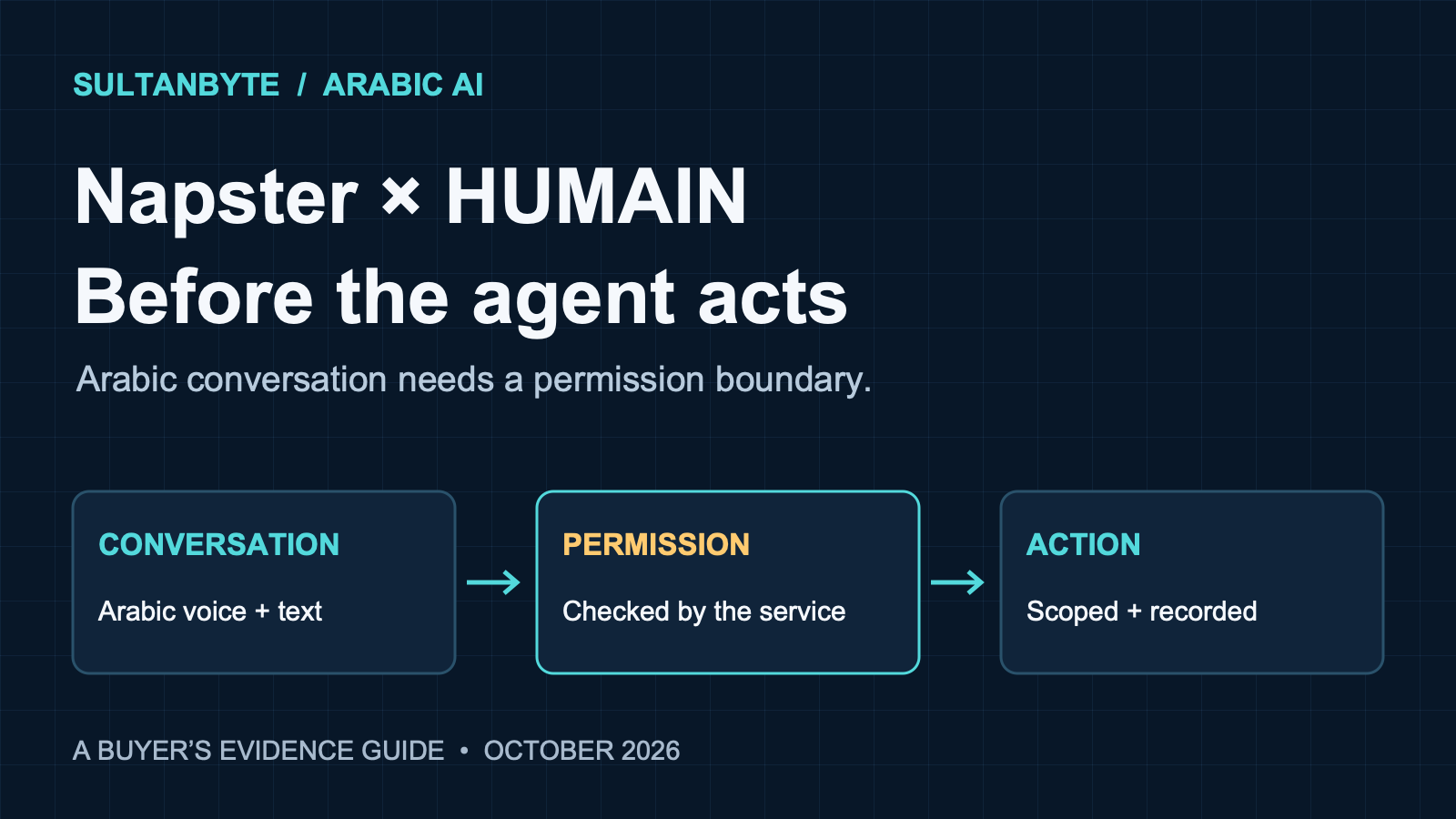
Cover: original SultanByte artwork showing the boundary between regulatory approval, a planned AED launch and operational funding evidence.
What is approved, and what is still planned
The register names Payward FZCO and licence reference VL/26/10/002. It permits the firm to serve institutional, qualified and retail investors. These are the regulator's categories; the company's release uses “professional” in its description of the intended audience.
Payward's proposed launch includes AED-denominated spot and margin trading, direct dirham deposits and withdrawals, on-chain staking, xStocks and transfers through Krak. Institutional offerings include OTC spot trading and Kraken Prime. The company places derivatives and additional yield products later in 2026 and into 2027, subject to regulatory approval.
Do not flatten that list into one availability claim. The active licence, the announced launch package and the conditional roadmap are different records. Finance Magnates' reporting also describes a launch within weeks and derivatives later. It reports the plan; it does not demonstrate that an eligible UAE customer has completed the new funding flow.
VARA's public-register guidance makes the earlier boundary explicit: an in-principle approval does not permit client servicing or virtual-asset operations. Payward has progressed beyond that stage. Operational readiness still needs its own evidence.
AED trading and AED funding are separate tests
An AED-quoted market answers what currency expresses the price. A dirham deposit method answers how money reaches the account. Neither, on its own, establishes withdrawal timing, bank acceptance or the cost of a failed transfer.
For a fintech considering an integration, the useful first deliverable is a funding specification. Request the supported bank-transfer method, beneficiary entity, required payment reference, minimums, limits and fees. Ask which charges belong to the platform and which may come from banks. Obtain separate deposit and withdrawal expectations, including how weekends, bank holidays and compliance reviews affect them.
Kraken's cash-deposit documentation, dated 1 October 2026, illustrates why launch-specific instructions matter. Its supported-currency list does not include AED. It also warns that the public information may not be current and directs customers to their account's funding page for the latest details.
That absence does not disprove the announced launch. It means the general support page cannot yet serve as an AED implementation contract. Do not copy another currency's transfer instructions, fees or processing time into a UAE product specification.
The same documentation says the transfer currency must match the selected deposit method, and a wrong-currency payment may be returned or incur charges. Make currency selection explicit in the interface. A translated label or an account balance displayed in AED should never silently select a different funding currency.
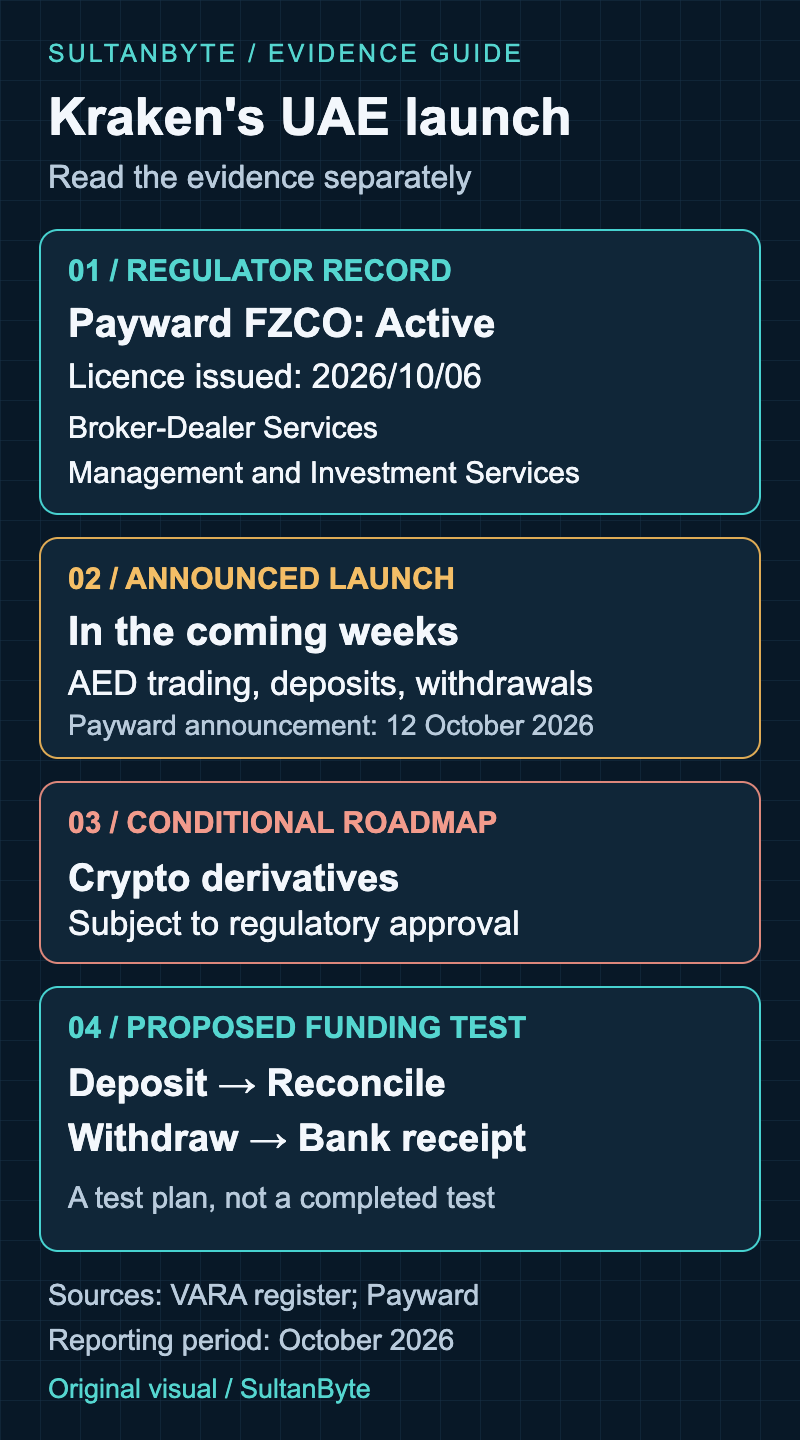
Original infographic: SultanByte. Regulatory status from VARA; launch plans from Payward's 12 October 2026 announcement. The funding test is an editorial proposal, not a completed platform test.
Keep the regulatory geography attached to the contract
Dubai, DIFC and ADGM should not appear as interchangeable jurisdiction labels in a procurement file. VARA describes its remit as Dubai's mainland and free zones, excluding the Dubai International Financial Centre.
Within DIFC, the Dubai Financial Services Authority's updated Crypto Token framework took effect on 12 January 2026. Its changes include making firms responsible for documented token-suitability assessments rather than relying on a regulator-published recognised-token list. That is a separate framework, not an extra permission conferred by Payward's VARA licence.
In Abu Dhabi's ADGM, the official digital-assets framework says firms carrying on the relevant financial services must apply for Financial Services Permission from the FSRA. A reference to “UAE regulation” is therefore too broad to identify the authority behind a particular contract.
This comparison concerns regulatory locations, not a claim that a Dubai customer necessarily needs three approvals. Ask counsel to establish the applicable permissions for the proposed business model, customer location and service. For a Saudi expansion, start a separate eligibility and permissions review; this announcement provides no Saudi launch commitment.
Keep the contracting entity and service-specific terms alongside the integration design. SultanByte's Fasset licence-map analysis explains why a group's wider footprint cannot substitute for an entity-level record.
Build the pilot around the return journey
Payward also proposes embedded trading infrastructure for regional partners. A branded interface can hide which party owns a stalled payment, so an integration pilot should begin with responsibility assignments rather than screens.
Agree who handles onboarding, funding exceptions and customer complaints. Establish which system records the authoritative cash balance, how the partner receives status changes, and how support correlates a bank reference with a platform transaction. Document what happens when the bank says a transfer was sent but the trading account has not credited it.
A proposed acceptance test should follow one authorised funding journey through deposit recognition, ledger reconciliation and withdrawal back to the approved bank account. Use the provider's approved test environment where available. Any live-money testing needs explicit approval, eligibility checks and a bounded amount; this is not a recommendation to trade or hold cryptoassets.
Record the timestamps and identifiers at each step. Test an incorrect reference through an agreed test mechanism, a pending review and a lost notification. A notification retry should update an existing record rather than create another credit. Keep a reconciliation path that can discover a completed transaction even when the event delivery failed.
For an Arabic-and-English product, show the same beneficiary, currency and payment reference in both languages. Let users copy the reference without altering it. Support teams should be able to inspect the underlying identifiers rather than guess from a screenshot of translated status text.
Set a release condition, not a headline deadline
The announcement gives UAE teams a reason to begin diligence, but not a reason to promise customers a launch date. Keep unreleased products out of the initial business case and do not turn a conditional derivatives roadmap into expected revenue.
Release the integration only when the eligible customer flow, AED funding instructions, contractual responsibilities and reconciliation results agree. The concrete next milestone is a documented deposit-and-withdrawal journey with resolved exceptions. VARA's active licence establishes the regulatory status; the product team still has to establish how its own service will operate.