Graceful shutdown for MENA APIs on Kubernetes
Coordinate routing, in-flight requests and durable outcomes before a deployment stops an API instance.
A deployment can finish successfully while a customer's request fails halfway through. The replacement pods are healthy, the old pods disappear, and the release dashboard turns green. None of those signals proves that an invoice submission or a long-running API request survived the handover.
For a MENA SaaS team operating separate Saudi and UAE deployments, shutdown deserves a test in each actual traffic path. Different ingress controllers, load balancers and application settings can produce different results from the same container image. Moving traffic across countries is not a substitute for fixing a local rollout, and this guide makes no claim about the legality of cross-border failover.
The approach below is a proposed engineering review for Kubernetes-hosted HTTP APIs. It separates routing withdrawal, application draining and business-operation recovery. It is not a benchmark or a promise of zero downtime.
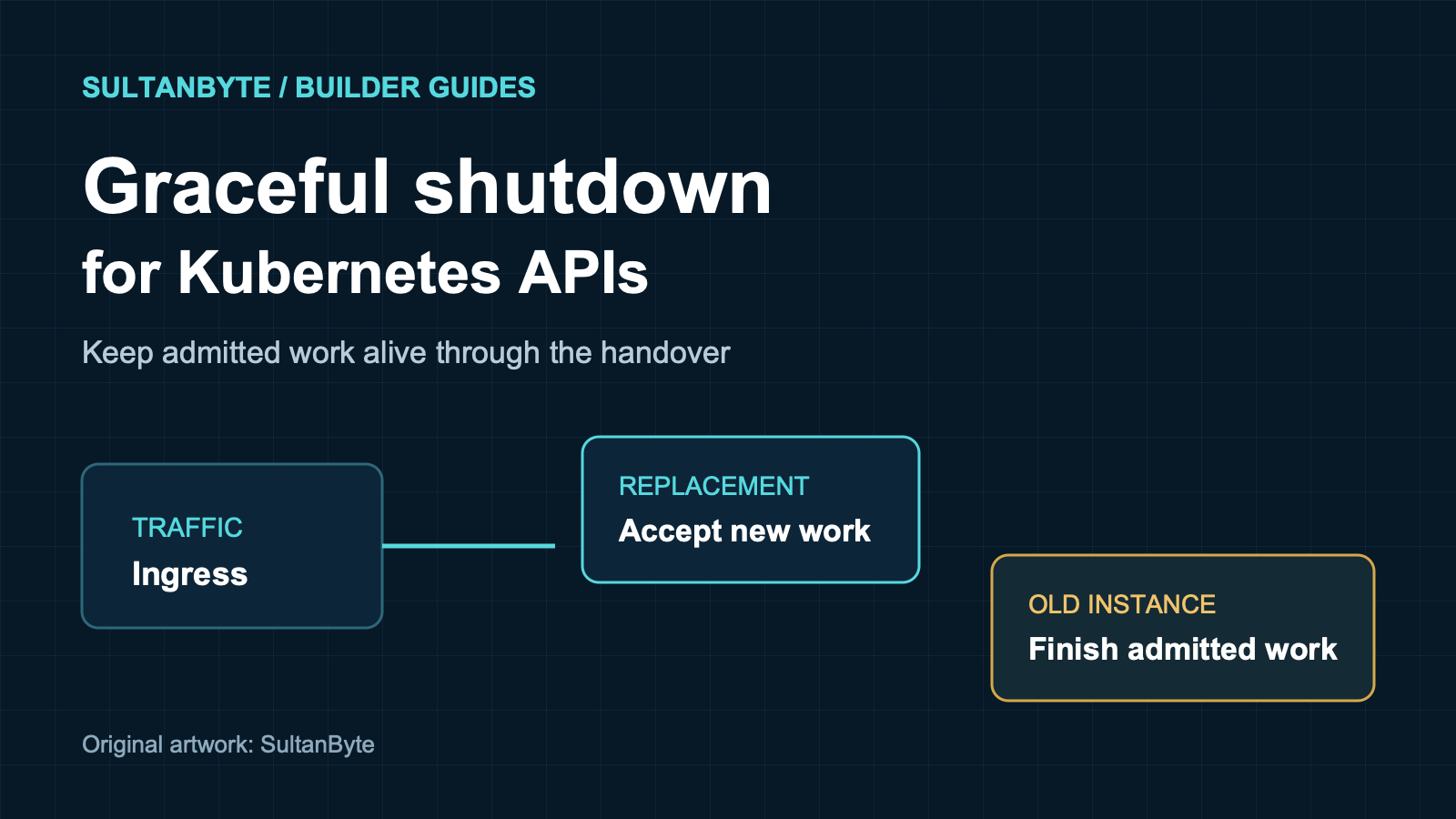
Cover: original SultanByte artwork showing traffic moving to a replacement API while an old instance finishes admitted work.
Readiness is not a shutdown handler
Kubernetes gives probes different jobs. Its probe documentation distinguishes readiness, which controls eligibility to receive traffic, from liveness, which can trigger a container restart. A startup probe delays the other probes until startup succeeds.
Give these endpoints deliberately different meanings. During an orderly drain, the process may be healthy enough to finish requests while no longer being suitable for new traffic. Treating that state as a liveness failure can turn a controlled handover into a restart.
Avoid making a shared database outage an automatic liveness failure for every API replica. Review whether restarting those processes would repair anything. Readiness may depend on a critical dependency, but consider what happens when every replica makes the same decision at once.
For shutdown, add an explicit application state. Make the transition into draining idempotent, so a hook and a signal cannot start competing cleanup routines. Record when draining began, how many requests were already admitted, and which work remains. Keep recovery actions separate from ordinary readiness polling; a health check must not initiate shutdown.
Treat termination as overlapping work
The Kubernetes pod lifecycle documentation describes local container shutdown alongside control-plane changes to endpoints. These are not one synchronous operation. A preStop hook runs before the runtime sends the stop signal, but its execution consumes the pod's termination grace period. Work still running when that period expires can be killed.
Terminating endpoints carry a terminating condition and have ready set to false. That control-plane state is not evidence that every proxy has already stopped using the old instance. Test the propagation through your ingress and load-balancing implementation rather than assuming an instantaneous handover.
A fixed sleep in preStop can reserve time for routing changes, but it cannot prove they have finished. If you use one, justify its duration with observations and include it in the shutdown budget. Do not spend the entire grace period sleeping and leave the application no time to finish work.
Write down the intended sequence: begin withdrawal, stop admitting new work at a defined point, finish or safely abandon admitted work, then close dependencies. Some of those activities can overlap. The required property is that the process remains available for the work it has promised to finish, not that every component follows an identical timer.
Align the load balancer with the application
A pod grace period and a load-balancer drain timeout belong to different systems. Increasing one does not extend the other.
For example, AWS documents Application Load Balancer target deregistration as stopping new requests to deregistering targets while allowing a configured delay for completion. AWS also warns that a target closing a connection before that delay ends can produce a 500-level response. This is ALB-specific documentation, not a description of every Kubernetes ingress.
Inspect how your controller maps pods or nodes to targets. Record which event initiates deregistration, which component observes readiness, and what happens to existing connections. A service mesh adds another participant whose shutdown behaviour needs inspection.
Use a budget worksheet rather than copying timeout values from another team's manifest:
- Routing withdrawal: what event starts it, and how is propagation observed?
- Admission boundary: when does the application stop taking new work?
- In-flight deadline: how long may an admitted request continue?
- Cleanup allowance: which resources must remain open until requests finish?
- Forced exit: what survives if the process runs out of time?
Choose values from your supported request durations and measured handover behaviour. An indefinitely open stream cannot fit inside a finite shutdown deadline; it needs a reconnect protocol. A long report should usually become a durable background job rather than forcing every deployment to wait for the report's entire execution.
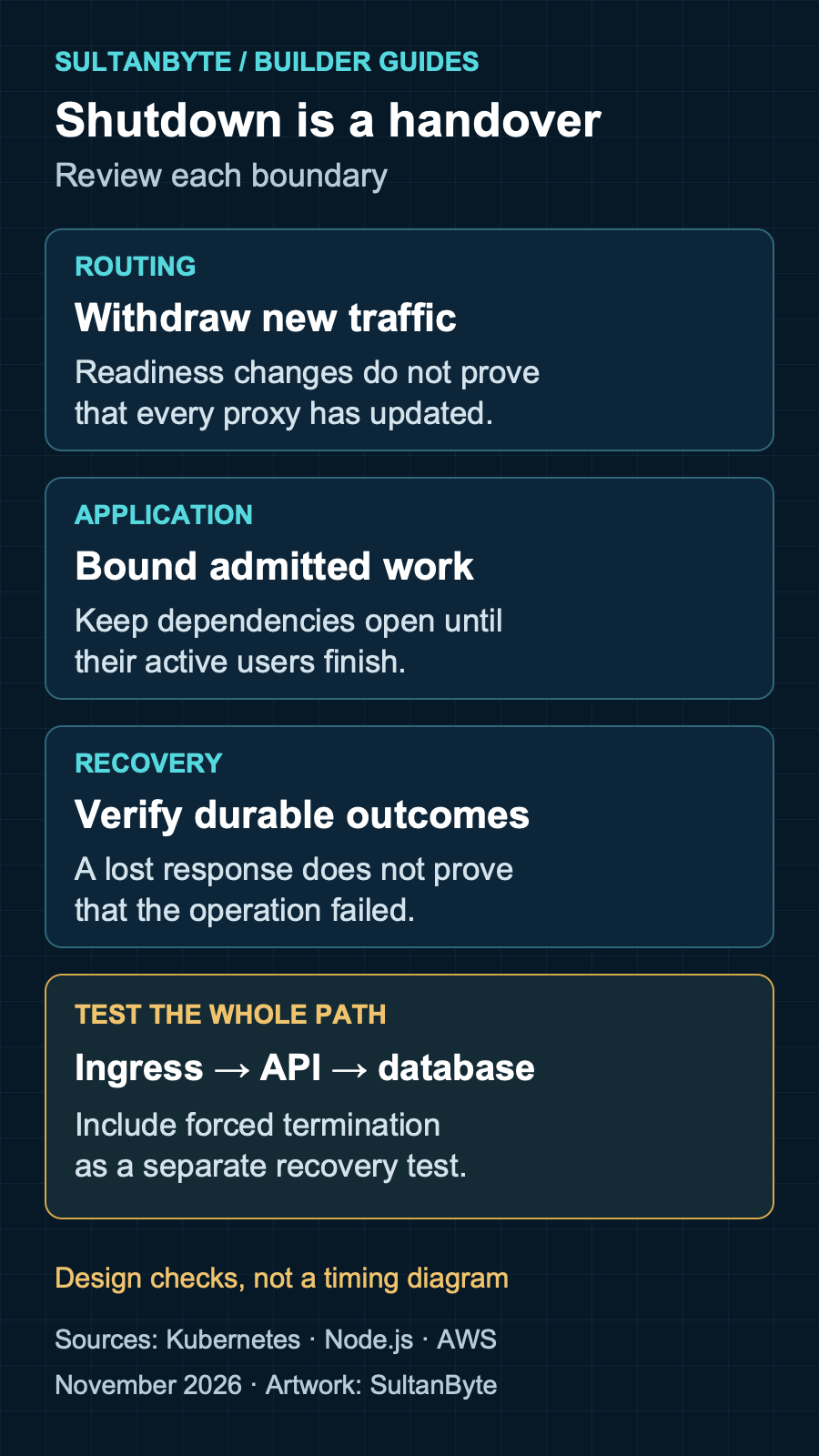
Original infographic: SultanByte. Proposed shutdown review informed by Kubernetes, Node.js and AWS documentation, November 2026. The cards are design checks, not a timing diagram or measured results.
Close the server before its dependencies
For Node.js HTTP/1 workloads, inspect the exact runtime and framework behaviour rather than treating every close method as graceful. The Node.js HTTP reference says server.close() stops accepting new connections and closes idle connections. Its closeAllConnections() method is forceful: it also closes active HTTP connections. The reference explicitly excludes upgraded sockets, such as WebSockets, from that method's coverage.
The application therefore needs a separate policy for active handlers and long-lived protocols. Keep the database pool available while admitted handlers still need it. Closing the pool as the first signal-handler action can break precisely the requests the drain was supposed to protect.
Use this as a design outline, not drop-in implementation code:
- Enter draining state once and record the shutdown deadline.
- Coordinate routing withdrawal and the chosen admission boundary.
- Stop acquiring new background work; track already-owned work separately.
- Wait for admitted requests within their bounded deadlines.
- Close dependencies after their last users finish.
- On deadline expiry, record unfinished operation identifiers and apply the recovery policy.
Verify that the application receives the configured stop signal through its container entrypoint. Test the built image, not just a process started from a developer's shell. Include cleanup failures: an unavailable logging endpoint must not leave shutdown waiting forever.
For SSE or WebSocket clients, design reconnection and state recovery explicitly. The browser should distinguish a temporary disconnect from a completed business action. SultanByte's SSE recovery guide addresses recovering dashboard state after the connection returns.
A failed response does not prove a failed operation
Consider an invoice submission that commits to the database just before the process exits. The client may receive no response even though the invoice exists. Automatically retrying it as a new operation can create a duplicate.
The proposed acceptance criterion is an identifiable durable outcome. Give retriable business mutations an operation identity and define how a client retrieves their result. Keep deduplication and the business change coordinated at the authoritative storage boundary. A request counter reaching zero is not enough to establish this property.
During the shutdown test, interrupt requests before admission, while processing, and after commit but before response delivery. Check the stored result as well as the HTTP status. The desired behaviour differs: work that never began may be retried; committed work should be discoverable without executing it again.
Do not assume all HTTP errors are safely retriable. State the retry policy per operation and enforce it on the server. For Arabic and English interfaces, preserve the same operation identifier across language changes and show a recoverable pending state when the outcome is unknown. Translation must not turn an uncertain submission into a confirmed failure.
Rollout capacity is a separate constraint
The Deployment documentation defines maxUnavailable and maxSurge for rolling updates. It also warns that terminating pods can continue consuming resources, so total resource use can temporarily exceed the simple replica-plus-surge expectation.
Budget for overlap. Old pods that are draining may still hold database connections while replacements establish their own pools. Include that overlap in the database connection budget, along with workers and operational access. A generous grace period can increase the time those resources coexist.
Do not use a PodDisruptionBudget as proof that a deployment is safe. Kubernetes' disruption guidance explains that workload controllers are not constrained by PDBs during rolling updates. PDBs govern supported eviction paths; they do not prevent involuntary failures or protect direct pod deletion.
Test node maintenance and application rollout separately. For each regional deployment, confirm spare scheduling capacity and the availability of replacement pods. A drain that works with idle replicas may fail under normal load when replacement capacity is unavailable.
Make the release test observe the customer outcome
Run the acceptance test through the real ingress path in a safe environment. Exercise short reads, slow requests, a durable mutation and any supported streaming protocol. Trigger an ordinary rollout, then a controlled node drain. Test forced termination separately as a recovery case, not as evidence of graceful behaviour.
Capture routing changes, application drain entry, admitted-work counts, dependency closure and process exit on a shared timeline. Compare those events with client-visible errors and durable operation results. Set pass criteria before the test; do not redefine a dropped request as acceptable because the release eventually completed.
Repeat against each deployment configuration that differs materially. Record the Kubernetes, runtime, ingress and controller versions with the results. For the engineering lead, the useful deliverable is a tested shutdown contract. For the product owner, it is a clear answer to what the customer sees and how an uncertain operation is recovered.
A green rollout remains useful. It just needs to be accompanied by evidence that the old instance stopped accepting responsibility before it lost the ability to fulfil it.
About the author
- I have lead the Engineering for multiple startups in UAE. I also have my own agency qualascend.com.
Comments
Join the discussionNo comments yet. Be the first to comment.
Builder Guides
Practical architecture, engineering, security and implementation guides for teams building technology in MENA.