Scale AI in Qatar and UAE: what buyers should verify
Qatar's office expansion and the UAE entity represent different commitments. Buyers need delivery scope, operating evidence and a workable handover.
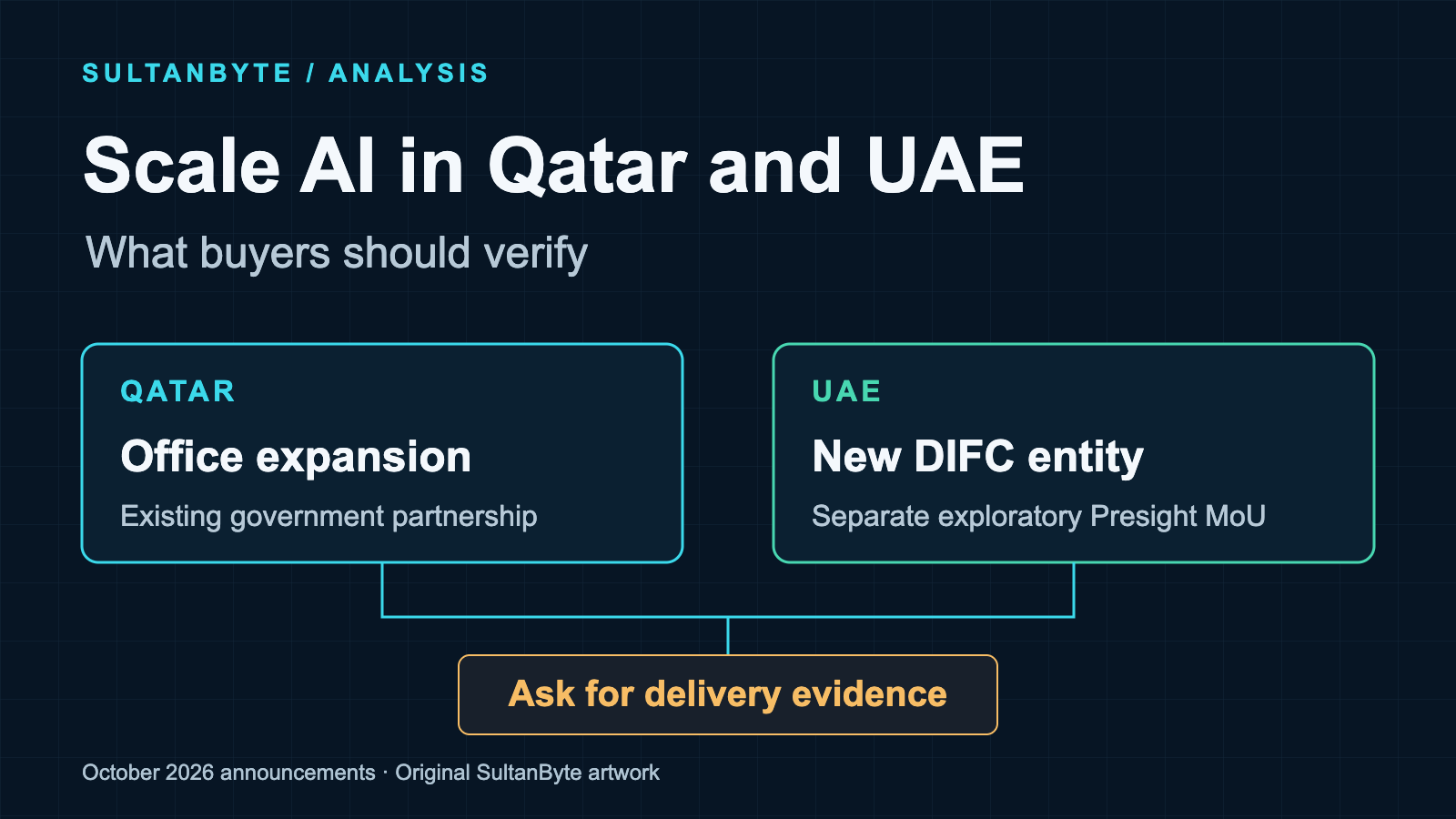
Scale AI's latest Gulf expansion has two different starting points. In Qatar, the company is enlarging its base around an existing government partnership. In the UAE, it has announced a local entity at Dubai International Financial Centre and a separate collaboration proposal with Presight.
Those developments make local delivery teams easier for buyers to reach. They do not establish that the same product, deployment arrangement or operating results are available in both countries. A procurement review should preserve that distinction instead of treating a regional office announcement as a completed implementation.
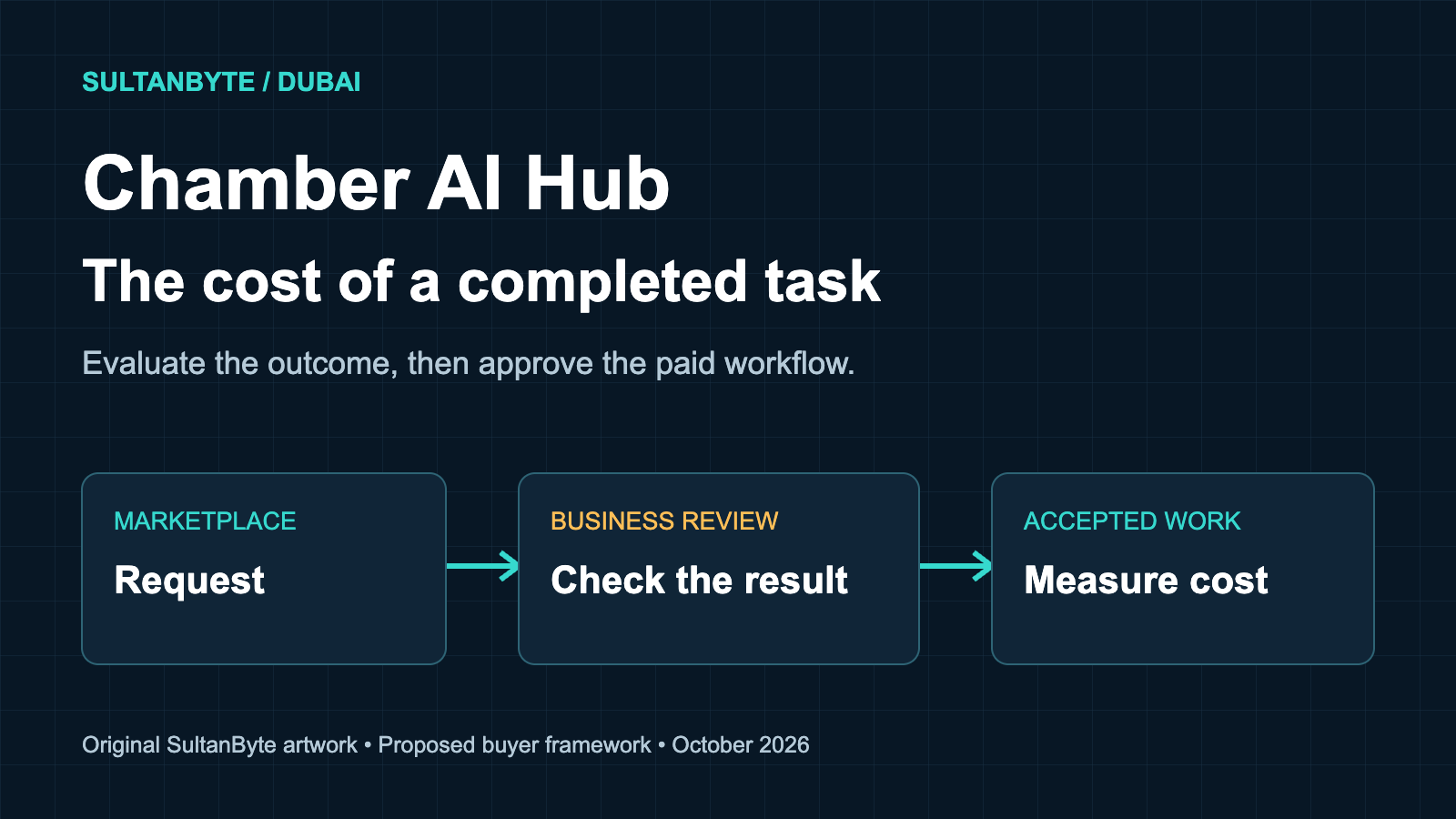
Cover: original SultanByte artwork comparing Scale AI's Qatar expansion with its new UAE entity. The connecting lines represent procurement questions, not data flows.
Qatar adds space around an existing programme
On 28 October 2026, United Development Company announced an agreement to establish Scale's long-term home at UDC Tower on The Pearl Island in Doha. The office is described as nearly 2,000 square metres. The agreement builds on the five-year partnership announced with Qatar and its Ministry of Communications and Information Technology at Web Summit Qatar 2025.
Scale's own account of the expansion says its Doha team has grown to nearly 100 employees, with close to 50% being technical engineers. It describes work across healthcare, justice, education, tourism and broader government. These are company-reported staffing and activity claims. The property agreement supports a physical commitment; it does not independently measure the performance of those applications.
That distinction matters when asking for references. A prospective customer can request a comparable workflow, the scope delivered by the local team and permission to speak with its operating owner. The size of an office is a poor substitute for that conversation.
Training is visible; its business effect needs a separate measure
There is a public institutional record behind the skills programme. MCIT announced ALIF in December 2025, in collaboration with Scale and delivered through the Qatar Digital Academy. It describes practical training for technical and non-technical government employees.
Scale now says it has helped nearly 6,000 government employees develop AI skills. UDC repeats a nearly 6,000 trained-or-upskilled figure. The repetition is not an independent assessment of competence or productivity, and the older MCIT announcement does not verify the current total.
For an agency buying a similar programme, separate attendance from the ability to operate a service. Ask staff to demonstrate the work after training: recognise an unsupported answer, route an exception and recover when the tool is unavailable. Then measure whether the department completes its actual workload with fewer corrections or less staff effort. Those are proposed acceptance measures, not reported outcomes of ALIF.
The UAE announcement describes a different stage
Scale announced its UAE entity on 26 October. DIFC's release, dated 27 October, places it at the Dubai AI Campus and describes the signing during the Dubai AI Festival. The National also reported the office announcement on 26 October. The records differ by a day; they describe the same launch, not two successive openings.
DIFC describes Scale's intended work as helping institutions build, evaluate and improve AI, including Arabic-language systems and local governance requirements. That establishes the proposition being offered. It does not supply a customer-specific architecture, an Arabic acceptance score or a production service-level commitment.
The related Presight memorandum, announced on 8 October, is explicitly exploratory. It covers possible agentic applications, evaluation, governance and scenario simulation for government and enterprise customers. Presight names critical sectors such as water, power, healthcare and transportation as potential areas of work.
A memorandum to explore collaboration is not a catalogue of jointly available products. Buyers should ask which party would contract, which components exist today and which would be developed for the engagement. Do not put a proposed joint offering on a production dependency list before those answers are documented.
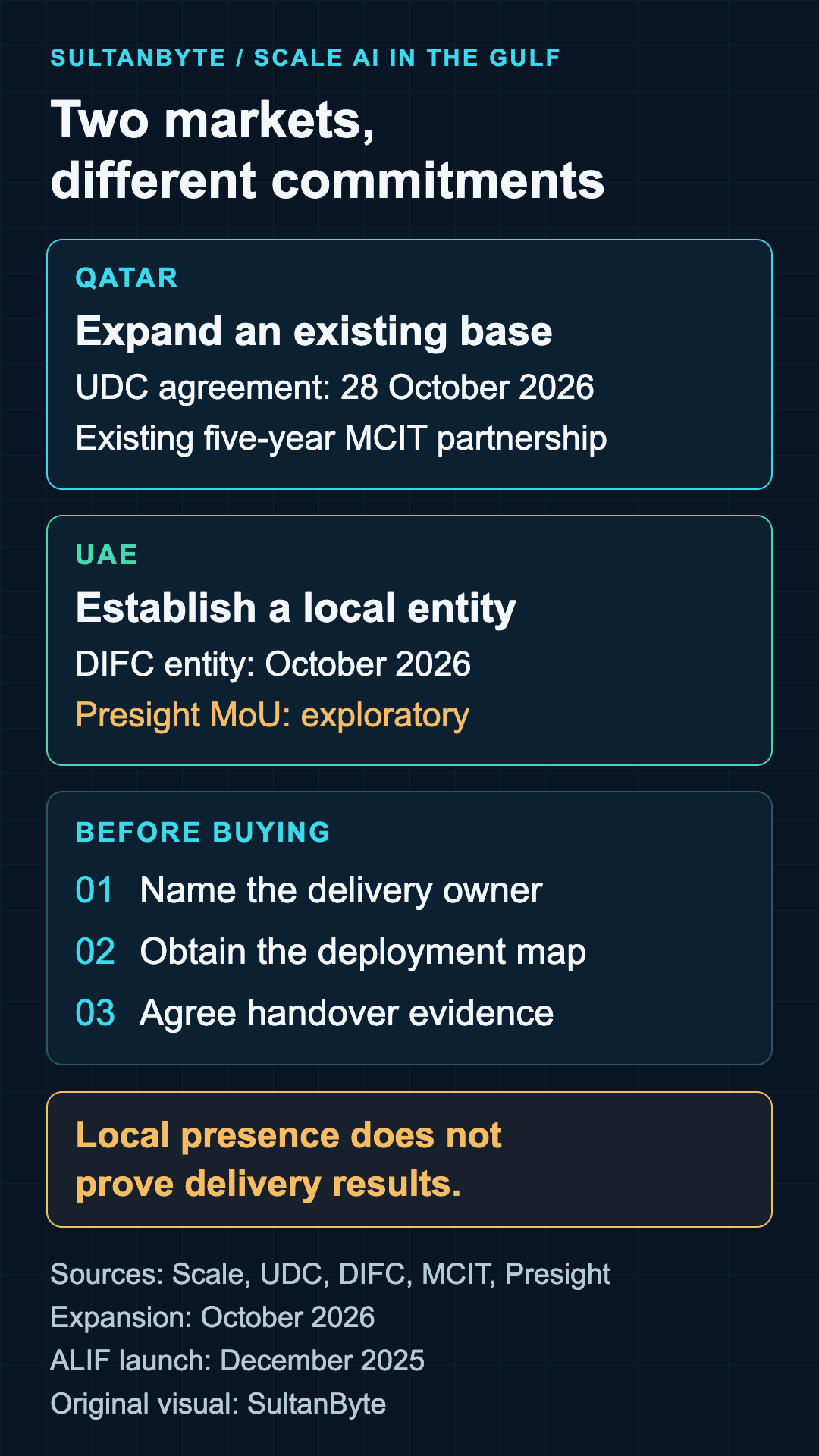
Original infographic: SultanByte. Based on Scale, UDC, DIFC, MCIT and Presight announcements. Expansion reporting: October 2026; ALIF launch: December 2025. Buyer questions are SultanByte's proposed review framework.
Specify what the local team will actually own
The useful comparison is the delivery arrangement for a particular customer, not a ranking of Qatar against the UAE. Qatar's existing programme may offer relevant reference work. A UAE entity may make local engagement more practical. Neither announcement automatically transfers an application, approval or contractual promise from one market to the other.
For a proposed project, request a named delivery lead and a responsibility map. Identify who prepares the data, operates the application and decides whether a release is acceptable. State which work the local team performs and what depends on overseas specialists or other suppliers. Make escalation available after the implementation team leaves.
Include the customer in that map. A department must own its service rules and the consequences of acting on an answer. If the supplier builds both the application and its evaluation, retain customer-controlled acceptance cases and review of disputed results. A good supplier evaluation helps the buyer; it should not become the buyer's only evidence.
Price the handover, not only the demonstration
Ask for the evaluation materials and operational artifacts the customer will receive. That could include the agreed test cases, scoring rubric, configuration record and runbook, with ownership and reuse rights settled in the contract. Do not assume the engagement transfers underlying models or proprietary tooling.
An Arabic service needs examples from its intended users and domain. SultanByte's Arabic LLM evaluation guide covers the detailed testing approach. Here, the procurement question is who will maintain those cases when policies, models or users change, and whether that work is included in the price.
Request a deployment diagram as well. It should identify processing, storage, support access and any external services. A company's address in Doha or Dubai does not establish where every request goes. Have the organisation's legal and security owners assess the proposed arrangement for that workload; this comparison does not certify either company's compliance.
Finally, test a handover using the customer's staff. Can they investigate a failed answer, stop a risky action and continue the underlying service without the demonstration team? Record the support commitments and the cost of maintaining that capability. Training seats and implementation fees alone will not answer those questions.
What would justify a larger commitment
The next useful evidence is a named deployment with a defined task, an accountable operating owner and results measured against the previous process. For investors, that is more informative than adding office announcements together as if they were contracted revenue. For technology buyers, it is the basis for deciding how much responsibility to entrust to a supplier.
Scale's Qatar expansion and UAE entity give customers concrete teams and partnerships to investigate. Start with the delivery scope that can be demonstrated in the relevant country. Expand the contract when the customer can verify the work and operate what is handed over.
About the author
- I have lead the Engineering for multiple startups in UAE. I also have my own agency qualascend.com.
Comments
Join the discussionNo comments yet. Be the first to comment.