UAE Vibe Codes: from prototype to production review
The new public coding experience opens up prototyping. Employers still need a separate decision before connecting an app to real users and data.
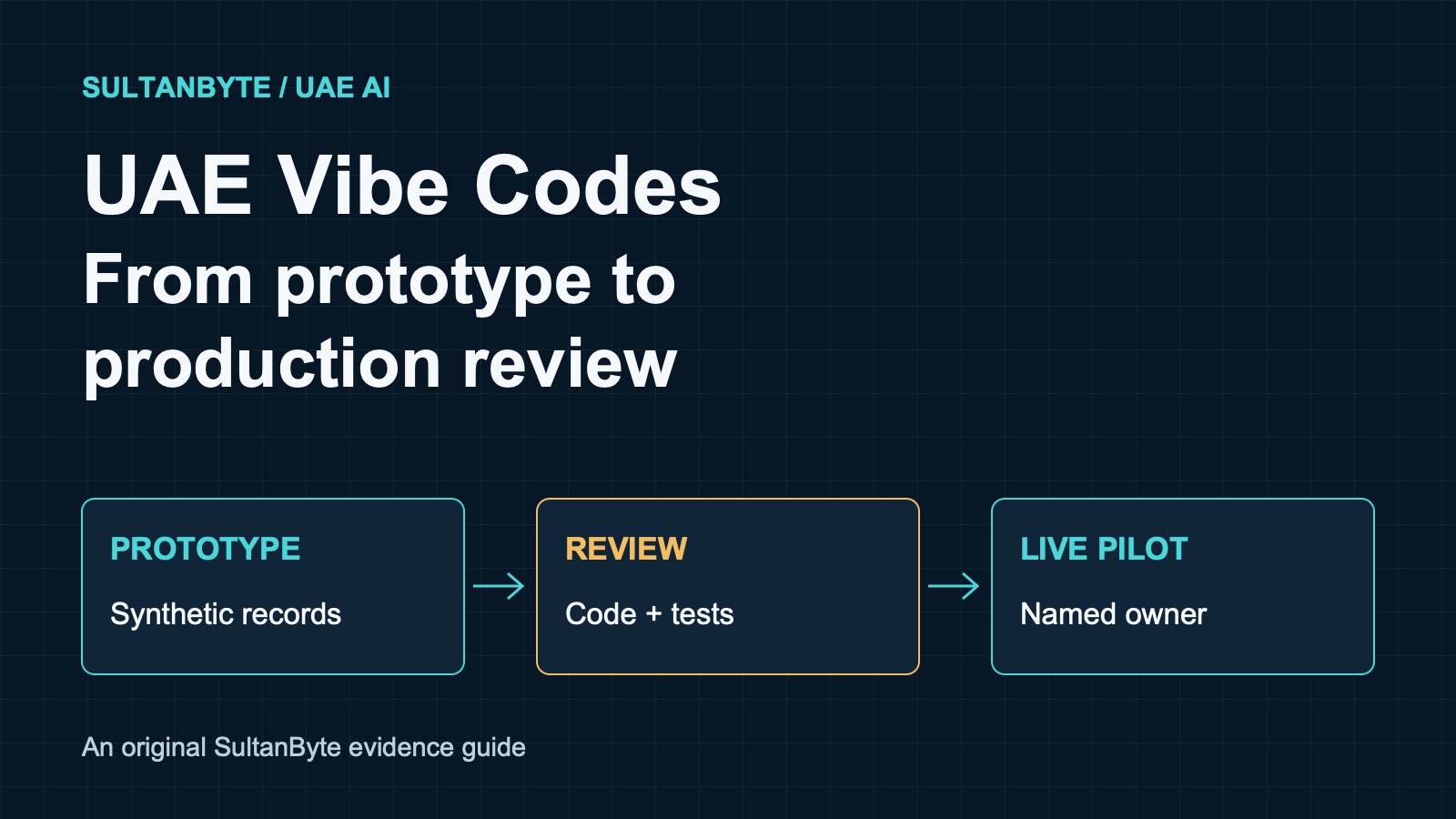
The UAE's new public coding experience makes a useful promise: describe an idea and see a prototype take shape. For an employer, the harder decision comes afterwards, when someone asks to connect that prototype to customer records or put it in front of paying users.
The Artificial Intelligence Office launched UAE Vibe Codes with Microsoft on 29 October, according to WAM's announcement. The experience uses natural-language instructions to help participants build websites and digital applications without prior programming experience. The announcement explicitly describes prototypes.
That is a sensible starting point for experimentation. It is not evidence that the resulting software is ready to operate a business service. UAE organisations can welcome the ideas while giving the transition into production a named owner and a separate approval process.
Cover: original SultanByte artwork showing an AI-generated prototype moving towards a reviewed production release.
What the public experience offers
The UAE Codes Day course page advertises a free online experience of about ten minutes, with six short units, a build activity and a downloadable certificate. It says no sign-up is needed and specifies ages 15 and up. That published age condition is more useful to schools and families than the announcement's broad invitation to everyone.
WAM reports 5,000 participants in the first hour. Treat that as a launch participation claim, not a count of completed applications, competent developers or deployed services. The Office's press release carried by Zawya repeats the figure; it is the same announcement, not independent measurement of outcomes.
The public offer is an introductory learning experience. Neither a short course duration nor a certificate establishes how an employer should handle source ownership, dependencies, customer information or maintenance. Those decisions belong to the organisation adopting an application.
Give promising prototypes somewhere safe to go
Consider a hypothetical operations coordinator who builds a maintenance-request tracker. A demonstration with invented tickets can reveal a useful screen layout and expose missing steps in the workflow. Connecting it immediately to a live building-management system would be a different decision.
For a first review, keep the prototype in an isolated environment with synthetic records. Do not supply production credentials or enable real outbound messages. Give it a visible owner, an intended audience and a short statement of what it must not do. An internal idea-review session does not need access to the customer database.
Then decide whether to discard it, keep it as a demonstration, or fund a maintained implementation. Keeping the design while rebuilding the application is a valid outcome. The organisation should not inherit a particular codebase merely because it produced the first convincing demo.
This is a proposed adoption process, not a claim about controls inside UAE Vibe Codes. It also differs from assessing whether an employee can use an AI assistant: the object under review here is software that may acquire users, data and continuing obligations.
Review the generated code as code
GitHub's application card for Copilot agents warns that generated code can appear valid while being incorrect or insecure. It recommends reviewing and testing generated changes, and using AI code review to supplement rather than replace human review. This is vendor guidance for Copilot, not evidence that UAE Vibe Codes uses a particular Copilot product or architecture.
A technical reviewer should be able to build the proposed application from a controlled repository and explain its dependencies. Check licences and public-code matches where relevant. Find where secrets are stored, which services receive information and who can change deployment settings. If the builder cannot export enough of the application to support that review, record the platform dependency and decide whether it is acceptable.
Avoid an approval that says only "the AI checked it". A generated test can share the same mistaken assumption as generated implementation code. Have the workflow owner specify expected behaviour independently: a closed ticket cannot be reassigned, for example, and one customer's account cannot read another customer's request.
NIST's Secure Software Development Framework provides a broader foundation for this work, covering organisational preparation, software protection, secure production and vulnerability response. NIST describes it as a risk-based starting point rather than a checklist to follow mechanically. It is not a UAE certification scheme.
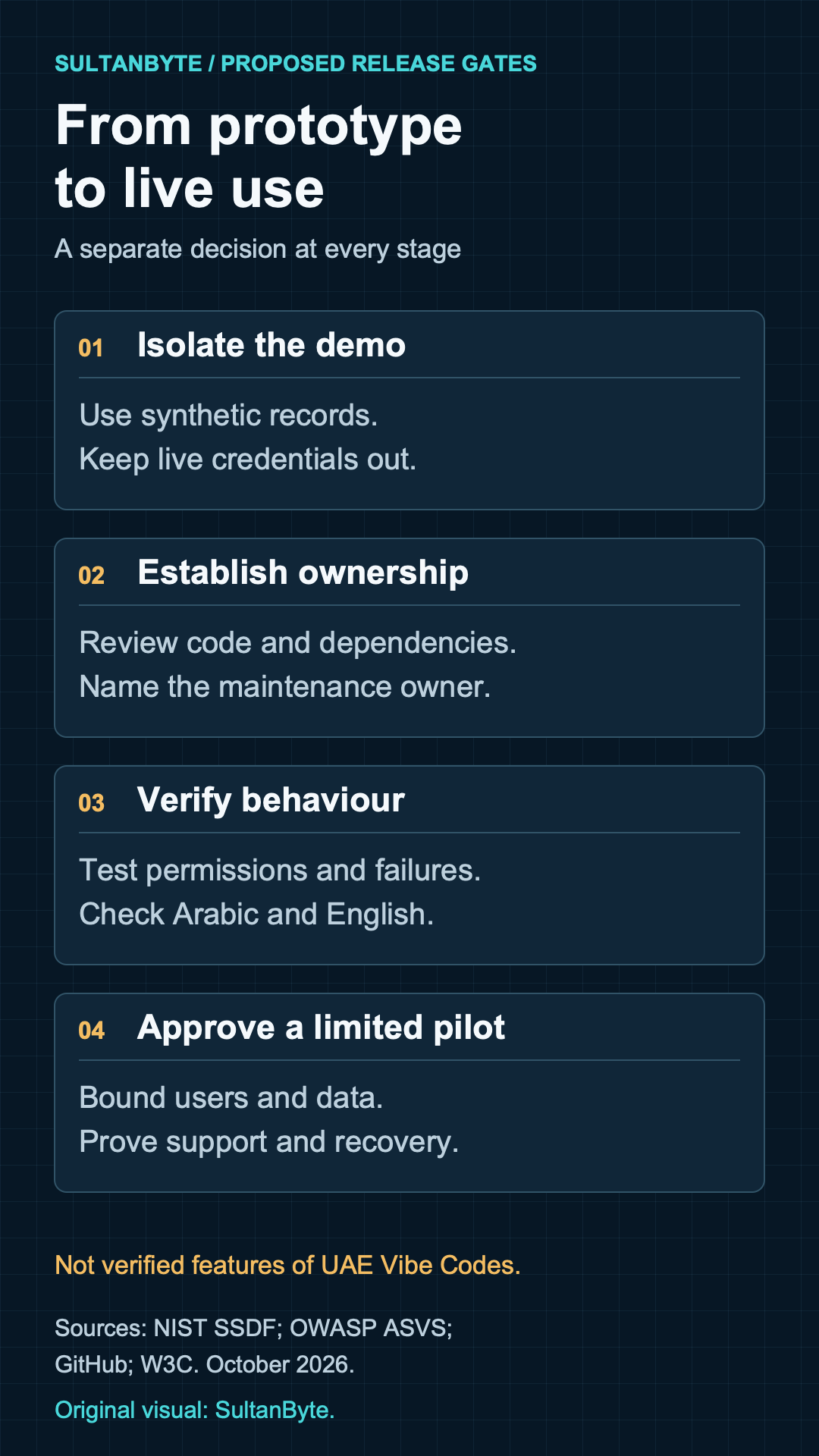
Original infographic: SultanByte. Proposed release gates informed by NIST SSDF, OWASP ASVS, GitHub guidance and W3C, October 2026. These are editorial recommendations, not verified features of UAE Vibe Codes.
Test what the demonstration leaves out
A demo usually follows the expected path. A release review needs the paths that should fail.
For the maintenance tracker, test a user changing a ticket identifier to request another customer's record. Remove an employee's access while a page is open. Submit the same change twice after a lost response. Check whether an error exposes internal details. Decide the expected outcome before running each case, and preserve the result against the reviewed application version.
OWASP's Application Security Verification Standard gives developers and buyers a common basis for specifying and testing application security controls. Use relevant, versioned requirements in the review or supplier contract. Do not describe a quick automated scan as ASVS verification of the whole application.
A UAE service may also need Arabic and English behaviour that a visually polished English demo never exercised. Review mixed-direction names and references, keyboard navigation, error recovery and narrow-screen layouts. W3C's reflow guidance explains the requirement for ordinary vertically scrolling content at a width equivalent to 320 CSS pixels, with exceptions for content that genuinely requires two-dimensional layout. Passing that check alone does not establish accessibility conformance.
Run these cases with people who understand the service and its languages. A translated button that changes the wrong record is a functional failure, not merely a copy problem.
Budget for the application after the workshop
A prototype's generation time is not its operating cost. Before approving a limited pilot, identify who pays for hosting, external APIs and the builder platform. Establish who handles dependency updates, security reports and user support. Test backup restoration where the service stores important records, and define how to stop or replace the service without losing its data.
For a founder buying an AI-built application, require a handover that includes the repository or documented platform constraints, deployment access, dependency inventory, tests and unresolved risks. Avoid accepting screenshots as the principal delivery evidence.
For a CTO, keep the initial pilot narrow enough to observe. Name the permitted users and data, define a stopping condition, and make the owner responsible for the next review. Expanding from an internal UAE trial to a Saudi customer deployment requires a separate review of that deployment's data flows and applicable obligations; a UAE learning initiative grants no cross-border compliance approval.
The useful outcome of UAE Vibe Codes is a wider pool of people able to express an idea in working software. Employers can preserve that benefit without treating every demo as a product. Give a promising prototype an engineering handover, test its failure cases, and approve live use only when someone can support what was built.
About the author
- I have lead the Engineering for multiple startups in UAE. I also have my own agency qualascend.com.
Comments
Join the discussionNo comments yet. Be the first to comment.