Foodics–Funding Souq: the restaurant financing test
Separate the investment from the lending target, verify Saudi and UAE offers, and reconcile deductions before rollout.
Foodics' investment in Funding Souq brings restaurant software closer to the credit decision. For operators, the attraction is financing that uses information their business already generates. The harder question is whether the resulting offer fits the cash left after suppliers, payroll and other obligations.
The announcement distributed on 13 October names Foodics as a major investor in the round. Wamda's 14 October report says the investment amount and ownership stake were not disclosed. Its article also reproduces the press release; it is not independent evidence of lending performance.
For Saudi restaurant groups and UAE expansion teams, the announcement is useful because it connects a specific operating platform with a financing provider. It does not establish identical products or eligibility in both countries.
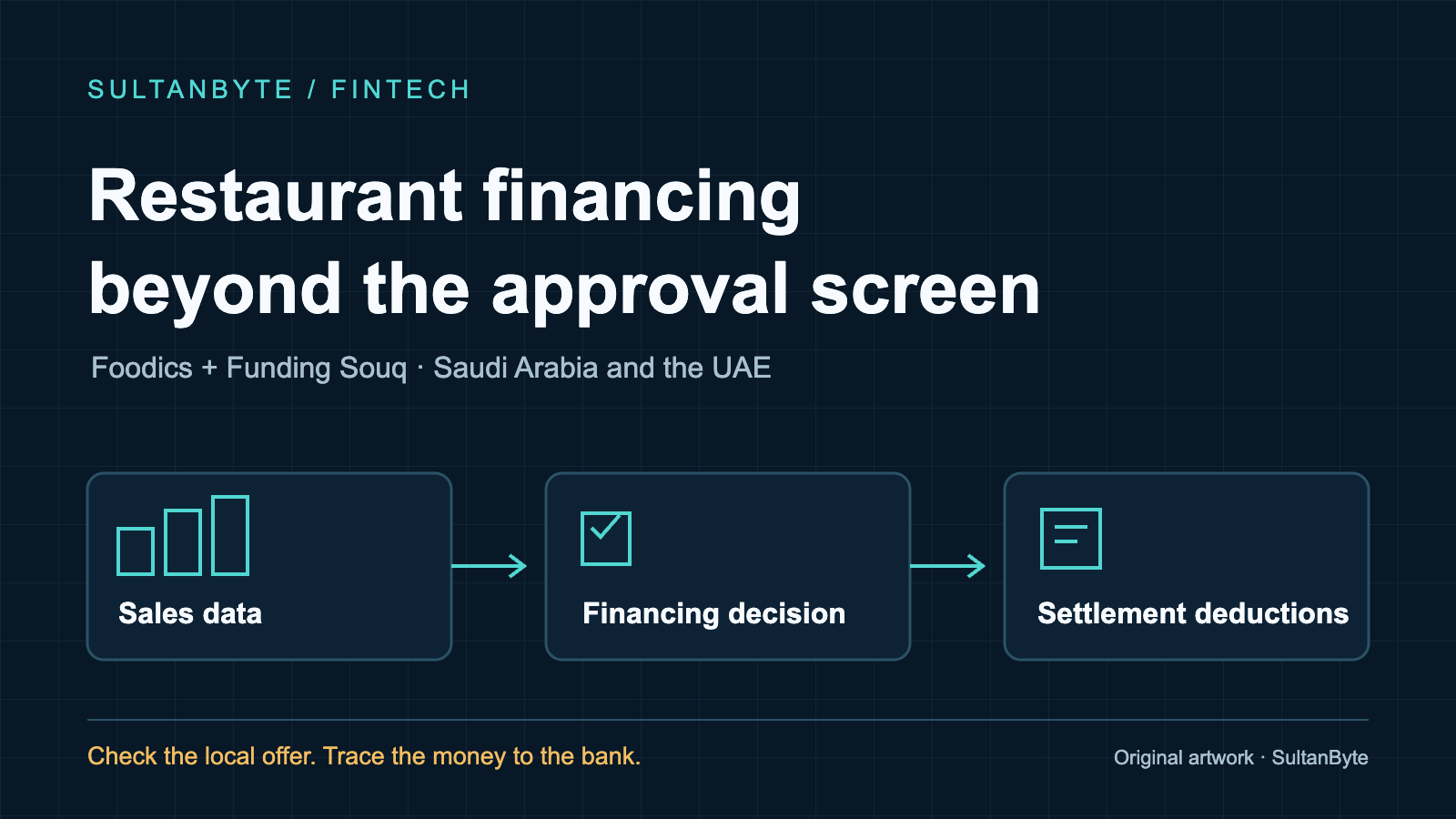
Cover: original SultanByte artwork showing restaurant sales data feeding a financing decision, followed by settlement deductions.
The investment is new; Capital 2.0 is not
Funding Souq's own announcement, dated 14 October, describes using Foodics merchants' sales and performance data to support credit assessment. It frames Saudi Arabia and the UAE as markets for broader embedded-finance expansion.
Capital 2.0 predates this investment announcement. Foodics launched it on 14 September, describing automated pre-qualification, an AI underwriting layer and digital completion for eligible restaurants. Foodics says disbursement follows within 24 hours after approval. That is a company description, not a measured guarantee that a new applicant receives money within a day.
Foodics set a first-year financing target of SAR 375 million. Keep that target separate from the undisclosed investment in Funding Souq. A planned volume of financing to restaurants is neither the price paid for an equity stake nor evidence that those funds have already been disbursed.
Funding Souq also claims the collaboration has produced Saudi Arabia's first fully automated business loan. The announcement does not provide a comparative market study establishing that superlative. Buyers can evaluate the actual workflow without accepting the “first” claim.
Daily deductions change the cash-flow review
Foodics describes repayments through deductions from daily settlements rather than a larger monthly payment. That puts the financing obligation into the same operating flow that pays a restaurant's bills.
A merchant should request the calculation behind the deduction. Which settlement amount is the base? How are refunds, fees, reversals and days without a payout treated? Does a weak trading period reduce the repayment amount, extend the schedule or create a separate obligation? The launch announcement does not settle those contractual questions.
Ask for a worked settlement statement before accepting an offer. It should connect sales activity to provider adjustments, the financing deduction and the amount credited to the merchant's bank. Finance staff should be able to explain every difference without opening a support ticket.
Compare offers using the complete repayment obligation and actual cash schedule, not just the size of a deduction. Include charges, early-settlement terms and the consequences of missed or insufficient settlements. A restaurant with strong recorded sales can still face a difficult week when supplier payments and payroll fall together. This is an operational review framework, not a recommendation to borrow or invest.
Saudi and UAE access need separate evidence
SAMA's live finance register lists “Funding Souq for debt crowdfunding” under Debt-Based Crowdfunding, with unified number 7017550612. Foodics' September release explicitly says its Shariah-compliant financing is provided to clients in Saudi Arabia through Funding Souq and other SAMA-licensed financing partners.
For a Saudi operator, the contract should identify the actual provider and the product being offered. The software brand on the screen should not obscure the entity responsible for the financing, servicing or complaints.
In the UAE, the DFSA register entry for Funding Souq Limited identifies a DIFC company, reference F005822, with the financial service “Operating a Crowdfunding Platform.” It lists endorsements including retail clients, holding or controlling client assets, and operating an Islamic window.
That is a different entity record in a different regulatory framework. It does not, by itself, prove that the Saudi Capital 2.0 product, its settlement deductions or its advertised timing are available to every UAE restaurant. A UAE buyer should request the local offer, eligibility rules, contracting entity and service terms before reusing a Saudi implementation plan.
The investment release describes a longer-term aspiration for Foodics to become a bank for restaurants. Treat that as an ambition, not a banking licence conferred by this transaction. Have qualified advisers review the permissions and obligations for the proposed arrangement.
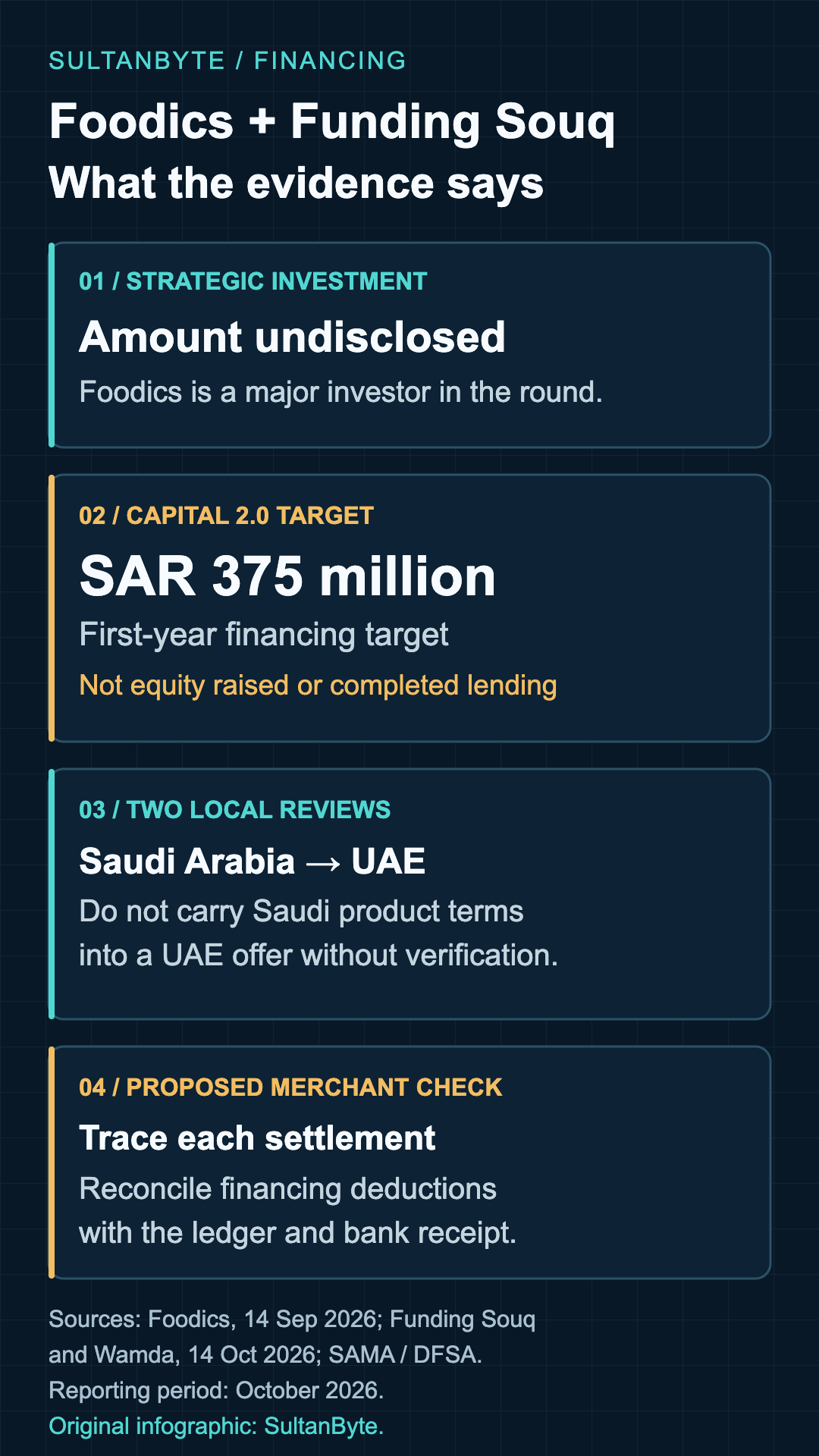
Original infographic: SultanByte. Sources: Foodics, 14 September 2026; Funding Souq and Wamda, 14 October 2026; SAMA and DFSA registers. The reconciliation check is an editorial proposal.
Sales data needs an explanation, not just a score
For product and engineering teams, the useful design work begins before a model receives merchant data. Specify which records support the assessment, which business and outlets they represent, and how current they are. Record the permitted purpose and access arrangement with the relevant specialists; using the same software does not make every downstream use appropriate.
A proposed review should distinguish sales from money available to service financing. Refunds, voids, discounts, marketplace payouts and missing trading days can change the interpretation of a revenue figure. Ask how the provider handles incomplete history, a newly opened outlet or a change in the merchant's operating pattern.
Preserve enough evidence to explain the offer shown to the operator: the data period, calculation or model version, decision time and accepted terms. A corrected sales record should trigger the documented review process, not silently rewrite the evidence behind a signed agreement.
Automation also needs an exception route. Ask who can explain an unexpected eligibility result, correct inaccurate merchant information and resolve a disagreement over a deduction. These are proposed diligence checks, not claims that either company currently lacks those capabilities.
Test a settlement cycle before expanding the rollout
Start with an approved test environment or a tightly scoped, explicitly authorised pilot. Walk through the offer, acceptance, disbursement and the first settlement deduction. Then reconcile the provider's records with the merchant ledger and bank receipt.
Include a refund after the original sale, a settlement with insufficient funds and a delayed status notification. Agree the expected treatment with the provider before testing. The goal is to establish how the contract behaves in ordinary exceptions, rather than assume that a successful approval screen proves the whole service.
For restaurant founders, the decision should rest on a complete offer and a cash-flow forecast that includes a weaker trading period. For CTOs, rollout should wait until the data boundaries, local provider responsibilities and reconciliation path are documented.
Foodics and Funding Souq have announced a closer commercial relationship. The next useful evidence is a merchant-specific offer whose deductions can be traced through to the bank account. That is the point at which embedded financing becomes an operating decision rather than a headline.