Saudi speech AI: reading NVIDIA’s new ASR results
What Saudi and UAE buyers should verify about dialect coverage, call audio and data permissions before a voice-AI pilot.
NVIDIA's new Saudi Arabic speech-recognition results give regional voice-AI teams a useful experiment to reproduce. They do not establish that a contact-centre product is ready to handle customer calls.
In a technical report published on 30 September, NVIDIA reports that adapting Nemotron 3.5 ASR reduced word error rate on SADA's Najdi and Hijazi test split from 55.05% to 29.96%. That is a substantial improvement within the reported experiment. The remaining work concerns the audio, transcription rules and commercial permissions of the intended deployment.
For a Saudi service team, the result is a reason to test a specialised recogniser. For a UAE buyer, it is evidence about a Saudi-dialect experiment, not a substitute for evaluating Emirati speech or the languages in its own call traffic.
Cover: original SultanByte artwork showing a speech waveform entering a transcription model and passing to a separate deployment review.
Read the test split before the headline
NVIDIA's model card describes a multilingual streaming recogniser with language-conditioning prompts and configurable audio chunks. It places Arabic in its transcription-ready tier. That product label does not tell a buyer how accurately the system transcribes a particular dialect over a particular telephone connection.
The adaptation report distinguishes its targeted Najdi/Hijazi test from the full SADA test set. The latter improved from 58.84% to 35.61% word error rate. These are NVIDIA-reported measurements, not independently reproduced results from a regional call centre.
Hugging Face's ASR evaluation guide defines word error rate through substitutions, insertions and deletions relative to reference words. It measures transcription disagreement. It does not measure whether an agent completed a refund correctly, preserved an account number or understood a customer's objection.
A buying decision therefore needs an error review alongside the aggregate score. Ask which mistakes change the business outcome. A misplaced filler word and a wrong delivery address should not carry the same operational consequence merely because each contributes to a transcript metric.
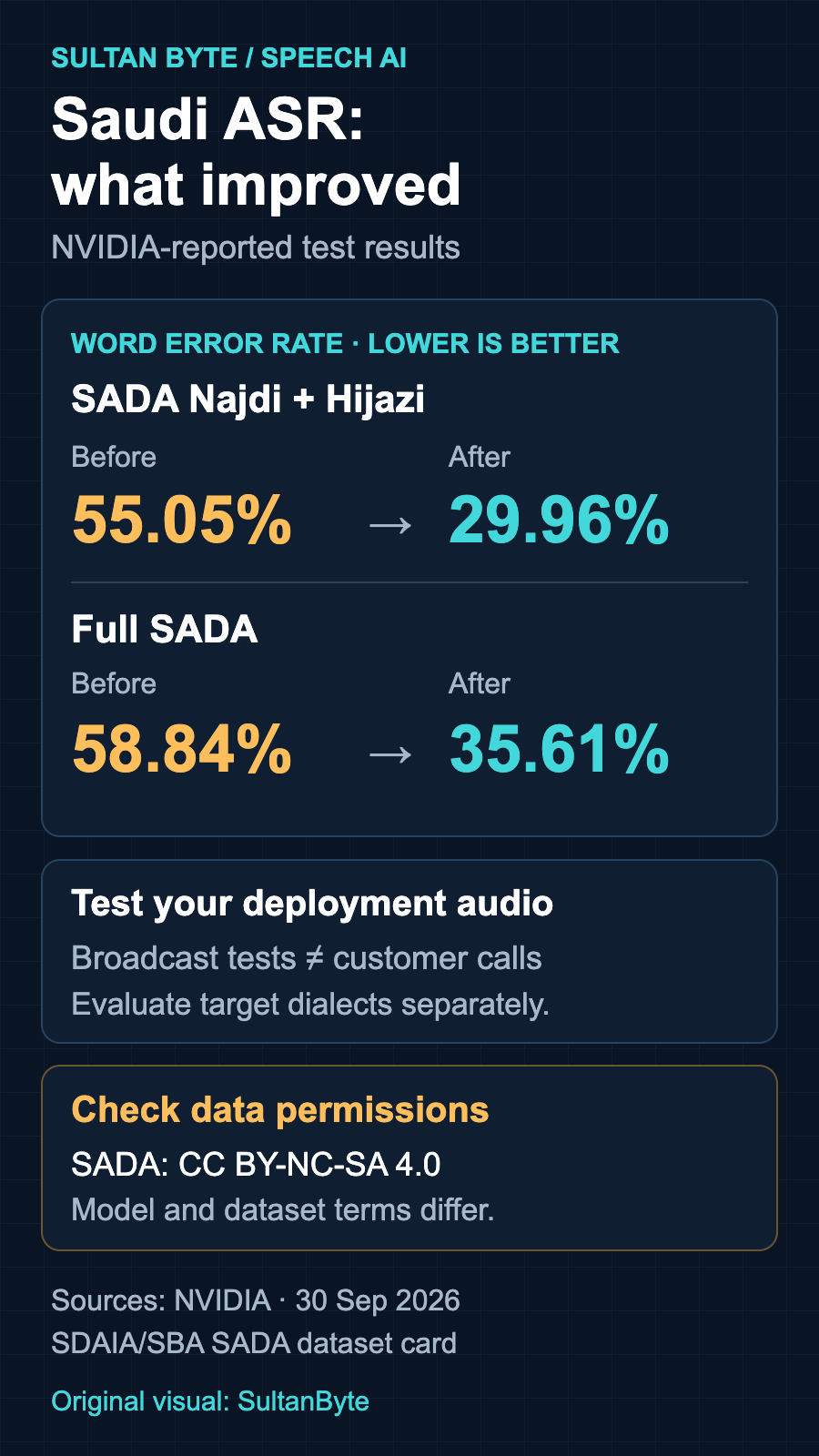
Original infographic: SultanByte. Benchmark source: NVIDIA technical report, 30 September 2026. Dataset scope and licence: SDAIA/SBA SADA card. Lower word error rate is better; these are reported test results, not customer-call measurements.
Broadcast audio leaves a gap for business calls
The SADA dataset card published by SDAIA's National Center for Artificial Intelligence says the recordings came from Saudi Broadcasting Authority television programmes. Its documentation describes dialect and environment labels, including noisy and music-containing material.
That makes SADA useful for studying speech beyond carefully read sentences. It still does not make a television-derived test set equivalent to your call recordings.
The card also documents preprocessing that discards utterances containing English words or digits. That detail deserves attention if a proposed product must capture mixed-language brand names, booking references or amounts. Do not assume that a benchmark result covers those cases; inspect the exact training and evaluation manifests used by the supplier.
For an initial pilot, create a separate, authorised test collection from the intended channel. Include the actual recording format and representative speakers. Keep difficult examples that are valid customer interactions rather than quietly cleaning the test into a studio-audio exercise.
Have reviewers transcribe the material under written rules. Decide how to represent spoken numbers, hesitations and borrowed words before comparing systems. Otherwise two recognisers can appear different because the scoring pipeline rewards one transcription convention over another.
Retaining English is not a code-switching test
NVIDIA reports improved English performance on FLEURS after adaptation. That is a useful regression check, but it answers a narrower question than whether a customer can switch languages halfway through a sentence.
Google's FLEURS documentation explicitly identifies its focus on read speech and warns about a mismatch with noisier production settings. Use it as a reference evaluation, then add the mixed-language cases your product expects.
Consider two proposed pilots rather than a single regional average. A Riyadh service handling Najdi calls needs evidence for those callers and its business vocabulary. A Dubai service needs a test collection reflecting its own customers; success on the Saudi slice cannot be carried across as an Emirati result. Neither pilot should borrow the other's acceptance threshold without reviewing the consequences of errors.
For each, score important entities separately. Record whether the transcript preserves the intended person, location, amount and reference. Where the application acts on a critical value, require a confirmation step or a review route instead of treating a plausible transcript as permission to proceed.
A lower error rate may require more waiting
NVIDIA also reports a decoding configuration reaching 27.25% word error rate on the target split, with larger lookahead adding roughly 800 milliseconds of buffering. Keep that configuration separate from the 29.96% result rather than combining the best figures into one imaginary operating point.
A team transcribing archived calls can consider a different delay budget from a live voice assistant. Test each mode as a complete service, including transport, queues and downstream processing. Record when a usable final transcript arrives, not just how quickly the model processes an audio chunk.
The procurement comparison should hold the workload constant. Run the proposed model and the incumbent on the same held-out audio under the intended concurrency. Compare the cost of an accepted transcript after corrections. A cheaper inference run is not necessarily a cheaper workflow if reviewers must repair more consequential mistakes.
Check dataset permission separately from model availability
The SADA page lists CC BY-NC-SA 4.0. The Creative Commons licence summary includes a non-commercial condition, attribution and share-alike requirements. An accessible download is not blanket permission for a commercial training project.
NVIDIA's model card separately describes its base model as ready for commercial use. These statements concern different materials. Before using the tutorial's data recipe in a commercial project, have the responsible legal or licensing team confirm the rights needed for the intended use, including any additional permission from the rights holder. This article does not determine the legal status of a trained derivative.
Ask vendors to identify the checkpoint they will deliver and the datasets used to adapt it. Keep that record separate from the model's technical score. A procurement team should be able to inspect both without relying on the phrase "open model" to answer every licensing question.
Commission a bounded pilot, not a regional rollout
The immediate opportunity is a controlled comparison against the system already in use. Freeze the test collection before tuning, keep its references away from the training pipeline, and record the checkpoint and decoding settings with every result.
Require reviewers to inspect the errors that matter to the workflow, then test delay under realistic load. Keep a human route for calls the product cannot handle reliably. Choose acceptance thresholds before viewing the final comparison so that a strong average cannot excuse failures in the launch population.
The September result supports spending effort on Saudi-dialect adaptation. A production commitment should follow only when the buyer has its own evidence for customer audio, operational behaviour and permitted data use.