PostgreSQL recovery drills for MENA SaaS: prove the restore
Test PostgreSQL point-in-time recovery, isolate restored copies and reconcile external actions before approving production cutover.
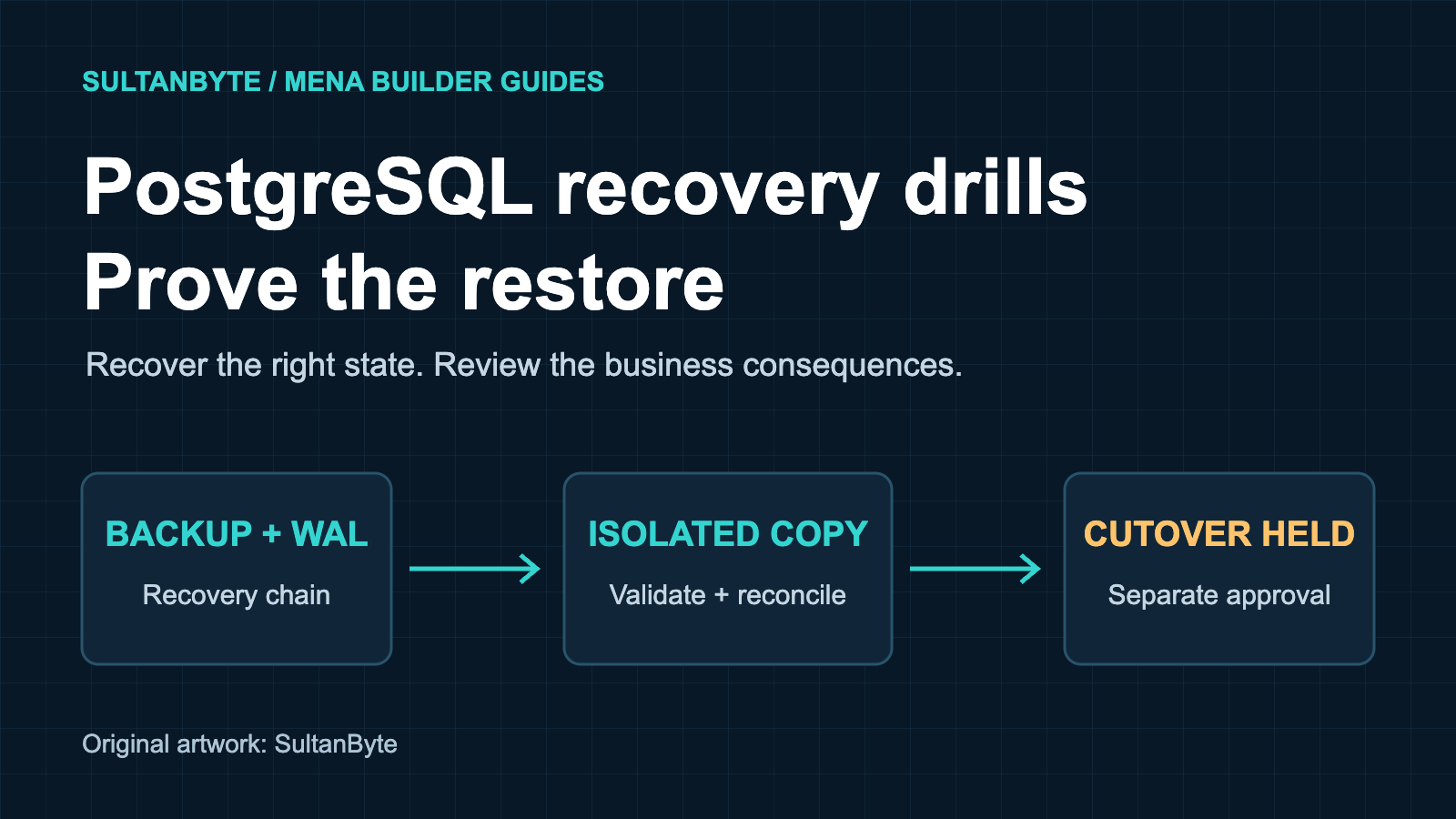
A database backup can finish successfully while the recovery plan remains untested. The missing proof is whether the team can recover the right state, keep the restored copy isolated and make the application usable without replaying old business actions.
For a MENA SaaS product, consider a hypothetical billing portal serving separate Saudi and UAE customer workspaces. An incorrect update changes invoice records. Restoring the whole database might recover those records, but it could also remove legitimate work completed afterward by customers who were not affected.
This guide proposes a PostgreSQL recovery drill for that problem. It separates database recovery from the decision to replace production. It is an implementation playbook, not a benchmark or a claim that a managed service meets a particular recovery target.
Cover: original SultanByte artwork showing a backup and WAL archive feeding an isolated restored database, with production cutover held for review.
Decide what you intend to recover
Write down the incident before choosing a restore button. Is the goal to investigate an earlier state, extract a small set of damaged records, or replace the entire production database?
Those are different operations. PostgreSQL's continuous-archiving documentation describes physical recovery of the entire cluster, not a selected tenant or table. Point-in-time recovery, or PITR, combines a base backup with the required write-ahead log (WAL) sequence to reach a historical state. A SQL dump cannot serve as the base for that WAL replay.
For the hypothetical invoice incident, restore into an isolated environment first. Compare the affected records with production, identify later legitimate changes and decide whether a narrowly reviewed repair is possible. Do not replace a shared database merely because one customer's records need recovery.
Keep regional disaster recovery separate. SultanByte's MENA cloud failover guide covers destination selection and service dependencies. This drill focuses on recovering an earlier database state after a destructive change, even when the original region is still healthy.
Check the recovery chain, not just the backup job
For self-managed PostgreSQL, record the base backup identifier, database major version, archive location and the WAL needed to reach the proposed target. Require evidence that the restore identity can read that chain. A successful upload yesterday does not establish that every subsequent segment remains available.
PostgreSQL requires a continuous archived WAL sequence reaching back to the start of the base backup. Build retention around recoverable chains rather than deleting files solely because each file has reached a chosen age. Keep the backup tool's own catalogue and dependency rules in that review.
Use pg_verifybackup where the backup format and manifest support it. PostgreSQL explicitly warns that this check cannot replace test restores. In PostgreSQL 18, WAL parsing supports plain-format backups; tar-format verification requires --no-parse-wal. Its WAL verification is version-specific, and extra WAL beyond what is needed to recover the base backup is not automatically checked. A passing result therefore does not prove replay to every later incident timestamp.
The PostgreSQL 18 archiving settings also explain a quiet-workload trap: archive commands operate on completed WAL segments. Low write volume can delay archival of recent transactions. Review segment switching and archive delivery together; choosing a timeout is not evidence that storage received the segment.
For managed databases, capture the service's actual restorable window immediately before the drill. Record the selected target rather than relying on a retention setting alone.
Treat each provider's restore as a separate contract
The following are documented service behaviours, not measured results from this article.
Amazon RDS DB instances. RDS point-in-time restore creates a new DB instance without changing the source. Inspect LatestRestorableTime rather than treating the present moment as recoverable. Review the restored security group and parameter-group choices explicitly. AWS notes that data blocks continue loading after the instance becomes available, so an available status is not a performance acceptance test. These details concern RDS DB instances; do not silently apply them to Aurora.
Azure Database for PostgreSQL flexible server. Microsoft's backup and restore documentation says ordinary PITR creates a new server in the source region. Geo-restore is a different path, and the documented geo-redundant restore does not offer arbitrary point-in-time selection. Post-restore work includes reviewing server parameters, network access and application connections. The page also identifies high availability and replicas as configurations to recreate when required.
Self-managed PostgreSQL. The operator owns the archive chain, compatible runtime, restore configuration and validation. PostgreSQL's recovery-target settings distinguish the target from the action taken when it is reached. Set both deliberately; do not let a generic startup script turn an investigative restore into an application destination.
Do not rank these options by how few clicks the console requires. Compare who owns the missing steps, whether they can be automated and what evidence the service exposes when recovery fails.
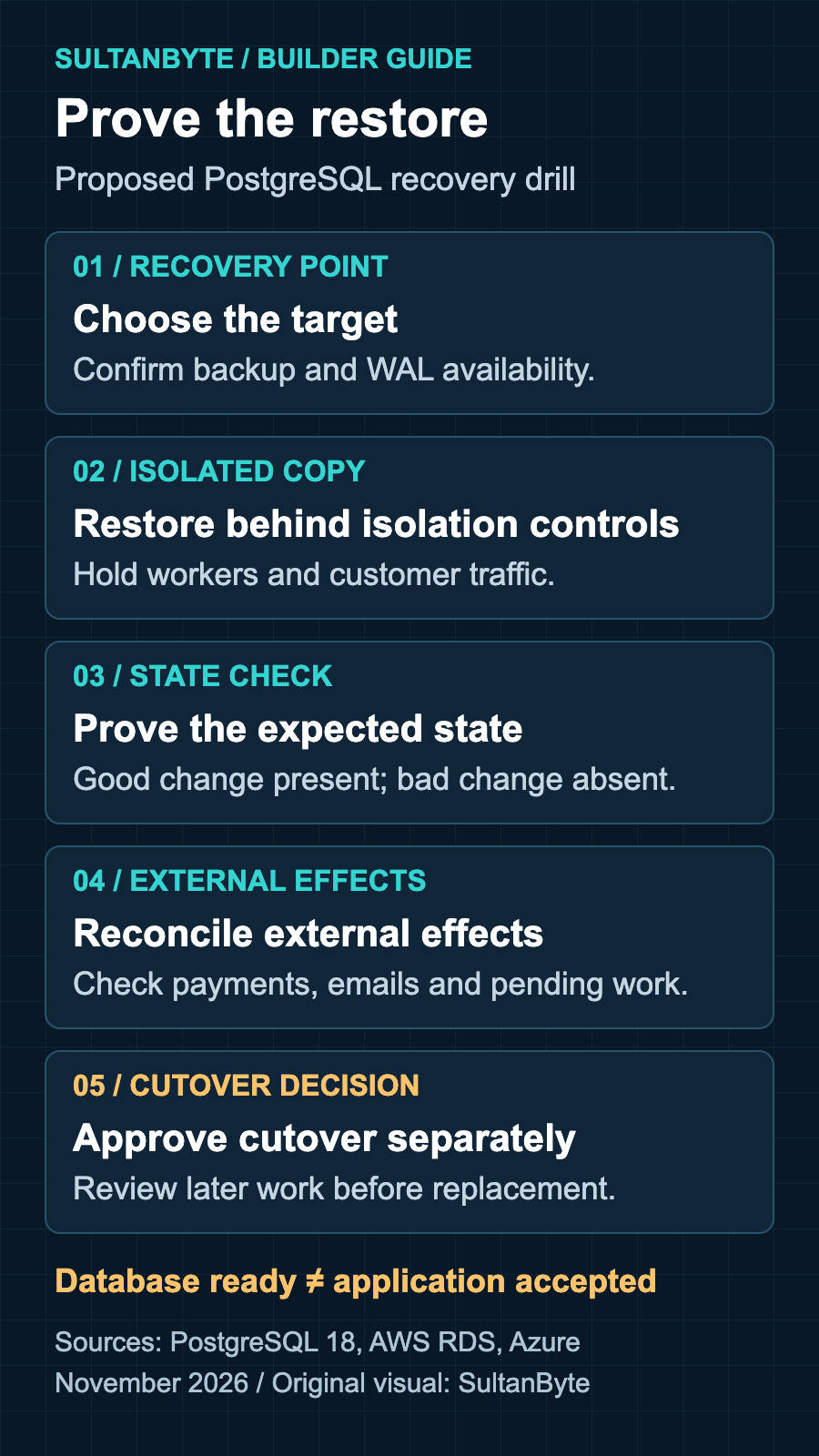
Original infographic: SultanByte. Proposed recovery framework informed by PostgreSQL 18, Amazon RDS and Microsoft Azure documentation, November 2026. It reports no measured restore time or data-loss guarantee.
Choose a target with evidence on both sides
For a controlled exercise, use synthetic records and a disposable environment that represents the production backup configuration. Ensure a usable base backup has completed before writing the markers. Commit a known good change, record its completion, then perform a separate deliberately damaging transaction. Retain an independent record of the sequence outside the database being restored.
After the damaging transaction commits, confirm that the required WAL has reached archive storage, or wait until the managed service's restorable window covers the target. Choose a supported target between the commits, with an explicit UTC offset. For self-managed PostgreSQL, record recovery_target_time and recovery_target_inclusive; for managed services, record the supported restore timestamp and verify the boundary using the markers. Avoid a timestamp copied from a dashboard with an unknown display timezone. The database commit boundary, rather than the time someone noticed the damaged screen, is what the exercise must establish.
Require positive and negative evidence. The known good transaction should be present; the damaging transaction should be absent. Include another tenant's marker so the review does not inspect only the record everyone already expects to find. If the result is ambiguous, stop and select another supported target or investigate the event sequence.
These markers test the recovery boundary. They do not establish that every business invariant survived. Add application-specific checks: invoice line totals against their header, references to existing customers and expected tenant ownership. Use synthetic Arabic and English text where the portal supports both, and check the returned values rather than relying on a screenshot of one row.
Keep the restored copy from acting like production
Prepare isolation before starting application processes against the restored database. Disable scheduled workers, webhook delivery, email and payment submission in the drill environment. Deny unnecessary outbound access. A copied queue table or outbox can otherwise become a list of actions waiting to run again.
Give the restore environment a distinct connection configuration and an unmistakable operator banner. Use a restricted validation identity for data inspection. Prevent normal customer traffic from reaching it until an authorised cutover decision exists.
Treat key access as part of the drill. AWS's RDS encryption documentation explains that encrypted backups and snapshots depend on KMS keys, and that disabling a key affects resources encrypted with it. Verify the intended recovery identity and key availability without disabling production keys to manufacture a test. Exercise destructive key scenarios only in a disposable setup approved for that purpose.
For Saudi and UAE workspaces, maintain separate approved-location records where contracts or data classifications differ. Name the backup storage country, restore destination and people allowed to inspect the copy. A region label or encryption setting does not answer all those questions. This is practical engineering information, not legal advice; obtain the applicable legal and contractual review before moving real customer data.
Reconcile events the database cannot rewind
A database restored to an earlier state does not undo an email already delivered or a payment already accepted by another system. Treat that mismatch as part of recovery, not a problem to discover after opening traffic.
In the invoice scenario, suppose the application submitted a payment after the chosen target. The restored database might no longer contain the corresponding receipt. Re-enabling its worker without reconciliation could submit the action again.
Keep external business identifiers and delivery receipts available through an independently recoverable audit path. Before resuming outbound work, compare the restored application's pending actions with the external system's authoritative outcomes. Preserve existing idempotency identities where the integration supports them; do not generate new ones merely because the database was restored.
Use a sandbox provider or a recording stub for this part of the drill. Require that an already completed action is recognised, an uncertain outcome remains held for review, and only an approved unsent action proceeds. The particular reconciliation algorithm belongs to the integration contract; PITR does not supply one.
If selective repair is appropriate, treat the recovered rows as evidence for a new controlled change. PostgreSQL's SQL dump documentation describes logical export and restoration separately from physical recovery. Review dependencies, ownership and current production changes before importing anything. A table export is not a tenant-safe merge procedure.
Keep a recovery acceptance record
Use one record per exercise, with fields that make the outcome reviewable:
- Scope: incident being simulated, source database, engine version and approved recovery location.
- Recovery point: backup reference, requested target, available restore window and evidence that the good marker survived while the bad change did not.
- Timing: request started, database ready, validation completed and application accepted. Preserve failed attempts rather than reporting only the fastest run.
- Isolation: outbound controls, validation identity and evidence that normal customers could not reach the copy.
- Business outcome: integrity checks, external-action reconciliation, unresolved differences and the person authorised to approve cutover.
Measure application recovery through the accepted user journey, not merely through a database status change. Record the interval of legitimate business work that a full rollback would discard. A recent backup can still be the wrong recovery point if the damaging change occurred earlier.
Keep production replacement outside the routine drill. A real cutover needs a write boundary, connection changes and a plan for handling later work on either database. Do not allow both copies to accept ordinary business writes by accident.
Run the drill again after changes to backup tooling, encryption, major database versions or application dependencies. Keep the restored instance identifier, validation results, unresolved differences and approval decision with the exercise record.
About the author
- I have lead the Engineering for multiple startups in UAE. I also have my own agency qualascend.com.
Comments
Join the discussionThe quiet-workload WAL trap is the detail I hadn't thought about before — archive commands only fire on completed WAL segments, so a low-write-volume database can look backed up while its recovery chain quietly has a gap. I learned the same lesson the hard way with files rather than WAL: my nightly job reported success for months while a whole branch of the directory tree was silently skipped after a permissions change, and I only found out on the night I actually needed the files.
I also liked the point that a restored database does not undo an email already delivered or a payment already taken — that reconciliation step is the part most restore guides skip entirely.
One question on the isolation step: when you restore into the isolated copy, do you use the production KMS key to decrypt it, and if so, how do you test that the key will actually be available and usable in a real incident — for example, if the key were disabled, or the account that owns it were the thing that failed?
Builder Guides
Practical architecture, engineering, security and implementation guides for teams building technology in MENA.