Mamun’s $3m round: the Gulf–Asia trade finance test
What Gulf trading businesses should verify about AI underwriting, funding commitments and supplier settlement.
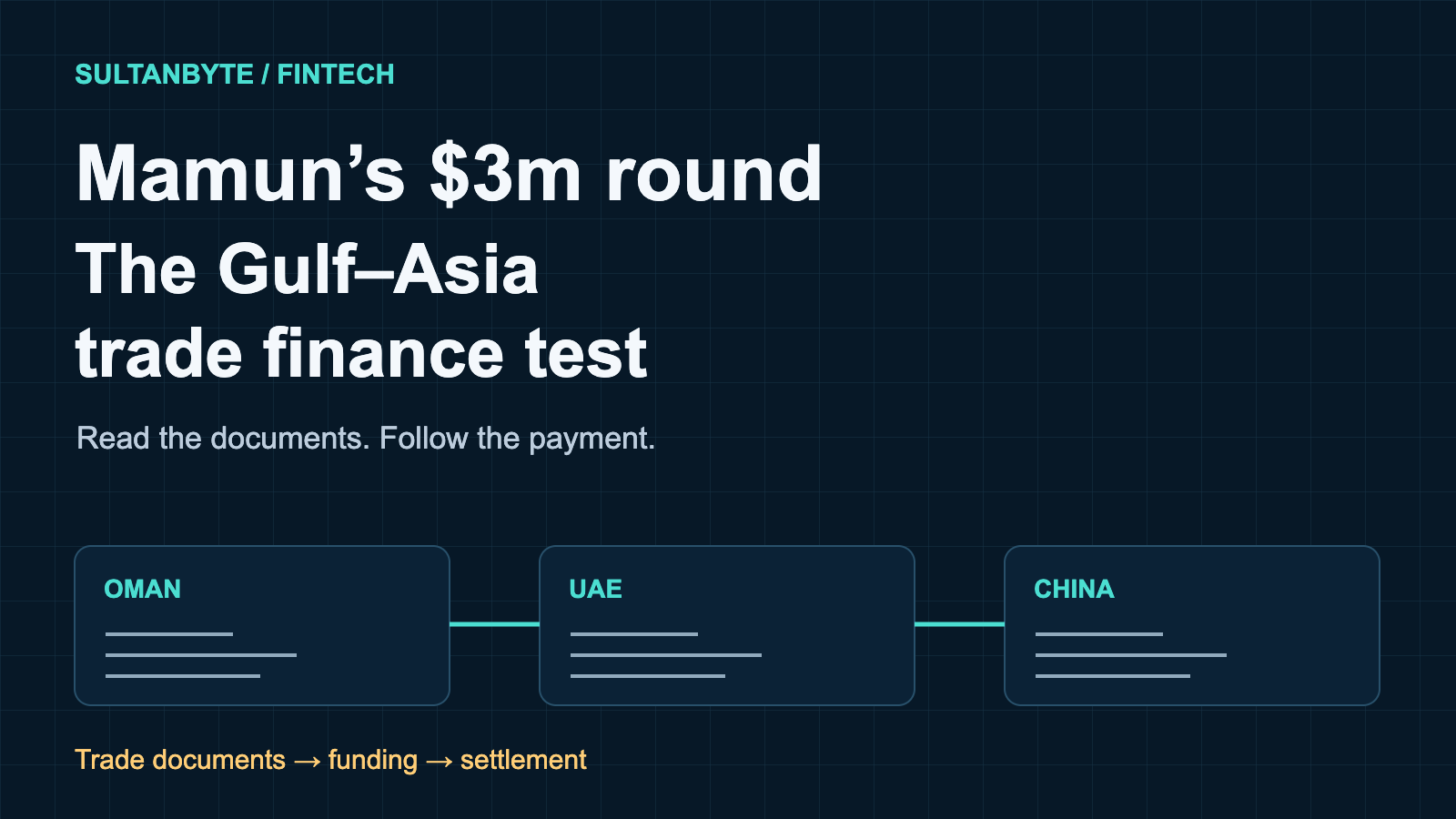
Oman’s mamun has raised $3 million to expand a trade-finance platform built around individual commercial transactions. Phaze Ventures announced the seed round on November 4, saying its Oman Fund led the investment alongside Jasoor Ventures. The planned expansion connects Oman, the UAE and China’s Greater Bay Area.
For an importer buying components or an exporter waiting for payment, the useful question is whether the platform can finance a specific shipment on workable terms. A funding announcement cannot answer that. It does, however, identify a business worth examining through its documents, cash movements and treatment of delayed payments.
Cover: original SultanByte illustration of trade documents and settlement routes between Oman, the UAE and China.
Capital for the platform is different from money for a shipment
Phaze says the new capital will support mamun’s AI-based origination and underwriting. It describes a system that assesses the business, buyer, contract, trade documents and trading history, with investors supplying financing for individual transactions. Those are the investor’s descriptions of the platform, not independently measured improvements in approval quality.
The distinction between the seed round and transaction financing matters. The announcement does not establish that $3 million has become an additional pool available to applicants. A prospective customer still needs an offer specifying who supplies the money, when it becomes committed and what conditions can prevent payment.
There is operating history to examine. In Oman Observer’s November 4 report, CEO Saleh Al Tamami supplied figures of nearly $20 million facilitated across more than 175 facilities for 84 businesses, including 78 Omani companies. These remain company-reported figures, rather than audited evidence of repayment performance.
They also differ from the $16 million financed amount displayed on mamun’s homepage. The dated report provides newer attributed information, but neither number should become a growth calculation without matching reporting periods and definitions. For buyers, asking for a dated operating report is more useful than choosing the larger headline.
Start with the trade, then examine the model
The practical attraction of transaction-based assessment is that the commercial evidence can be specific. A purchase order names a buyer; an invoice states an obligation; shipping records help establish what moved. Whether those records support a financeable transaction still needs scrutiny.
For a proposed pilot, give the provider one complete trade file and ask it to explain the decision. Identify the contracting businesses, goods, payment currency, expected settlement date and evidence that the buyer accepted the obligation. Ask how the assessment changes when the buyer is new or a shipment is only partly delivered.
The technology review should cover contradictory documents, too. A revised invoice must not silently replace the version used to approve financing. Ask for the record of changes and the person authorised to resolve an exception. These are proposed diligence checks, not findings that mamun lacks these controls.
An AI label provides little help when a document is wrong. The useful evidence is an explanation tied to the trade file and a correction route that leaves the original decision traceable.
Map the entities before comparing offers
Oman’s regulator provides historical corroboration of the platform’s regulatory roots. An April 2023 announcement now hosted by the Financial Services Authority included Mamun Financial Technologies among licensed crowdfunding businesses. That historical record should not be treated as a current permission for every group entity or overseas activity.
Mamun’s compliance page identifies an Omani FSA licence, CMI051, and says Ihkam Advisors reviews its Sharia structures. Its investor registration terms, dated December 22, 2025, name Mamun Crowd Funding LLC and describe mamun as an intermediary rather than the lender or principal.
These documents make the entity map worth requesting. A business should ask which company signs its financing agreement, which party pays its supplier and who services the obligation. Have qualified advisers check the permissions relevant to that arrangement; an office location or a website’s country list does not settle the issue.
The homepage lists business eligibility in Oman, the UAE, Bahrain and Qatar. That is a company description of eligible markets, not proof of identical contracts, permissions or funding availability across them. A UAE applicant should obtain its own written offer rather than assume an Omani example applies unchanged.
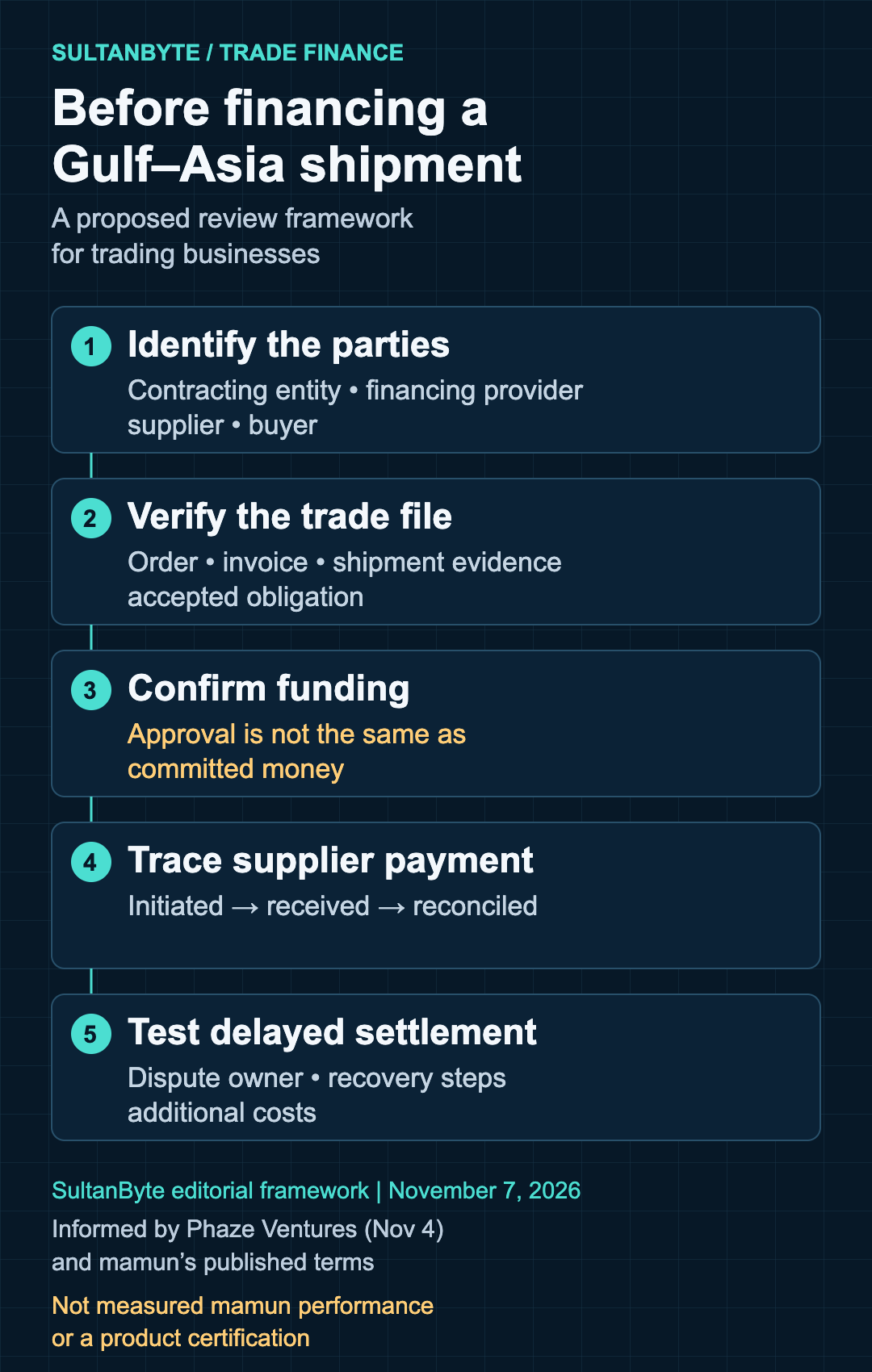
Infographic: SultanByte. Proposed decision framework informed by Phaze Ventures’ November 4 announcement and mamun’s published platform and investor terms; it is not a product certification.
Follow the money through a delayed payment
For a finance manager, the comparison should begin with the full payment schedule. Request the amount the supplier receives, all charges, the repayment obligation and the treatment of currency conversion. Compare offers against the same shipment and dates. A quick decision is less useful if the supplier receives the money after its contractual deadline.
Keep approval, investor funding, payment initiation and confirmed receipt as separate events in the pilot record. The business should know which event allows it to release an order. The homepage advertises supplier payment within days, but that wording is not a contractual service level for a particular applicant.
Then examine a delayed settlement. Ask what happens if the buyer disputes part of the delivery, pays late or sends less than expected. Establish who contacts the buyer, which documents support recovery and how additional costs are allocated. For a trade spanning jurisdictions, ask advisers where the relevant obligations can be enforced.
Investor diligence needs a different file. Mamun’s registration terms warn of possible loss and illiquidity, and say automated allocation does not guarantee returns. Request repayment history by completed transaction cohort, overdue amounts, recoveries and concentration by underlying buyer. Several invoices owed by the same customer should not be mistaken for unrelated exposures.
A useful next step for Gulf trading businesses
Mamun’s round supports a specific proposition: use trade records to assess financing across the Gulf–Asia corridor. The announcement gives businesses a reason to investigate, not a reason to skip comparison.
A sensible first engagement would be a document review followed, if appropriate, by a limited and explicitly authorised transaction. Before proceeding, agree the funding conditions and the evidence needed to reconcile supplier receipt and eventual repayment. Keep a named owner for exceptions on each side.
For founders, the decision rests on whether the offer fits the trade’s cash cycle. For product and finance teams, it rests on whether the records remain explainable when the shipment or payment changes. That is the evidence to request before making the platform part of routine working-capital operations.
About the author
- I have lead the Engineering for multiple startups in UAE. I also have my own agency qualascend.com.
Comments
Join the discussionNo comments yet. Be the first to comment.