Journify’s $12m round: better ad signals need better tests
A GCC retailer’s guide to conversion quality, duplicate events and the difference between attributed revenue and additional sales.
Journify has announced a $12 million Series A to expand its advertising-data business into the US and Europe. For retailers in Saudi Arabia and the UAE, the useful question is closer to home: will better conversion signals improve commercial decisions, or mainly change what the advertising dashboard reports?
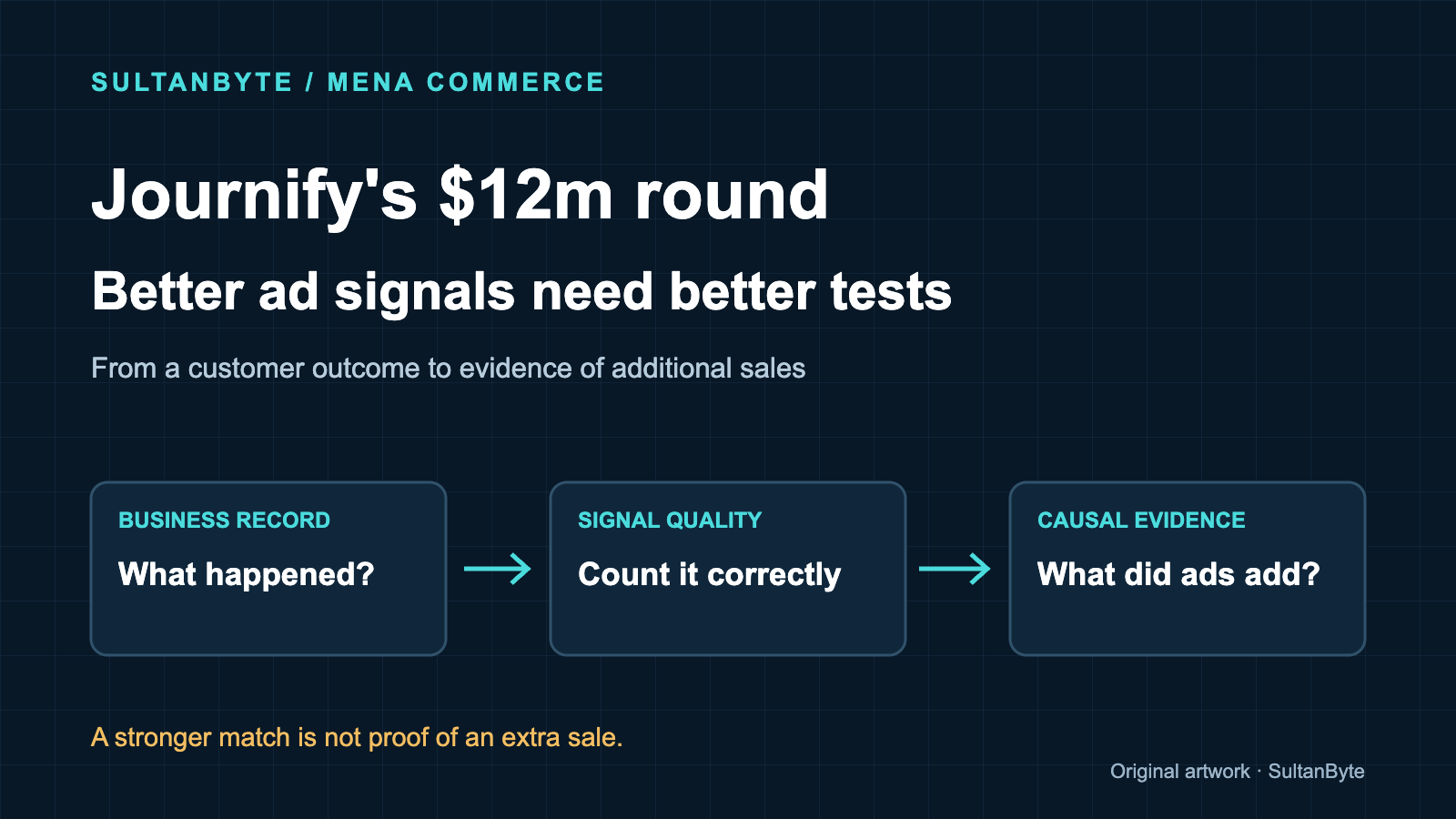
The distinction matters when a purchase can begin on a phone, finish in a shop and later be returned. Connecting those records can improve measurement. It does not, on its own, establish how many extra sales an advertisement caused.
Cover: original SultanByte artwork showing customer outcomes passing through a controlled signal pipeline to advertising measurement.
What the funding announcement establishes
In its 3 November announcement, Journify says Al Mada Ventures led the round, with returning investor Silicon Badia as co-lead. Shorooq and Bunat Ventures increased their investment; Du Ventures and Oraseya Capital joined. The company describes plans to expand its AI capabilities alongside its geographic reach.
Journify is headquartered in San Francisco, with offices in Dubai and Riyadh. It names Saudi retailers Jarir Bookstore and Baytonia among its customers. This is a business with a GCC operating footprint, not a company whose headquarters should be inferred from the location of its customers or investors.
Wamda's 4 November coverage reports the same round and explicitly includes the press release. That corroborates the public announcement, but it is not an independent audit of customer performance. The reported valuation increase and revenue growth should remain attributed claims, not evidence that a particular retailer will achieve similar results.
The investment gives prospective buyers a reason to examine the product. It does not remove the need for a pilot with their own order data.
Separate a business outcome from its advertising signal
A conversion pipeline starts with a definition. Does "purchase" mean an order was submitted, a payment succeeded, goods were delivered or revenue was retained after returns? Those definitions can produce different counts without any software being broken.
TikTok's standard-event documentation defines predefined events for reporting, optimisation and audiences. Its Purchase guidance recommends that event when placing an order and making a purchase are the same. For a proposed retail integration, that wording is a reason to examine the order lifecycle before mapping every checkout submission to Purchase.
Use the commerce system as the authority for business status. Keep an internal record linking the business transaction to the permitted advertising event, its version and its destination. Decide how cancellations, partial returns and late store uploads affect measurement. Do not silently redefine the event midway through a campaign comparison.
For example, a proposed Saudi deployment with delivery-confirmed orders and a UAE deployment with immediate paid collection may need different source mappings. These are illustrative business models, not claims about national shopping behaviour. Country labels cannot substitute for the merchant's actual fulfilment process.
A second delivery path must not become a second sale
TikTok describes Events API as a connection for marketing data across web, app and offline channels, including stores and CRM systems. It recommends combining the API with Pixel for website connections. Those are platform capabilities and recommendations, not a guarantee of better results for every advertiser.
When the browser and server both report one purchase, counting both would create a measurement defect. TikTok's deduplication documentation requires an event ID through both Pixel and Events API for overlapping events and describes matching event and event_id parameters.
For a buyer's pilot, require the same logical purchase to retain its identifier across the two paths. Then retry a server delivery and refresh the confirmation page. Inspect what the destination accepted and counted. Test delayed arrivals against that platform's documented rules rather than assuming indefinite deduplication.
Keep this separate from customer matching. Identifying which person converted and identifying whether two messages describe the same conversion answer different questions. A high customer-match score does not prove that duplicate purchases were removed.
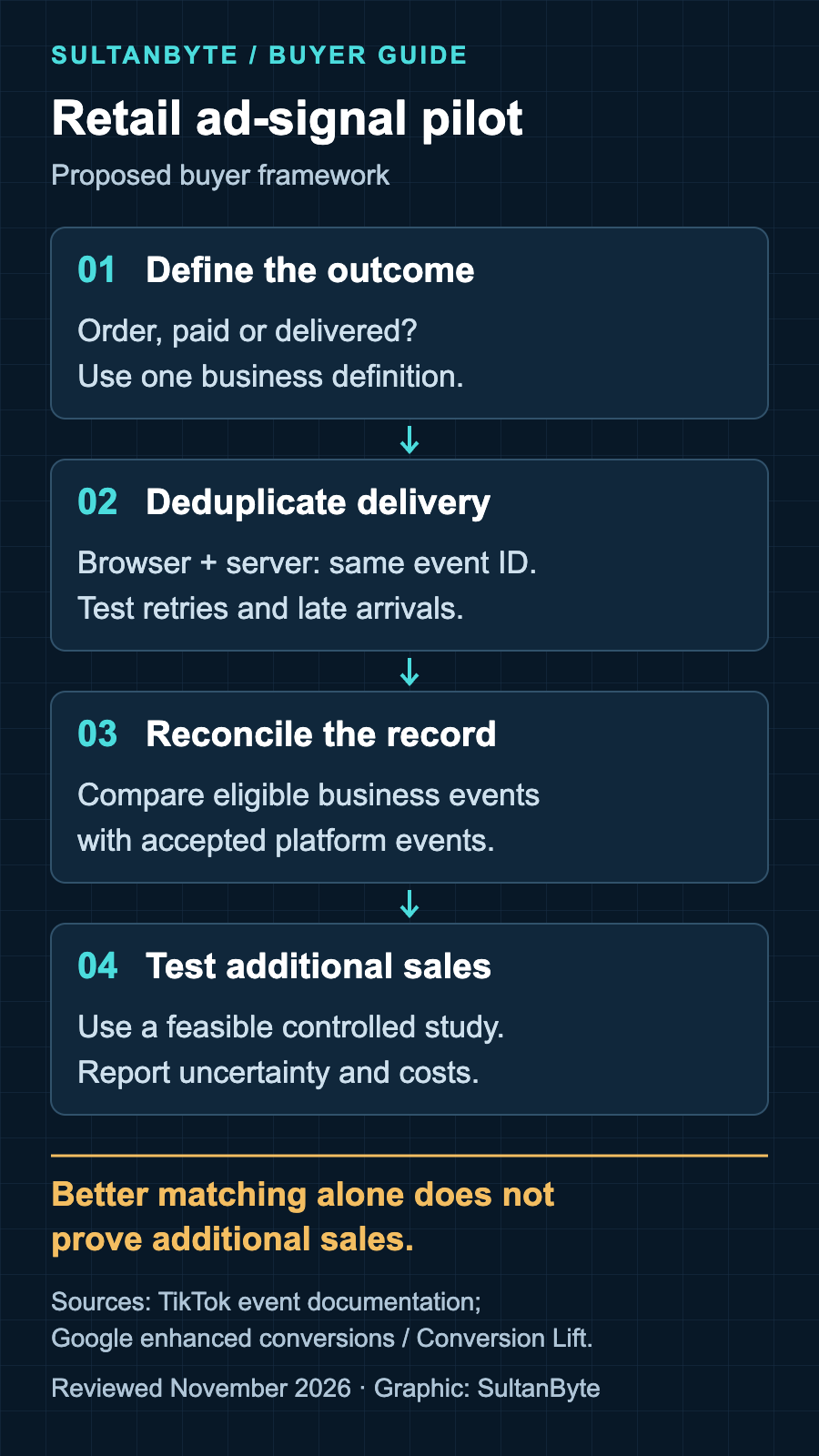
Original infographic: SultanByte. Proposed buyer framework informed by TikTok event documentation and Google enhanced-conversion and Conversion Lift documentation, reviewed November 2026. The steps are recommendations, not measured Journify results.
Better matching can change the reported return
Google's enhanced-conversion documentation explains how first-party customer information can supplement conversion measurement. For web conversions, Google describes matching customer data to signed-in Google accounts that engaged with ads. Its lead workflow connects imported offline outcomes to earlier leads.
The analytical implication is important: recovering a previously unrecognised conversion can change attributed results even when the underlying number of sales has not changed. That is useful measurement repair, but it is not automatically sales growth.
Ask a vendor to separate delivery completeness, matching, attributed revenue and incremental revenue. Do not add platform-attributed sales across several advertising networks and assume the total represents unique business revenue. Reconcile against the merchant's own records and document the attribution rules used in each report.
For a multi-country rollout, keep currencies explicit and compare consistent reporting periods. Show Saudi and UAE results separately before producing any combined view. Agree how exchange rates, tax, returns and cancelled orders enter the commercial calculation; otherwise a better-looking return can come from a changed denominator or revenue definition.
Test causality separately from integration quality
Google's Conversion Lift documentation describes controlled experiments comparing treatment and control groups to estimate conversions caused by advertising. It distinguishes that incremental result from ordinary conversion reporting. Google also says the feature is not available to every account and directs advertisers to their account representative.
That provides a useful distinction for procurement, not a promise that every buyer can immediately run the same Google study. Ask the measurement team which experimental design is feasible for the campaign, audience and available volume. Record uncertainty and avoid declaring success from a small or interrupted test.
Run integration acceptance first: trace known test orders, check duplicate handling and reconcile eligible outcomes. Then evaluate commercial impact under a pre-agreed design. A change to tracking, creative, bidding and promotions at the same time makes a simple before-and-after comparison hard to interpret.
Privacy review belongs before either stage. Obtain the actual destination map, permitted fields, access arrangements and retention terms for each deployment. Server-side collection describes a technical path, not permission to send every customer record. SultanByte's Saudi/UAE product-analytics guide covers the separate purpose and processor controls; those should not be replaced by a vendor's "privacy-first" label.
Buy against a reconciliation test
For a CTO, the first deliverable should be a traceable connection between the commerce record and each permitted outbound event. For a marketing leader, it should be an agreed explanation of which result changed: recorded conversions, attributed return or experimentally estimated additional sales.
Request a pilot report that preserves those distinctions, includes failed and delayed events, and states the full operating cost. Keep an exportable record of mappings and outcomes so the team can investigate discrepancies or change providers later.
Journify's new funding may support a broader product and more markets. The purchase decision should still turn on a narrower demonstration: one real order, correctly represented once at each intended destination, followed by a credible test of whether advertising produced additional business.
About the author
- I have lead the Engineering for multiple startups in UAE. I also have my own agency qualascend.com.
Comments
Join the discussionNo comments yet. Be the first to comment.