Jordan’s BareedPay card: what the new programme adds
Separate Jordan’s new card programme from its earlier wallet launch, then test fees, service coverage and payment recovery.
Jordan's BareedPay announcement adds a card programme to a postal-wallet project that was already under way. For technology buyers, the useful question is what that extra payment channel changes for customers, merchants and the teams responsible for support.
On 3 November, Mastercard, uwallet and Jordan Post announced the co-branded programme. The combination is worth watching: a postal distribution network, a wallet operator and an international card network are bringing different parts of the customer journey together. The announcement does not yet establish how often customers use the service or how reliably a difficult transaction gets resolved.
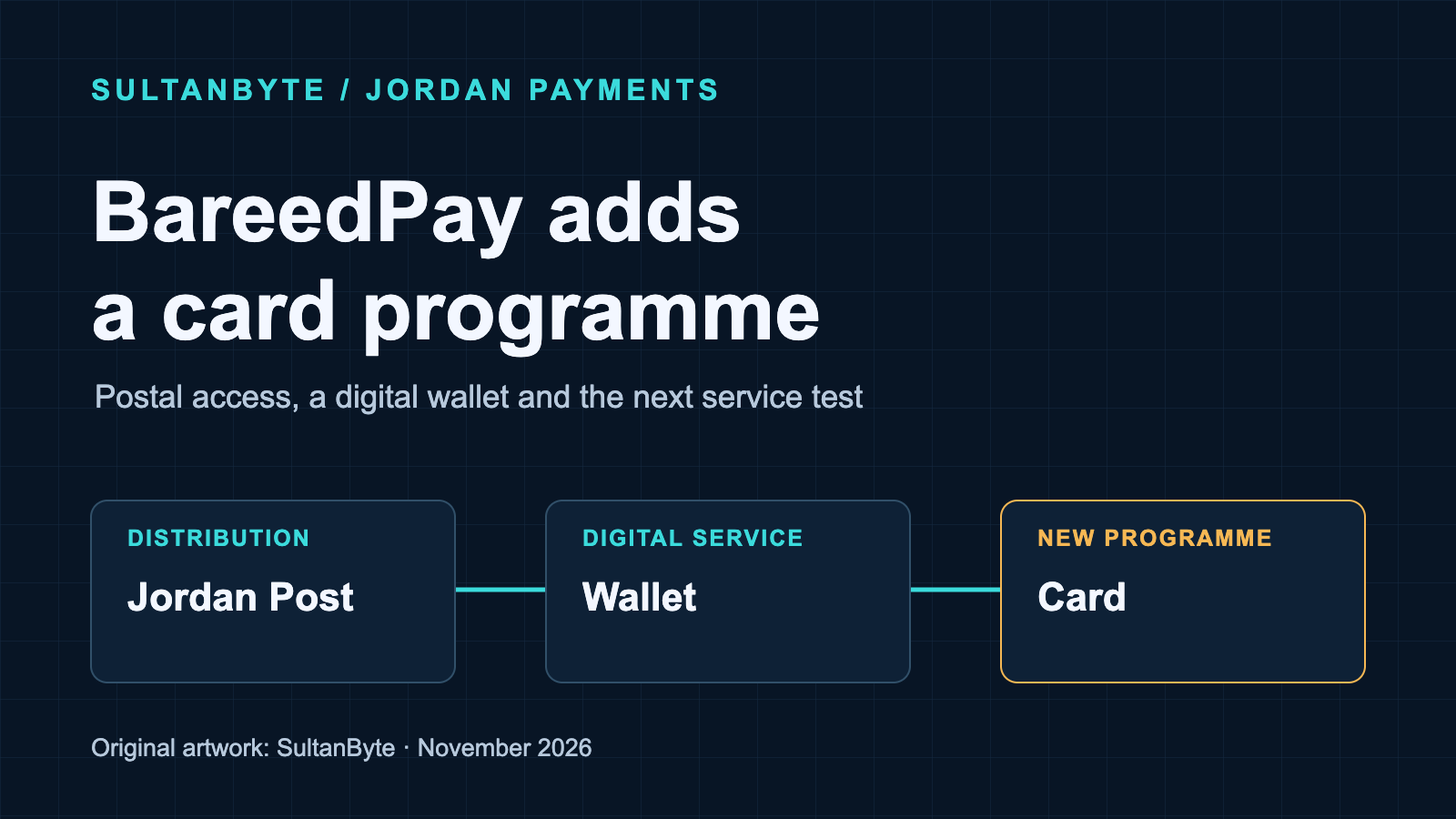
Cover: original SultanByte artwork showing the relationship between postal access, a digital wallet and the new card programme.
A card announcement, not the first wallet launch
The history matters. In its 19 April partnership announcement, uwallet described an agreement to provide the technical platform for Jordan Post's Bareed Pay digital wallet. The postal company would contribute its geographic reach and public familiarity.
uwallet's 8 July announcement then reported the wallet's official launch. It listed instant transfers, bill payments through eFAWATEERcom, electronic vouchers, cash deposits and withdrawals. Those are the operator's descriptions of the wallet offering, not independently measured service results.
The 3 November Mastercard release concerns the co-branded card programme. It names uwallet as the issuing partner and describes online shopping, government dues and bill payments. It also says the programme will support merchants and SMEs, prepaid and multi-currency products, and peer-to-peer and cross-border transfers.
That wording should not be turned into a claim that every advertised capability is available to every applicant today. A launch release is not a customer eligibility guide, fee schedule or supported-corridor list. Buyers should obtain those documents before designing a service around a particular feature.
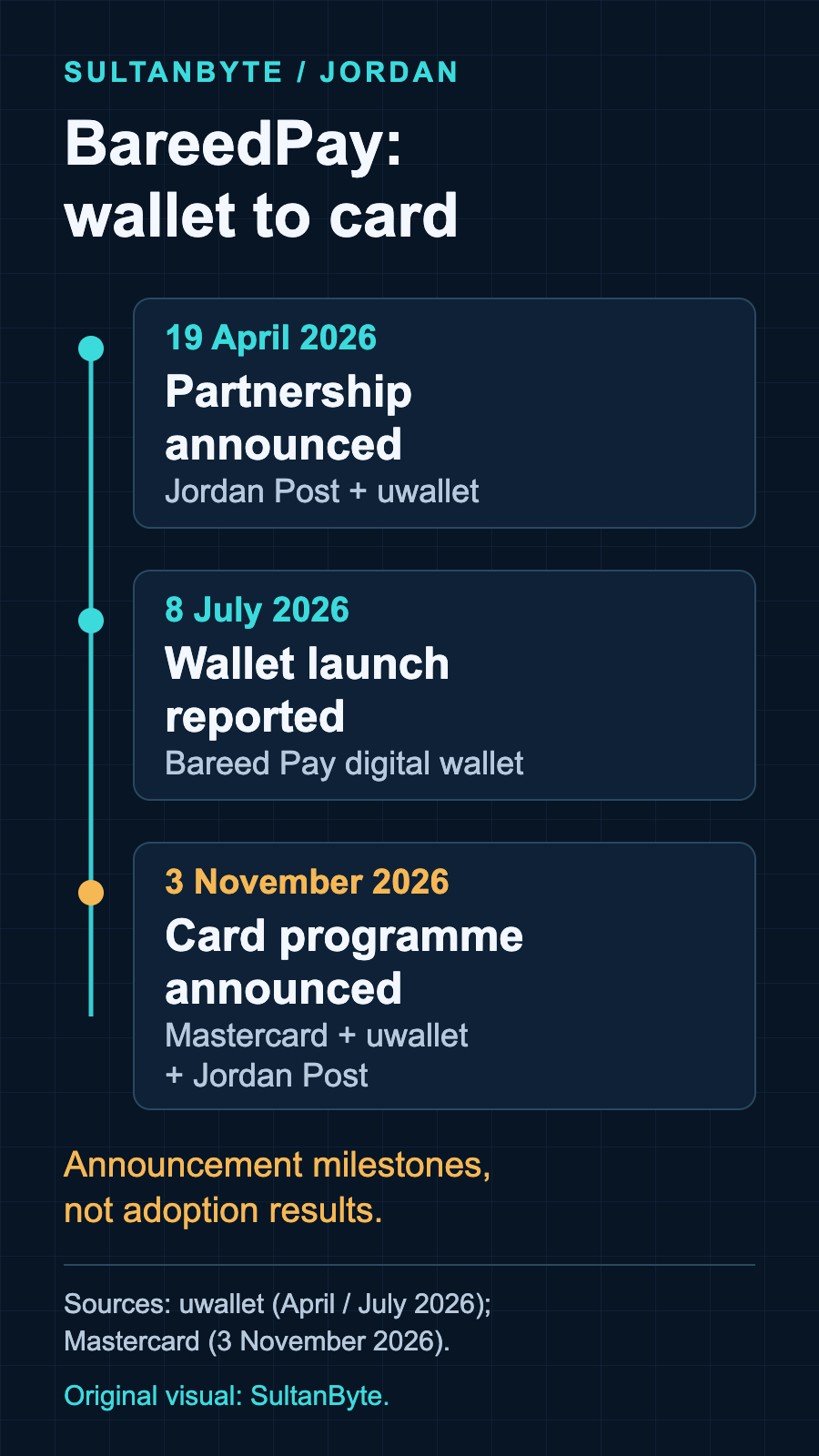
Original infographic: SultanByte. Sources: uwallet's April and July 2026 announcements and Mastercard's 3 November 2026 release. Dates identify published announcements, not independently verified adoption milestones.
Postal reach is useful, but it needs an operating model
Mastercard says Jordan Post has more than 400 branches. Ammon's local coverage repeats that network figure and the partners' description of the programme. It provides a local record of the announcement, but not an independent audit of branch readiness or customer outcomes.
A branch count is not a count of active card-issuing or cash-service locations. The practical advantage would come from making a customer's next step easier: opening the right account, obtaining help, funding a wallet or resolving a problem without a long journey. Each of those services needs its own location and availability information.
For a prospective distribution partner, request a service map rather than a national coverage claim. Which branches handle registration? Which can answer card questions? Where can a customer deposit or withdraw cash, during what hours, and under which limits? A location that can explain the product may still be unable to complete the required transaction.
Product teams should also decide who owns the case when it crosses organisations. A customer should not have to determine whether a failure belongs to the post office, wallet operator, card service or biller before asking for help. Agree an escalation route and a reference that survives the handoff.
Jordan already has payment infrastructure underneath
The new branding should not obscure the existing domestic systems. JoPACC's mobile-wallet overview explains that JoMoPay enables instant payments between wallets and transfers to and from bank accounts. It also describes recipient-name confirmation and transfer-receipt information among wallet capabilities.
That establishes the role of the national infrastructure. It does not prove that every function is exposed in the same way in BareedPay, or that a card transaction follows the same processing path as a wallet transfer. An integration review should ask which system handles each journey rather than use "digital payment" as one undifferentiated category.
Bill payment is another distinct service. JoPACC's eFAWATEERcom overview lists mobile wallets and Jordan Post offices among its payment channels. It identifies JoPACC as the owner and MadfoatCom as the operator. Its fee explanation also distinguishes most online government-service payments from other services whose commissions can vary by biller and service type.
The Central Bank of Jordan's system description dates eFAWATEERcom's launch to 29 June 2014 and includes post offices among the channels. Postal access to electronic bill payment therefore predates this card announcement. The new programme should be assessed for what it adds, not credited with creating an entirely new national payment capability.
For teams elsewhere in MENA, this is a Jordan-specific combination of institutions and payment systems. Do not assume that a similar postal partnership in Saudi Arabia, the UAE or Egypt would inherit the same interoperability, operating arrangements or customer terms.
Test a complete customer journey
A useful pilot would follow one permitted customer journey from registration to a confirmed outcome, then deliberately interrupt it. These are proposed acceptance tests for a buyer, not claims that the launch partners have failed them.
Start with onboarding. Check the actual eligibility rules, identity documents and account limits. Test whether Arabic instructions distinguish the wallet from the card and explain any separate activation step. If a customer cannot finish registration, the support team needs to explain the unresolved requirement without asking them to repeat the entire process.
For bill payment, disconnect the client after submission. The application should recover an authoritative status and a usable reference rather than invite an immediate second payment. Ask the provider to explain how a pending result, rejection, reversal and completed payment appear to both the customer and support staff.
For card use, examine the route from authorisation through settlement, reversal and dispute handling. A merchant's checkout success screen and the customer's final account record are different pieces of evidence. Require a reconciliation demonstration using the records the business will actually receive.
For any cross-border use, obtain the currently supported destinations, currencies, charges and delivery conditions in writing. The broad programme description is insufficient for promising a particular remittance journey to a customer. Keep that review separate from domestic wallet-transfer testing.
Measure repeat use, not just distribution
For an investor or programme owner, the next useful evidence is a defined set of operating measures: successful onboarding, repeat usage over a stated period, completion by transaction type and resolution of failed payments. Keep registered accounts separate from active customers, and separate branch coverage from branches demonstrably delivering each service.
Any cost comparison should include the whole journey, including funding, withdrawal and support where relevant. A free step does not establish a free end-to-end service. Nor does adding a card prove that a customer who previously relied on cash can now complete the transactions they need.
BareedPay's new card programme gives Jordan Post and uwallet another way to serve customers. The immediate buyer decision is narrower than the financial-inclusion ambition: verify one eligible journey, its total charges and its recovery path. Expand only when the service records show that customers can complete it and get help when they cannot.
About the author
- I have lead the Engineering for multiple startups in UAE. I also have my own agency qualascend.com.
Comments
Join the discussionNo comments yet. Be the first to comment.