Dubai RTA's AI strategy: launches, targets and buyer tests
Separate reported launches from promised congestion and service improvements before using the programme as a procurement benchmark.
Dubai's Roads and Transport Authority has put numbers around its next phase of AI adoption. Its updated strategy, announced on 1 November, combines products it says are already launched with targets for congestion, transaction speed and economic value. Those categories need to stay separate.
Technology buyers need to connect this portfolio of AI projects to evidence that a transport service works better. Counting products is a start. It does not establish how much time passengers save or whether an automated transaction finishes correctly.
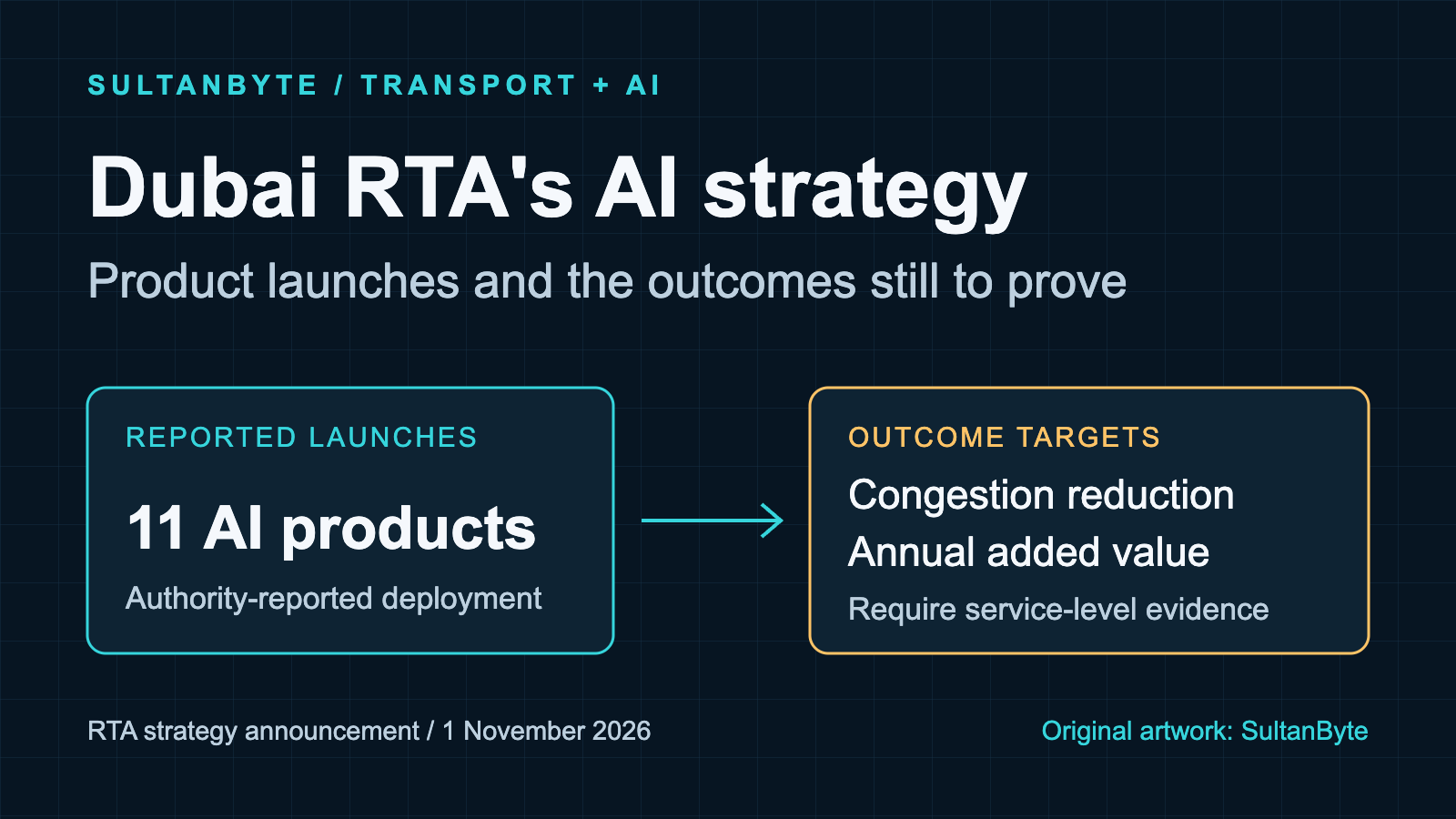
Cover: original SultanByte artwork contrasting reported AI product launches with future transport and service outcomes.
What RTA has announced
RTA's 1 November announcement describes a strategy covering 41 areas. Its first two waves cover 11 business areas and 40 AI products, with 11 products already launched. The authority places the implementation period at two and a half years.
The same announcement sets targets of more than AED 300 million in annual added value and a transition of 50% of operations and services to an agentic AI ecosystem. These are ambitions, not reported financial results or a statement that half of RTA's work is already autonomous.
Gulf News's coverage reports the transport goals: a 3% to 5% reduction in congestion, up to a 10% improvement in bus on-time performance and a 10% to 20% reduction in accidents involving newly licensed drivers. Its account attributes the programme to RTA; it is not an independent evaluation of those outcomes.
The financial wording matters too. Added value is not the same thing as revenue, cash savings or profit. A buyer assessing a similar proposal should require the calculation behind the headline before using it in an investment case.
Mahboub shows the service boundary
Mahboub, RTA's conversational assistant, is a more concrete example than the portfolio totals. WAM's 23 October report described an enhanced version being prepared for public rollout. It outlined a connected journey, such as paying vehicle fines before renewing registration, with support for Arabic and English.
The later RTA release says the upgraded platform enables five vehicle-licensing services and approximately 100 information services, with UAE PASS and Dubai Pay integration. That is a stronger availability statement than the earlier preparation announcement. It still does not establish that every customer, channel or eligibility case can complete every service without assistance.
An information answer and a completed licensing transaction are different units of work. For a buyer, combining them into one chatbot usage count would hide the distinction that matters most: whether the customer obtained the intended result.
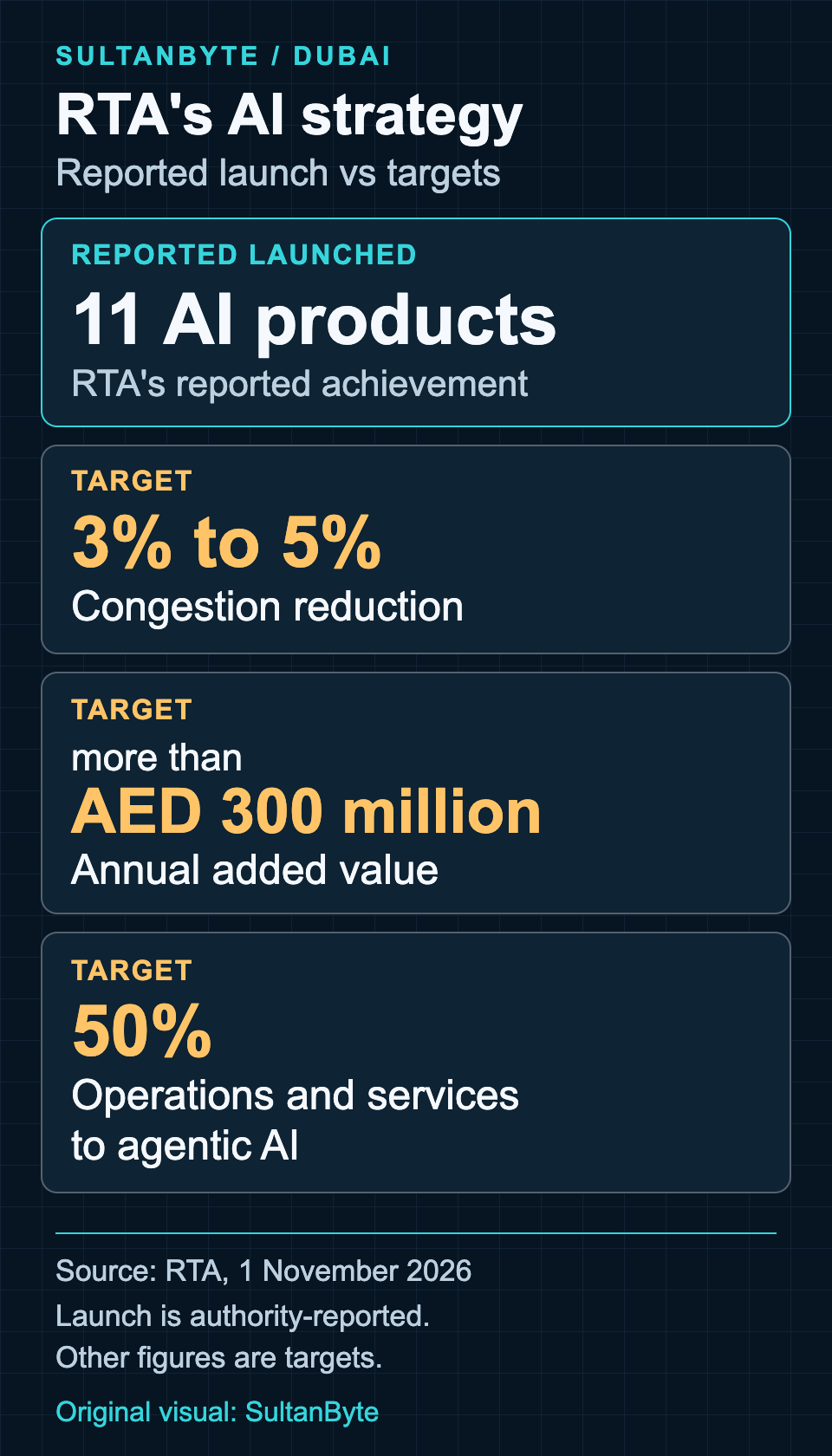
Original infographic: SultanByte. Source: RTA's 1 November 2026 strategy announcement. Launch status is authority-reported; the other figures are programme targets.
Identity and payment remain separate dependencies
The federal identity authority describes UAE PASS as the national digital identity used to access participating services and digitally sign documents. Digital Dubai describes DubaiPay as a shared, government-operated payment gateway supporting multiple channels and payment options. These official descriptions establish the roles of the supporting services, not the performance of Mahboub's integration.
For teams building comparable journeys, the proposed acceptance test should cross those boundaries. A successful identity check should not be counted as a completed renewal. Nor should a successful payment response prove that the licensing system issued the intended result.
Ask the supplier to demonstrate a payment accepted just before a connection fails. The customer needs a recoverable transaction reference and an authoritative status check, rather than a chatbot confidently asking for payment again. Test the same interruption after document submission and after the final service update.
This is a Dubai transport implementation using UAE infrastructure. A team adapting the idea elsewhere in MENA should budget separately for local identity, payment and service-owner integration. The announcement does not establish cross-border availability or transferable approval to operate another country's government services.
Specify outcomes before buying the next product
A useful procurement scorecard would separate deployment evidence from service outcomes. For each proposed product, require a named service owner, a defined eligible population and a baseline period. Then specify the comparison that will determine acceptance.
For congestion, ask which roads, time windows and traffic conditions are included. A network-wide average can conceal deterioration on a particular corridor. Changes in road capacity or demand also need to be recorded before attributing an improvement to AI.
For licensing, measure completion across all eligible attempts, not only successful conversations. Include abandonment, manual handover, repeated submissions and payment reconciliation. Report Arabic and English journeys separately, along with the channels being tested. A fast successful journey is useful evidence, but it says little about customers who never reach the finish.
For bus planning, separate faster analysis from a better passenger service. A planning tool can generate alternatives quickly without improving punctuality after a timetable change. Procurement milestones should distinguish an accepted recommendation, an implemented service change and the subsequent operating result.
These are proposed evaluation requirements, not claims about RTA's unpublished measurement design. NIST's AI RMF Playbook offers voluntary guidance organised around governing, mapping, measuring and managing AI risk. It can inform a buyer's review, but it neither certifies this deployment nor replaces local requirements.
Keep the business case auditable
For a supplier, the practical opportunity is to show evidence at one service boundary before promising organisation-wide transformation. Bring the baseline, the failure cases and the cost of maintaining the integration. Include the human work required when an automated journey stops.
For a technology leader, insist on a reconciliation between claimed benefits and the budget. Staff time released is not automatically a cash saving. Faster processing may create service capacity without reducing expenditure. An increase in collected fees has a different explanation again. Record each benefit once, with its owner and assumptions, rather than adding overlapping estimates across products.
RTA's announcement gives buyers a substantial programme to watch. The next useful evidence will be service-level results against stated baselines, including exceptions and operating costs. Until then, treat launched-product counts as deployment evidence and the outcome figures as targets. Make the next purchasing decision depend on a demonstrated service improvement, not a larger catalogue of AI products.
About the author
- I have lead the Engineering for multiple startups in UAE. I also have my own agency qualascend.com.
Comments
Join the discussionNo comments yet. Be the first to comment.