Aramco closes HUMAIN deal: cash, assets and compute
The 49% stake combines cash and AI assets. Separate the ownership change from live services and future capacity targets.
Aramco has completed its entry into HUMAIN, giving Saudi Arabia's AI company a second major shareholder and a clearer connection to industrial customers. The useful distinction is between what closed on 1 November and what still has to be built or delivered.
The deal combines cash with transferred assets. It also sits alongside separate infrastructure partnerships with different equipment, dates and capacity targets. For technology buyers, those details matter more than adding every announcement into one large number.
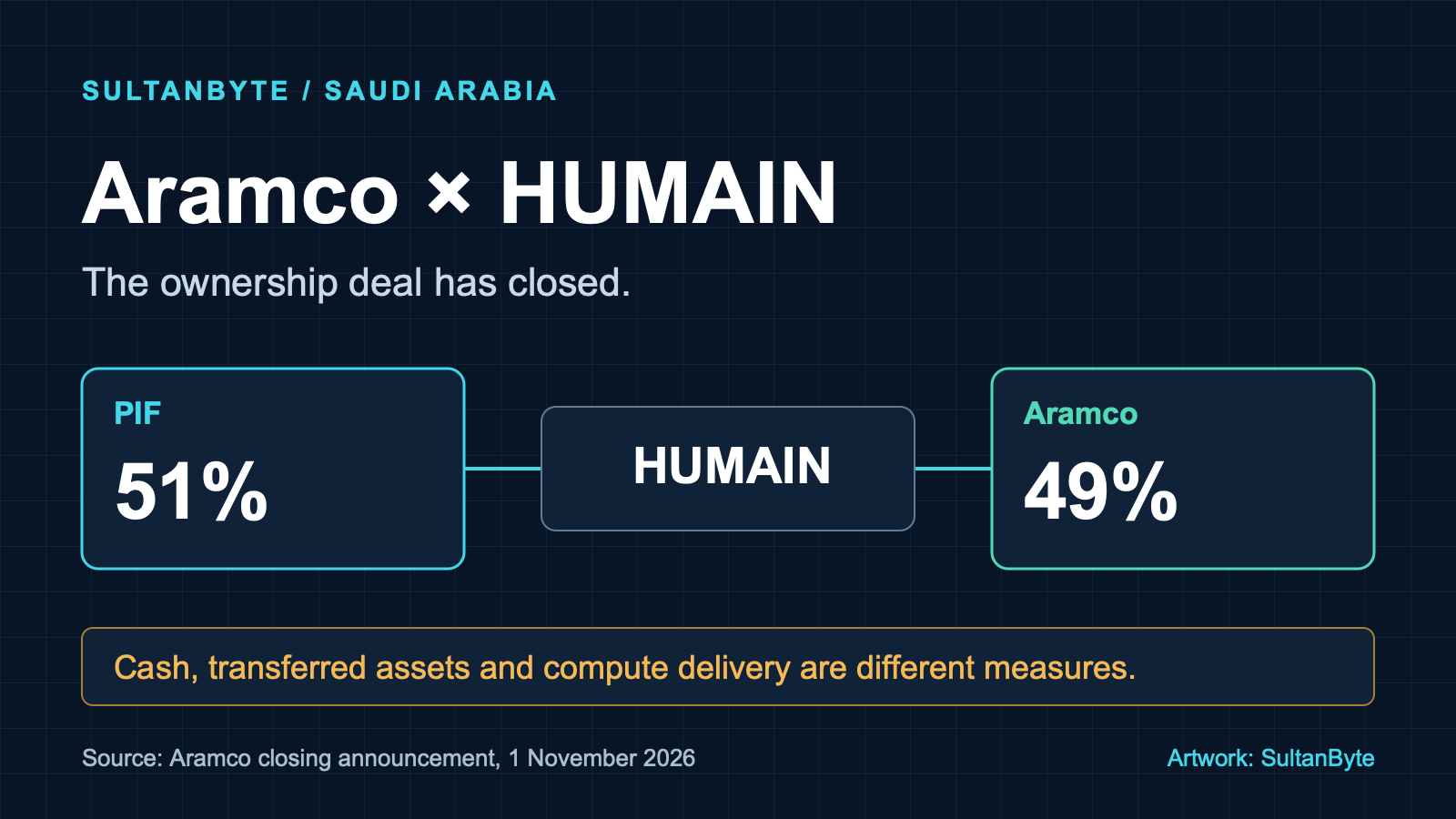
Cover: original SultanByte artwork showing PIF and Aramco's ownership of HUMAIN. The diagram represents shareholding, not compute capacity or customer data flows.
What changed on 1 November
Aramco's closing announcement says PIF retains 51% of HUMAIN and Aramco acquires 49% through a wholly owned subsidiary. It describes approximately SAR 9.9 billion ($2.6 billion) in cash contributions in 2026, alongside AI, compute and digital assets.
This is a completed transaction, rather than a repeat of the non-binding term sheet announced on 28 October 2025. That earlier document left the proposed investment subject to definitive agreements, approvals and other conditions. It did not specify the final 49% stake.
Reuters' 1 November brief reports the same ownership and cash terms, explicitly attributing them to Aramco. It corroborates the reporting of the announcement; it is not an independent valuation of the transferred assets.
Calling this simply a "$2.6 billion acquisition" loses part of the consideration. Nor should readers divide the cash amount by the acquired percentage to infer HUMAIN's total value. The disclosed package includes non-cash assets, and the release does not provide the asset valuations needed for that calculation.
An industrial customer joins the ownership structure
The strategic difference is that Aramco expects to use HUMAIN's infrastructure in its own industrial applications. Enterprise's coverage on 2 November makes the commercial connection explicit: Aramco brings funding and a potential use for the infrastructure. Its account also rests on the companies' announcement, rather than a disclosed customer order book.
Our reading is that industrial demand could give HUMAIN a more concrete development agenda. An application team working with maintenance records or engineering documents has specific requirements for permissions, terminology and integration. Those requirements can guide product development more usefully than a generic promise to serve every sector.
That is an opportunity, not evidence of guaranteed revenue. Share ownership does not reveal minimum purchase commitments, service prices, utilisation or margins. A business case should identify contracted demand separately from expected demand, even when the prospective customer is also a shareholder.
For Saudi suppliers and founders, the useful question is where they can contribute to a defined industrial workflow. A local integration team might compete on document preparation, evaluation or connection to an existing system. None should assume that a large shareholder's requirements describe the needs of a hospital, retailer or smaller manufacturer.
Some compute is live; the expansion figures remain plans
The deal's 3-gigawatt data-centre ambition is a target for 2030. It is not an operating-capacity statement. Equally, it would be wrong to describe HUMAIN's entire infrastructure proposition as still on paper.
In an August 31 announcement, AMD, Cisco and HUMAIN said their MI355X-based infrastructure was live in Saudi Arabia and serving customers. That is a supplier-reported production milestone, not an independently audited capacity inventory.
The same release describes a further phase of up to 250 MW using MI400-series GPUs, with deployment planned to begin in 2027 and capacity expected to start coming online in the second half of that year. It also states a joint-venture target of up to 1 GW by 2030.
Keep those categories separate. A live service, a future phase and a longer-term joint-venture target do not belong in one total unless their boundaries and possible overlap are established. The closing release does not provide a reconciliation that would justify adding all partnership targets to HUMAIN's 3 GW ambition.
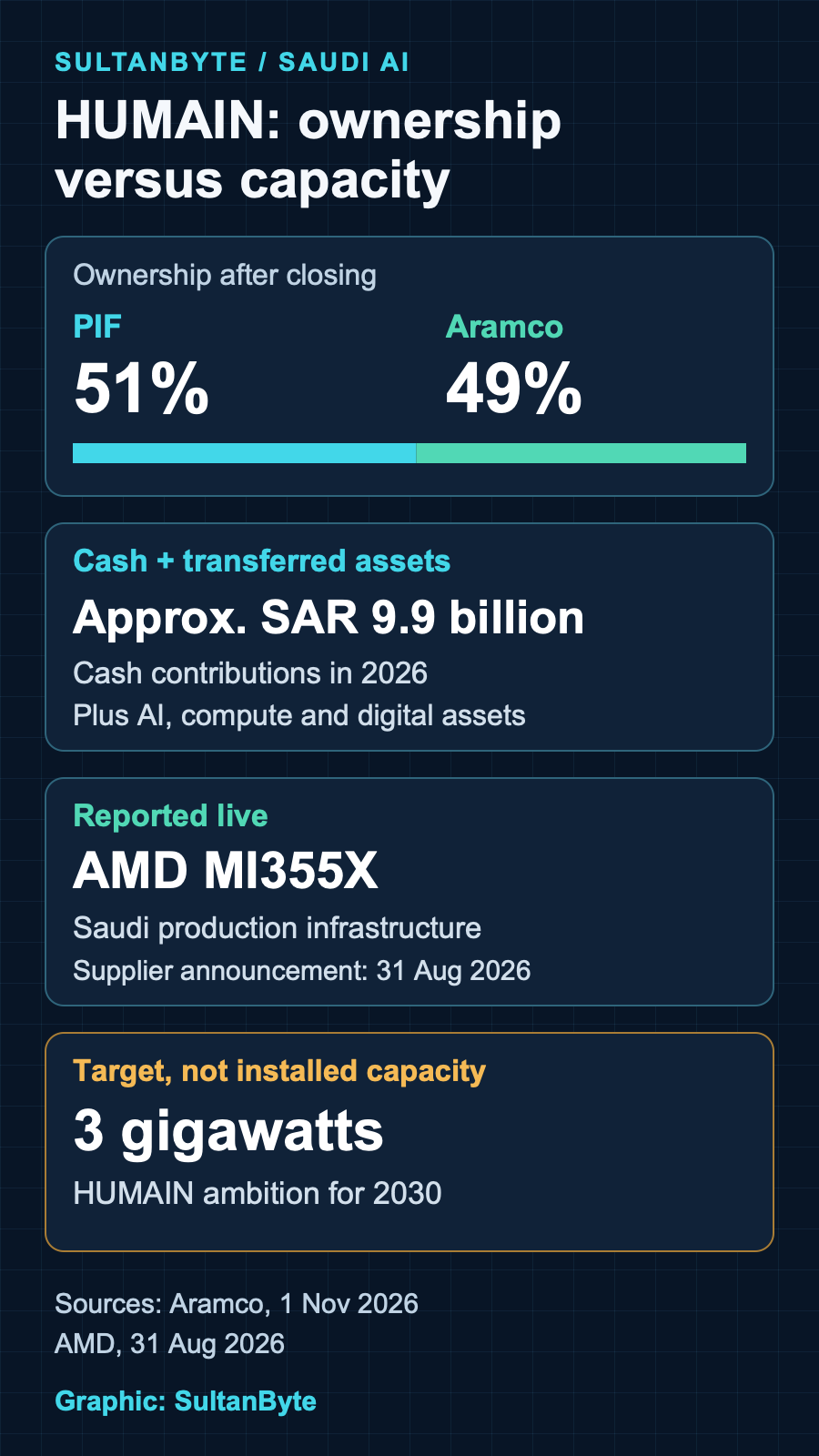
Original infographic: SultanByte. Sources: Aramco's 1 November 2026 closing release and AMD's 31 August 2026 announcement. Live-service status is supplier-reported; the 2030 figure is a target, not installed capacity.
AWS is another delivery path, not interchangeable capacity
AWS's Saudi infrastructure announcement describes up to 50 MW for the HUMAIN AI Zone by 2028, including Trainium chips and NVIDIA infrastructure. That establishes another planned technology path. It does not make an AWS service equivalent to an AMD-based GPU service.
For engineering teams, portability needs to be demonstrated at the workload level. Check the framework, accelerator libraries, supported model formats and operational tooling required by the proposed service. A model that runs successfully in one environment may need additional engineering and evaluation in another.
Do not compare offers using megawatts alone. Ask what capacity the customer can actually reserve, which hardware and software it includes, and when access begins. For an inference workload, compare the cost and quality of completed requests under the same test conditions. For training, document the model, dataset and completion criteria before comparing elapsed time or price.
SultanByte's earlier HUMAIN infrastructure and model-partnership analysis explains the distinction between construction scope, model integration and distribution. The ownership transaction changes the corporate backing; it does not remove those separate delivery obligations.
A Saudi deployment does not answer every regional question
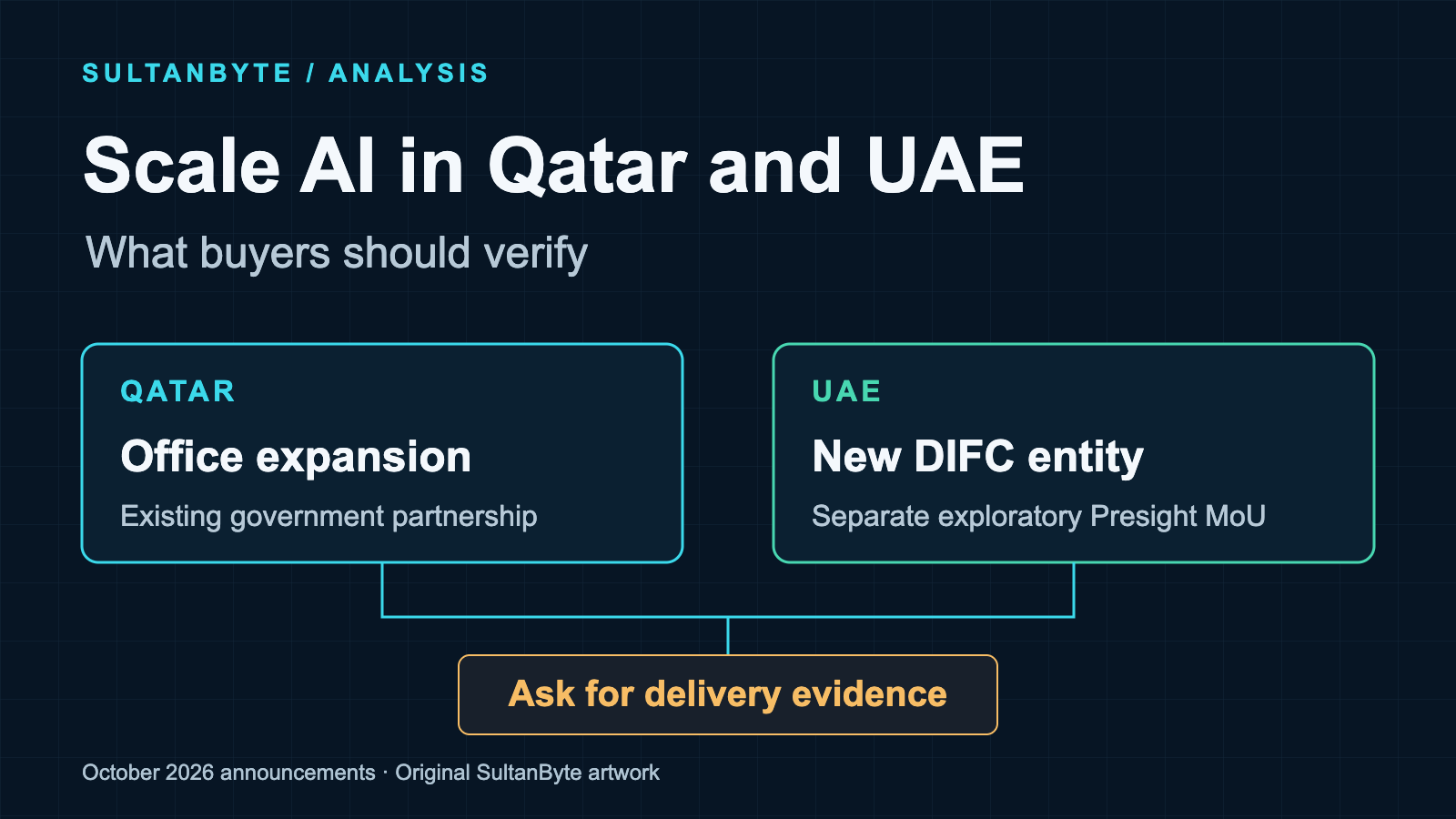
This announcement is about a Saudi company and its shareholders. A UAE or Qatar customer should not infer an in-country deployment from the availability of a regional sales relationship. The relevant evidence is the architecture and contract offered to that customer.
Ask for the actual locations of inference, storage, logs and backups, along with administrative and support access. Have the responsible legal and security teams assess that arrangement for the customer's sector and jurisdiction. A Saudi ownership structure alone neither proves nor disproves suitability elsewhere in MENA.
For Arabic applications, select evaluation material from the intended service population. Industrial vocabulary, document quality and language switching can differ between customers even within one country. Test a useful business result, such as retrieving the correct maintenance procedure with an attributable source, rather than treating fluent Arabic as sufficient acceptance evidence.
Put the delivery commitment in the order
Procurement teams can use the stronger shareholder backing as one input to supplier assessment. The order still needs a named service, a delivery date and a clear allocation of responsibility when something fails. Ask whether capacity is reserved or shared, what support covers, and how data and models can be retrieved at exit.
For an initial industrial deployment, choose a bounded workflow whose output can be checked by an accountable operator. Keep consequential actions outside the model's direct authority until the permissions and recovery paths have been tested. Record the exact service configuration so a later hardware or model change triggers a fresh review where needed.
The closing settles who owns HUMAIN and clarifies part of the capital and asset contribution. The next useful evidence is customer-specific: an available service, a signed delivery commitment and a workload that performs acceptably on the system being purchased.
About the author
- I have lead the Engineering for multiple startups in UAE. I also have my own agency qualascend.com.
Comments
Join the discussionNo comments yet. Be the first to comment.