AIQ’s Genesis partnerships: from simulation to action
What energy buyers should test in AIQ’s tNavigator integration and Siemens Energy collaboration, from reproducible models to authorised action.
AIQ’s latest announcements put two different engineering tasks beside its new Genesis platform: interpreting subsurface models and supporting autonomous operations. For energy buyers, those tasks need separate acceptance tests. A successful reservoir calculation does not establish permission to change a well’s operating conditions.
On November 5, the Abu Dhabi company announced the integration of Rock Flow Dynamics’ tNavigator into Genesis. The same day, it announced a collaboration with Siemens Energy to develop an autonomous-operations offering, with RoboWell among the first applications intended for that proposition.
These announcements give operators a reason to examine how engineering software and operational AI will work together. They do not, by themselves, establish a generally available, fully integrated production system at a particular customer site.
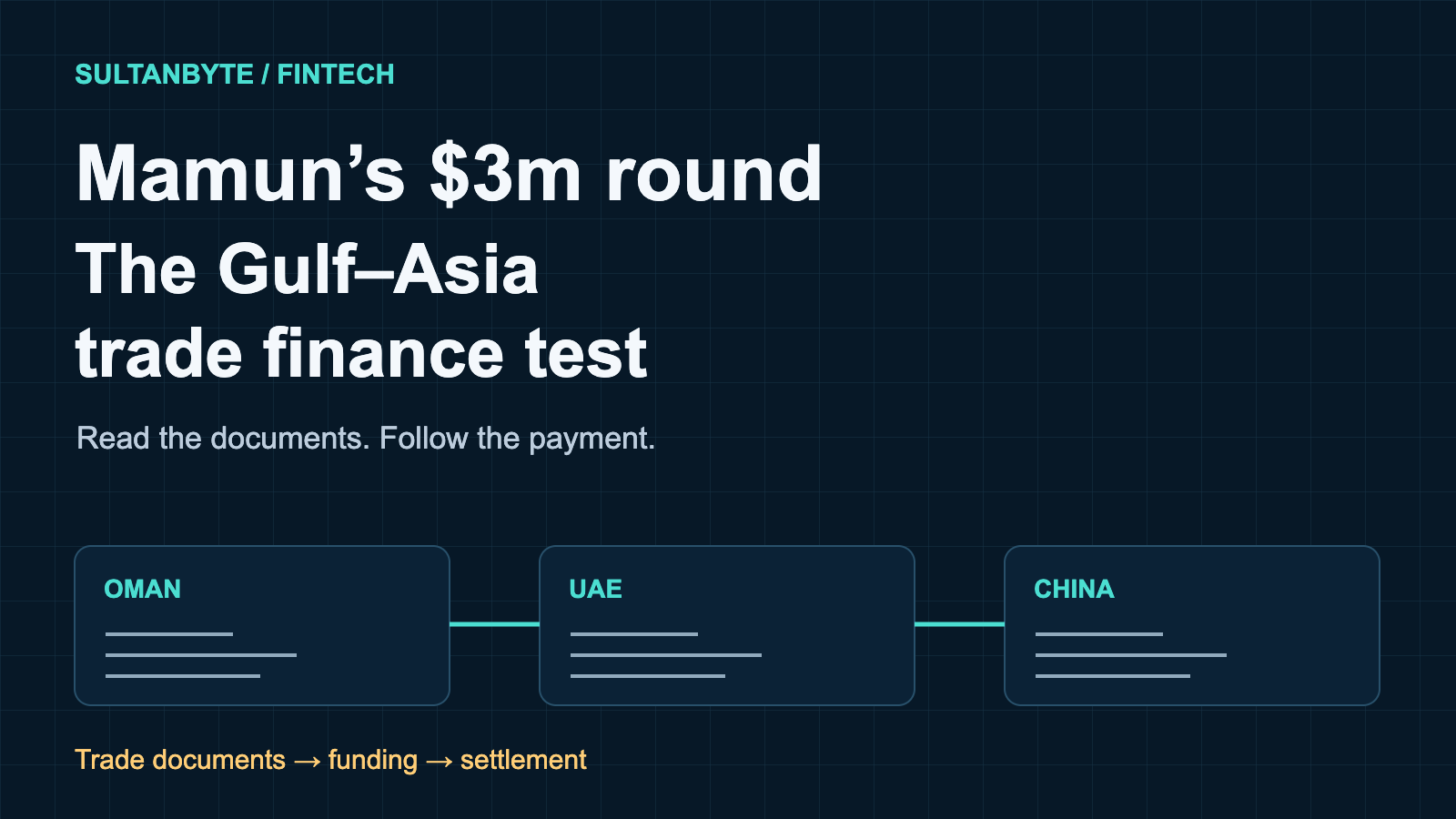
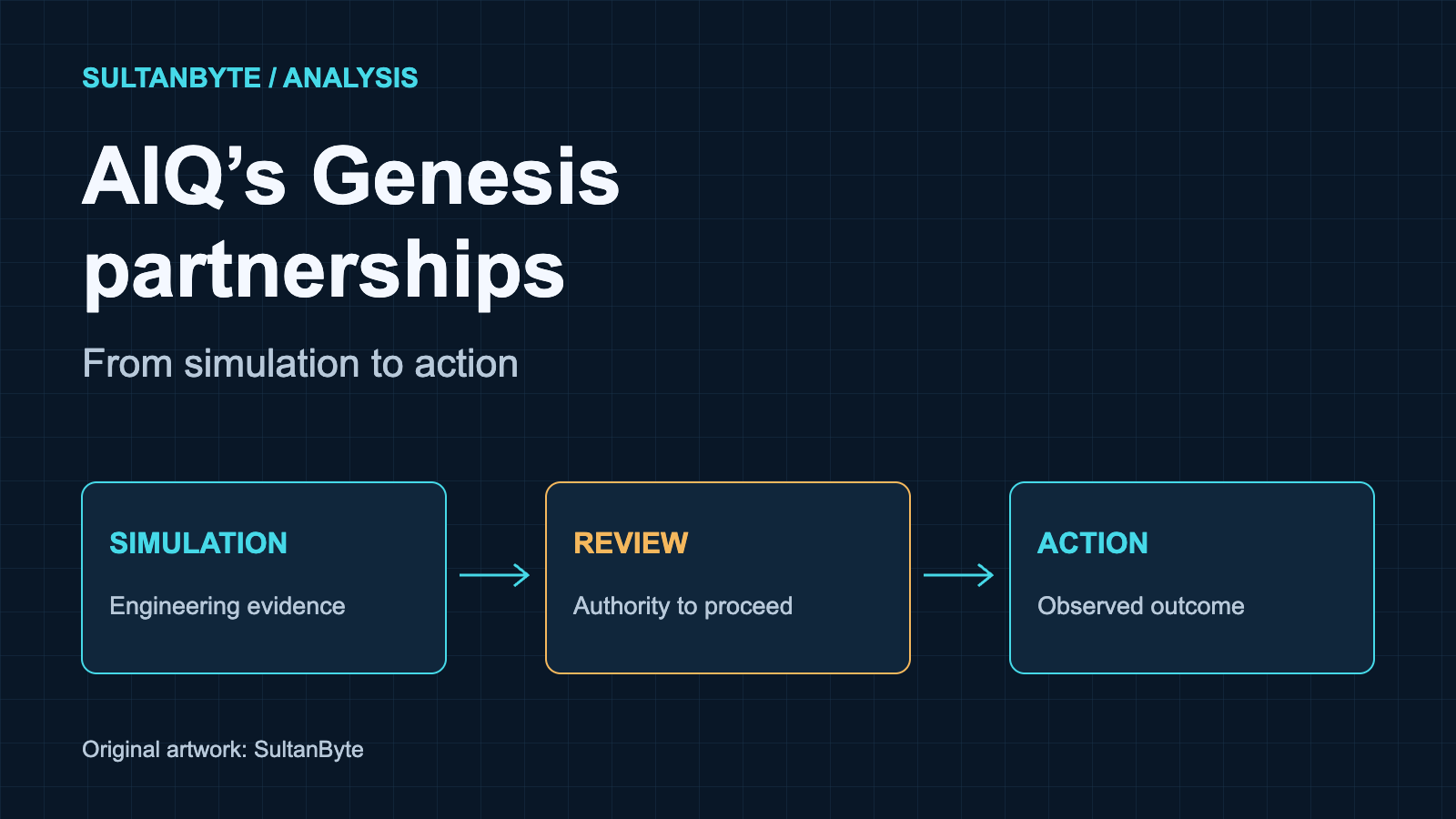
Cover: original SultanByte artwork showing engineering analysis separated from operational action by an approval boundary.
Two announcements, different delivery questions
The tNavigator announcement says the platform will connect subsurface work, from seismic interpretation through surface-network optimisation, to broader Genesis workflows. Its listed applications include AI-assisted modelling, connected simulation and multidisciplinary collaboration. Much of that list is explicitly presented as potential applications.
The Siemens Energy agreement concerns a commercial offering. AIQ says the partners demonstrated how RoboWell could operate within a broader autonomous and remote-operations environment at ADIPEC. A demonstration is useful evidence of the proposed direction; it is not a customer acceptance record or a service commitment.
Ask for separate delivery documents. For tNavigator, establish the supported software versions, interfaces and workflows available to your team. For the Siemens Energy proposition, establish who integrates the system, which assets are in scope and which organisation owns support when something fails. Neither announcement should be used as a substitute for those answers.
An operating layer does not replace the engineering model
AIQ describes Genesis as a layer across existing applications, data and AI rather than a replacement for them. Its product page says supported findings retain links to source information and execution stays within approved identity, infrastructure and access boundaries. Those are vendor descriptions to test in the proposed deployment.
The engineering application already has its own automation. In Rock Flow Dynamics’ October 8 release notes for tNavigator 26.3, the company describes an assistant that can manage projects, import models and run calculations. It also describes connecting to third-party language models from a workstation.
That makes the integration review more specific than “does the chatbot answer correctly?” A buyer should identify which component chooses a tool, which identity runs it and where its inputs go. Adding an orchestration layer must not obscure permissions or model connections already present inside the engineering application.
Start the evaluation with a previously reviewed engineering case. Preserve the input dataset, model version, units, boundary conditions and calculation settings. Ask the proposed workflow to reproduce the case, then explain any difference. A fluent summary of a simulation result is not evidence that the underlying case was configured correctly.
Make the handoff observable
For a proposed pilot, use four distinct records: the engineering case, its calculated result, the reviewed recommendation and any authorised action. This is an editorial evaluation framework, not a description of Genesis’ internal architecture.
The case record should identify the source material and settings. The result should point back to that case and distinguish a completed calculation from a failed or incomplete run. The recommendation should name the reviewer and the evidence they accepted. An action record should identify the permitted target, the authorising party and the observed outcome.
Test the boundaries with ordinary failures. Replace an input file after a recommendation has been prepared. Revoke a user’s access before execution. Interrupt the connection after a command has been submitted. The system should expose the changed state rather than silently treating an earlier approval as permission for a different operation.
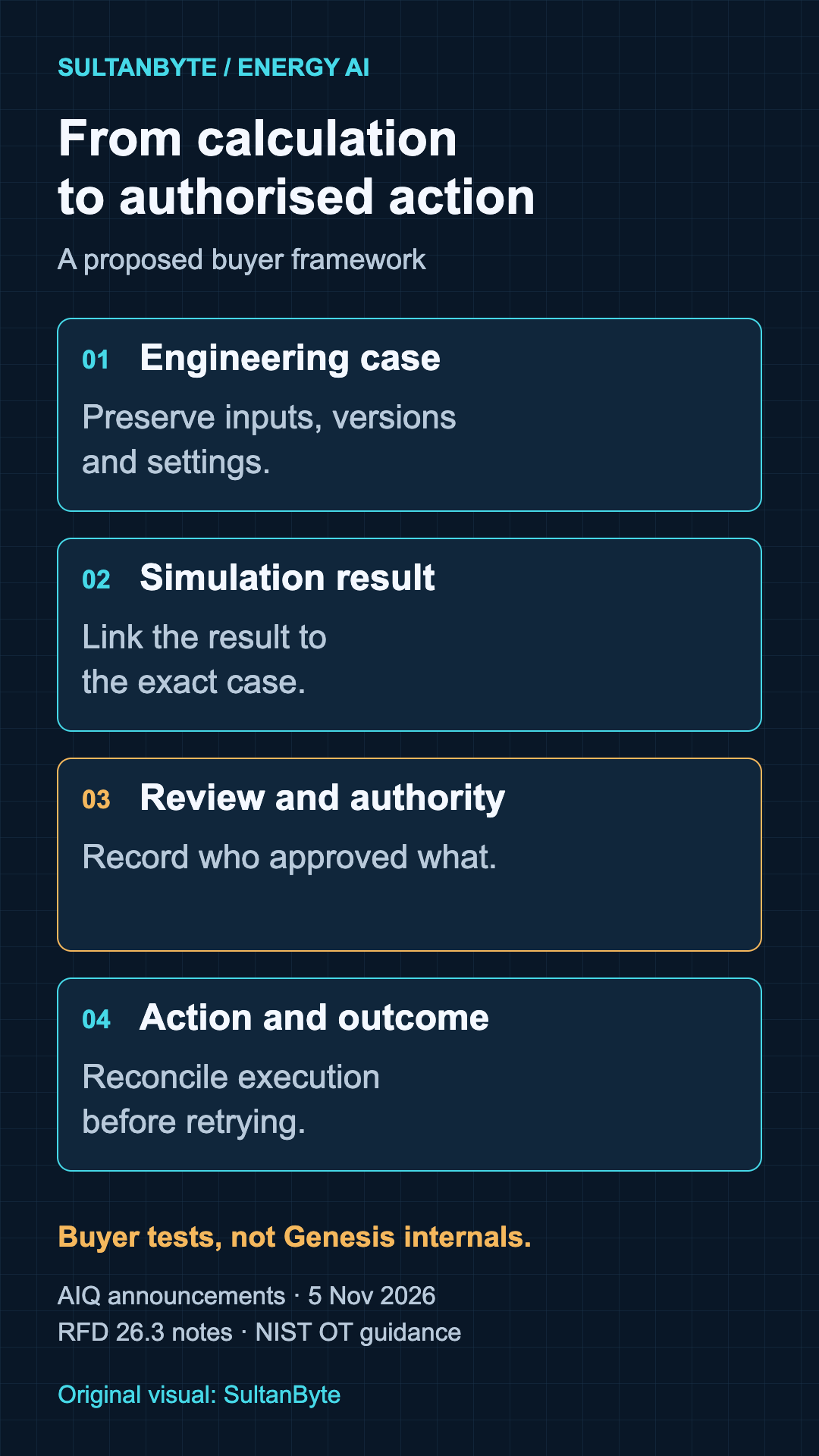
Infographic: SultanByte. Proposed buyer framework informed by AIQ’s November 5, 2026 announcements, RFD’s tNavigator 26.3 notes and NIST OT guidance. It does not certify a product or report measured performance.
Agent identity needs an operational owner
In a November 5 interview with WAM, AIQ CEO Dennis Jol described Genesis as a way to verify AI agents’ identities and activities and govern their operations. The interview provides a direct account of the company’s intent, not an independent security assessment.
Translate that intent into a demonstration the asset owner can inspect. Ask the supplier to show the requesting user, the agent, the tool account and the final system of record for one workflow. Check what each identity may read or change. A shared service account with broad permissions would require a different review from a narrowly authorised operation tied to a named requester.
Operational technology also has constraints that ordinary office automation does not. NIST’s Guide to Operational Technology Security explicitly addresses performance, reliability and safety alongside security. It is useful technical guidance here, not a UAE regulatory approval or a certification of the announced products.
Keep the first evaluation away from live control unless the operator has separately approved that scope. An offline or advisory exercise can test evidence retrieval and engineering reproducibility without making control-system integration an accidental part of the trial. The asset’s existing safety and change-management owners should decide when a later stage is appropriate.
UAE experience is not an Oman deployment record
The regional opportunity extends beyond the UAE, but country-specific delivery evidence still matters. AIQ’s May 21 agreement with Oman’s Ras Al Hamra was a memorandum of understanding. It described local operational support and planned on-premise integration involving JMC Group AMEA.
That earlier agreement supplies context for AIQ’s regional route to market. It does not establish that Genesis, or the newly announced tNavigator integration, is already deployed in Oman. An Omani buyer should request a site-specific scope and local support arrangement rather than inherit assumptions from a UAE reference.
The same discipline applies inside the UAE: evidence from one asset or application does not automatically validate another. Compare the actual workflow and operating environment, not just the customer logo.
Buy a reproducible workflow before expanding authority
The next useful step is a bounded engineering evaluation with an agreed baseline. Measure whether the team can reproduce a reviewed result, inspect its inputs and resolve a failed run. Record the staff time required for review and correction, rather than counting only the time needed to generate an answer.
Procurement should make acceptance depend on that evidence and a clear support boundary. Engineering should retain ownership of the model and its assumptions. Any move towards operational execution needs its own authorisation and failure tests.
AIQ’s partnerships make a more connected engineering workflow plausible. The purchasing decision should turn on a demonstrated handoff from a traceable calculation to an approved, observable action at the buyer’s own site.
About the author
- I have lead the Engineering for multiple startups in UAE. I also have my own agency qualascend.com.
Comments
Join the discussionNo comments yet. Be the first to comment.