NEOPAY–noon payments: what merchants should verify
The proposed 65% stake connects acquiring and online payments. UAE, Saudi and Egyptian merchants still need local service evidence.
NEOPAY's agreement to buy control of noon payments puts a practical question in front of merchants: what will change in the service they actually buy?
On 5 October, NEOPAY announced a definitive agreement to acquire a 65% controlling stake. Completion remains subject to conditions including regulatory and antitrust approvals. The proposed combination brings acquiring and in-store acceptance together with noon payments' online gateway and merchant relationships across the UAE, Saudi Arabia and Egypt.
That could simplify procurement for a business selling through shops and websites. It does not yet establish a common contract, a migration date or better payment performance. Merchants should keep existing arrangements separate from the proposed combined offer until the suppliers document what changes.
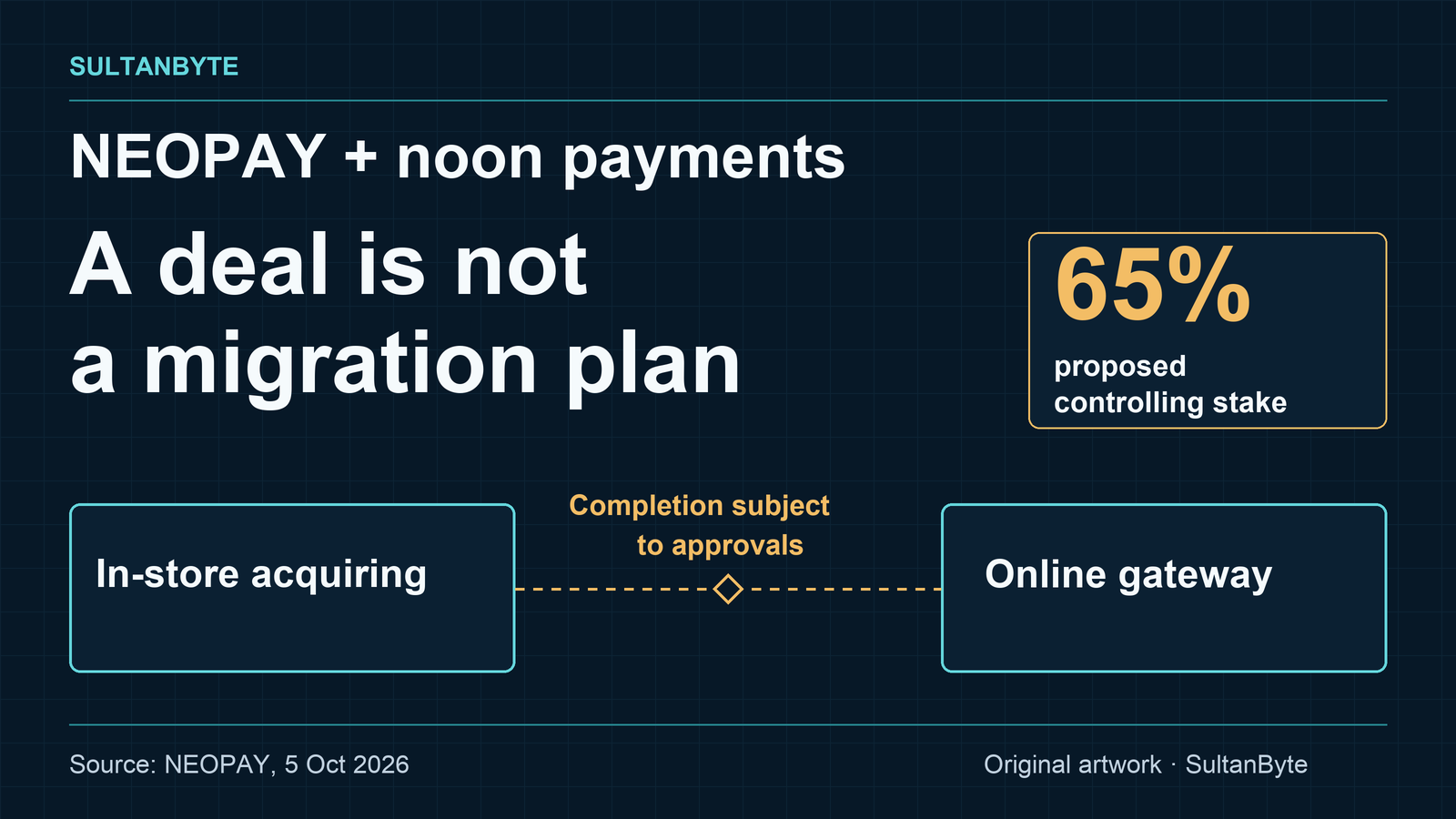
Cover: original SultanByte artwork showing in-store acquiring and an online gateway connected by a pending-approval transaction.
An agreement, not a completed integration
Gulf News' report corroborates the agreement and approval conditions. Its descriptions of future services come from the companies, rather than an evaluation of the combined platform.
NEOPAY's announcement describes plans for faster onboarding and settlement, improved payment performance, fraud capabilities and additional financial services. It does not publish a delivery schedule, merchant pricing or comparative operating results. Those are proposed benefits, not demonstrated outcomes.
FWDstart reports that financial terms have not been disclosed. Do not confuse this transaction with NEOPAY's own ownership change: Mashreq announced the completed sale of a majority stake in NEOPAY to the Arcapita–DgPays consortium in January 2025, while retaining a significant minority holding.
For investors, the acquisition thesis is plausible: combine a merchant-acquiring business with an online payments platform and sell more services across the customer base. Whether that produces attractive economics depends on integration costs, retention and the margin of the payment mix. The announcement does not provide enough information to calculate those outcomes.
For merchants, a narrower question is more useful: which problem will the combined service solve that the current contracts do not?
The UAE relationship predates the deal
The companies already had a product collaboration. On 27 October 2025, noon payments announced an Aani pilot with NEOPAY for UAE merchants. The announcement described payments initiated through a mobile number, email address or QR code, with customers authorising through their banking or Aani app.
That is evidence of an earlier collaboration, not proof that every merchant now has the same production service. A buyer should request current eligibility, supported channels, fees and settlement terms for its own account.
Al Etihad Payments' customer guidance describes Aani transfers as domestic payments between UAE accounts in AED. It also directs customers to their financial institution or payment provider for availability and charges. A regional acquisition does not, by itself, turn that domestic capability into cross-border settlement.
For a UAE retailer, ask the provider to demonstrate the complete journey: customer approval, an unambiguous payment result, the merchant ledger entry and the corresponding bank credit. Include a cancelled request and a refund. A successful checkout screen is only one part of the service being purchased.
Saudi Arabia and Egypt need separate answers
Saudi Arabia is not simply another currency setting. Noon payments said in June 2026 that it had obtained Payment Technical Service Provider certification from SAMA under the e-commerce Merchant Service Provider framework. That is the company's account of its certification; it should not be expanded into a claim that every proposed group service has regulatory approval.
A Saudi merchant should ask which legal entity provides each service, what role its banking partners perform and which payment methods the contract covers. Request evidence for that exact arrangement. An ownership announcement does not answer those questions, and a technical-service description should not substitute for a service-scope review.
In Egypt, noon payments announced a partnership with FABMISR in October 2025 to support digital payments and e-commerce. This gives buyers a named bank relationship to examine. It does not establish that an Egyptian merchant will receive the same settlement schedule, support arrangement or product catalogue as a UAE merchant.
For an Egyptian business, identify who owes the settlement obligation and which account receives the funds. Ask for sample reconciliation files, fee treatment, refund procedures and escalation contacts. Have the local finance and compliance teams review the proposed contract rather than relying on a regional sales presentation.
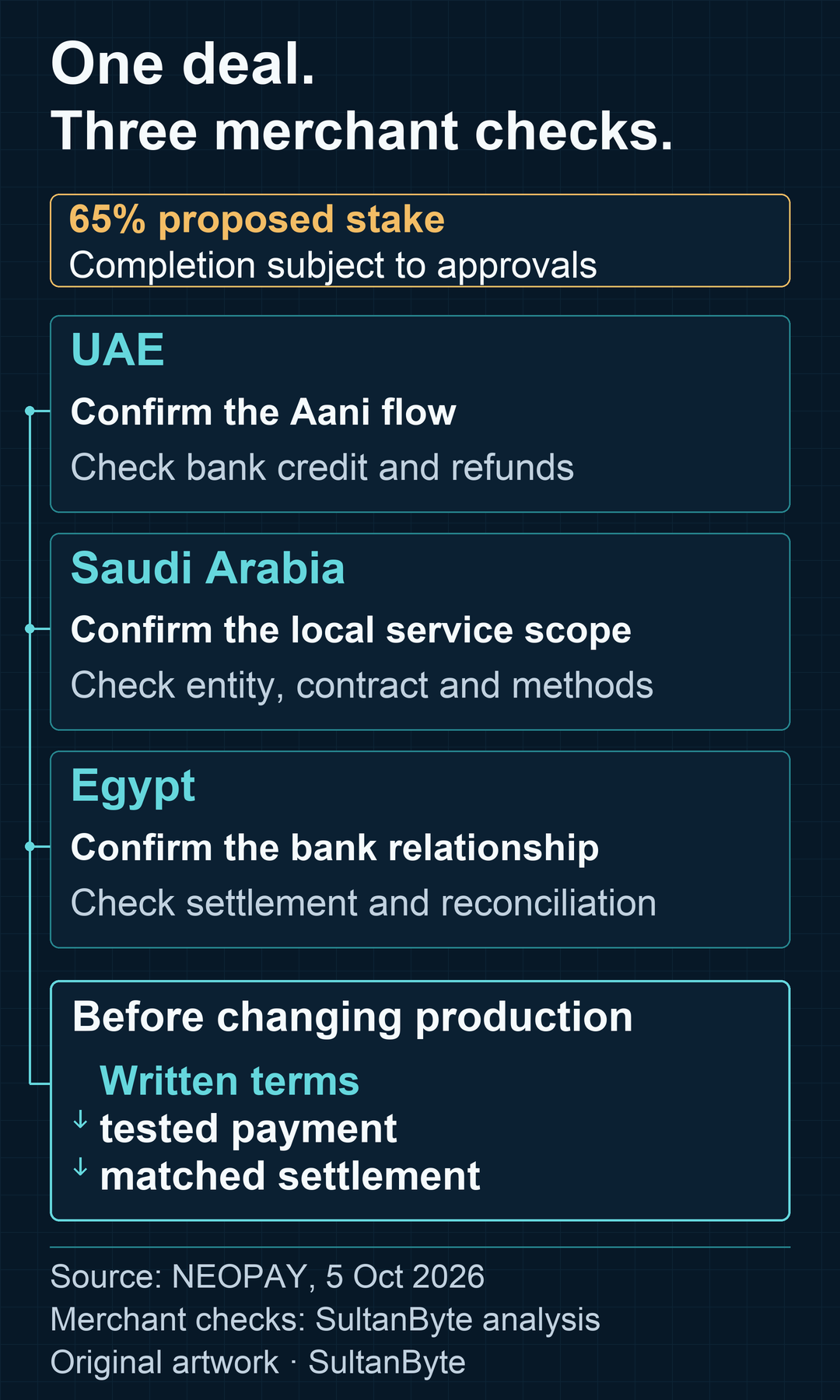
Original infographic: SultanByte. Transaction source: NEOPAY, 5 October 2026. Country checks are SultanByte's proposed buyer framework, informed by the provider and operator sources linked above; they are not measured service results.
Make any migration a separate decision
An acquisition can close without requiring an immediate API change. Conversely, a commercial consolidation can eventually affect contracts, identifiers, reporting or support even when checkout code stays the same. The announcement does not specify which of these changes merchants should expect.
Ask for a written change notice before allocating engineering work. It should say whether existing credentials, merchant IDs, payment tokens, webhooks and settlement reports remain valid, and who supports transactions created before a cutover. Do not assume stored payment credentials can move between services without a documented, approved process.
For any proposed migration, define an acceptance record with the provider:
- A representative set of payment methods and customer journeys for each country.
- Expected treatment of declines, timeouts, duplicate notifications and refunds.
- Matching references across orders, provider records, fees and bank settlement.
- A rollback procedure, including how old transactions remain accessible after the switch.
These are proposed tests, not claims that either company currently has a defect. SultanByte's payment-webhook guide covers the engineering controls behind duplicate delivery and reconciliation; the acquisition review should determine whether those existing controls need to change.
Keep commercial acceptance separate from technical acceptance. A working integration does not establish that reserves, payout timing or dispute charges meet the merchant's cash-flow needs.
Buy the improvement you can measure
A founder evaluating the combined offer should choose a specific outcome before signing: less reconciliation work, a useful additional payment method or a clearer support arrangement. Establish the existing baseline and agree how the supplier will demonstrate improvement. Avoid an undifferentiated promise of a better regional platform.
A CTO should preserve the country and provider boundaries until the replacement contract and implementation justify removing them. Finance should approve the settlement evidence, not just the proposed price sheet.
The next meaningful evidence will be completion of the transaction, followed by concrete service terms and a delivery plan. Until then, merchants can use the agreement to start a procurement review without treating it as an instruction to migrate. Ask for the local contract, test the promised service and match the money before changing production.